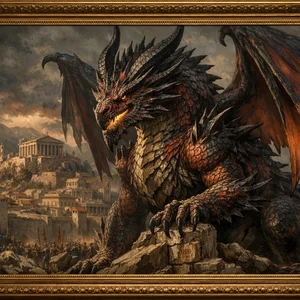

A monstrous creature sacred to Ares in Greek mythology, it guarded the divine spring near Thebes. Slain by the Phoenician hero Cadmus, its teeth were sown into the earth and gave rise to the Spartoi, the ancestral warriors of Thebes.
Dragon of Thebes
Dragon of Thebes
9 min read
Frequently asked questions
Key Facts
- Son or servant of Ares, it guarded the sacred spring essential to the founding of Thebes
- Slain by Cadmus, a Phoenician prince who came to Boeotia on the orders of Apollo
- Its teeth sown into the earth caused the Spartoi to spring up, armed warriors born from the ground
- The Spartoi slaughtered one another until only five remained, who became the ancestors of Thebes' great noble families
- The myth is recounted notably by Ovid in the Metamorphoses (III, 1–130) and by Apollodorus in the Library
Works & Achievements
The dragon's most extraordinary legacy was an involuntary one: the teeth sown in the earth gave rise to the five warrior ancestors of Thebes. These Spartoi founded the great noble lineages of the city and embodied a uniquely chthonic origin within the entire Greek world.
His role as guardian of the divine spring gave him a cosmological function: he maintained the boundary between the wild world belonging to the gods and the human world still taking shape. Without him, the spring would have held no sacred value.
Ovid devotes about a hundred lines to describing the dragon and its battle with Cadmus, providing the most detailed and most influential narrative version of the myth. This text was central to the transmission of the myth to medieval and modern Europe.
By bringing back the teeth of the Theban dragon in the story of Jason's journey to Colchis, Apollonius wove an intertextual network between two major heroic cycles, showing that the dragon's power extended far beyond the founding myth of Thebes alone.
In its prologue, Euripides' play recalls Cadmus's slaying of the dragon and the birth of the Spartoi, grounding the conflict of the Seven Against Thebes in an ultra-violent mythic origin. The dragon is presented as the ground zero of the entire Theban tragedy.
Anecdotes
The Dragon of Thebes was a colossal serpent, son or servant of Ares, god of war. It had guarded the sacred spring near the future city of Thebes since time immemorial. When Cadmus and his companions approached to draw water from it, the creature sprang forth and devoured nearly all of them, proving that its role as guardian was no mere legend.
Cadmus, after killing the dragon with a thrust of his spear or sword, heeded the advice of Athena: he pulled out the teeth of the dead monster and sowed them in the earth as one would sow grain. From the soil burst forth armed warriors, the Spartoi (Spartoi, “the sown men”), who immediately fought one another with such ferocity that only five survived. These five ancestors — Echion, Udaeus, Chthonios, Hyperenor, and Pelorus — became the noble founders of Thebes's great families.
The dragon's teeth held such extraordinary magical power that they were used more than once. The goddess Athena kept some of the teeth and gave them much later to King Aeëtes of Colchis. And so it was that Jason, during his quest for the Golden Fleece, in turn had to sow those very same teeth and face the warriors who rose from the earth, repeating Cadmus's founding act centuries later.
In Greek tradition, the dragon is not simply a monster to be slain: it embodies the wild and sacred power of the earth before civilization. By killing Ares's creature, Cadmus does not merely destroy a danger — he converts that chthonic energy into a human foundation. The Spartoi, born from the teeth, carried within their very bodies the dragon's primordial violence, which explains why the Thebans boasted of a warrior origin inscribed in the earth itself.
Primary Sources
The serpent of Ares, gleaming with gold, guarded that spring; its eyes blazed with fire, its body swollen with venom, its three tongues flickered, and its teeth were set in triple rows. Cadmus hurled his javelin and pinned it to an ancient oak.
Cadmus slew the dragon with a stone, then, on Athena's advice, sowed its teeth in the earth. Armed warriors sprang up from the ground; Cadmus threw stones among them and, each believing himself attacked by the others, they turned on one another until only five survived.
There the dragon of Ares, guardian of the spring, watched over the clear waters with ever-open eyes. Cadmus struck it down and sowed its teeth in Theban soil, from which men clad in bronze were born.
The Spartoi, sown by Cadmus, carried within them the fierce nature of the sacred serpent. Their birth from the earth bound them to the city of Thebes by a tie deeper than any other.
Aeëtes held in reserve the teeth that Pallas Athena had drawn from the Theban dragon after Cadmus had slain it in Boeotia; half of those teeth had been given to the king of Colchis.
Key Places
The exact site where the dragon dwelt and guarded access to the sacred water. It is here that Cadmus faced it and sowed the teeth, making this place the mythical cradle of Theban civilization.
Acropolis founded by Cadmus on the site indicated by the sacred cow, after his victory over the dragon. It became the political and religious heart of the Theban city and the place of memory of the Spartoi.
Phoenician city from which Cadmus, the hero who slew the dragon, originated. The myth thus connects the Near East to Greece, reflecting the cultural exchanges of the Bronze Age and the traditions of alphabet transmission.
Kingdom on the shores of the Black Sea where King Aeëtes kept some of the Theban dragon's teeth. Jason had to accomplish the same feat as Cadmus there, sowing the teeth and facing the warriors who sprang from them.
Typical Objects

Torn from the creature after its death and sown in the earth by Cadmus on Athena's advice, they possessed a magical power to generate warriors. Their power was so formidable that some were kept by Athena and given to Aeëtes to put Jason to the test.

A water source guarded by the dragon near the future site of Thebes, this spring represented the boundary between the wild world and the human world. Anyone wishing to found a city first had to seize it by facing its guardian.

The weapon with which the Phoenician hero slew the dragon, sometimes depicted as a javelin pinning the serpent against a sacred oak. It symbolizes the intelligence and skill of the civilizing hero in the face of the monster's brute power.

Described as golden or gleaming in some versions, they expressed both the monstrous and sacred nature of the creature, a direct servant of Ares. Their brilliance marked the divine origin of the beast.

According to Ovid, Cadmus pinned the dragon against an ancient oak after running it through. This tree, associated with Zeus in Greek religion, served as the setting for the founding combat and grounded the myth in a concrete landscape.

Helmets, shields, and spears of the warriors who sprang from the sown teeth. These weapons appeared spontaneously alongside them, signifying that military violence was embedded in Theban identity from the very beginning.
School Curriculum
Vocabulary & Tags
Key Vocabulary
Daily Life
Morning
In mythological accounts, the dragon emerged at dawn from its lair near the spring to watch over its sacred waters. An immortal creature in the service of Ares, it never truly slept: its blazing eyes remained open at all times, like a divine guardian that nothing could catch off guard.
Afternoon
Throughout the day, the dragon patrolled around the spring, driving away any men or beasts that dared approach. In the Greek imagination, this constant vigilance made it the very embodiment of the boundary between the human world and the domain reserved for the gods — a threshold that only an exceptional hero could cross.
Evening
As night fell, the creature coiled around the spring like a serpent around a treasure. The ancient Greeks imagined monstrous guardians as beings outside of time — neither living nor dead in the ordinary sense — indifferent to seasons and human cycles, existing solely for their sacred function.
Food
As a sacred creature of Ares, the dragon was portrayed as carnivorous and merciless: it devoured the companions of Cadmus who had come to fetch water without a moment's hesitation. In Greek mythological tradition, divine serpents were often linked to the earth and its underground resources, drawing their strength from chthonic energy itself.
Clothing
The dragon is not depicted with any garments or adornments, but its physical descriptions serve as a kind of “lifery”: golden or gleaming scales, raised crests, a triple flickering tongue, and eyes of fire. These visual details signaled its status as a sacred creature, set apart from ordinary serpents by its near-divine nature.
Housing
The dragon's lair was the Spring of Ares itself, nestled in a sacred grove on the outskirts of the Boeotian plain. In Greek mythological geography, springs and caves were the natural haunts of chthonic creatures — on the boundary between the underworld and the visible world, where the sacred broke through to the surface of the earth.
Historical Timeline
Period Vocabulary
Liens externes & ressources
Références
Œuvres
Naissance des Spartes (les « Semés »)
Époque mythique
Gardien de la source sacrée d'Arès
Époque mythique
Ovide, Métamorphoses, Livre III (récit du dragon)
vers 8 apr. J.-C.
Apollonios de Rhodes, Argonautiques, Livre III (réemploi des dents)
IIIe siècle av. J.-C.
Euripide, Les Phéniciennes (représentation scénique du mythe)
vers 409 av. J.-C.