 flip
flipKönigsberger Marzipan (golden marzipan of Königsberg)
Königsberger Marzipan (golden marzipan of Königsberg)
Why this dish? Königsberg, Hoffmann's hometown, was famous throughout Germany for its distinctive marzipan, lightly browned in the oven and edged with a caramelized border. A festive sweet and precious gift that kept for weeks, this marzipan was a pride of East Prussia that he knew as a child.
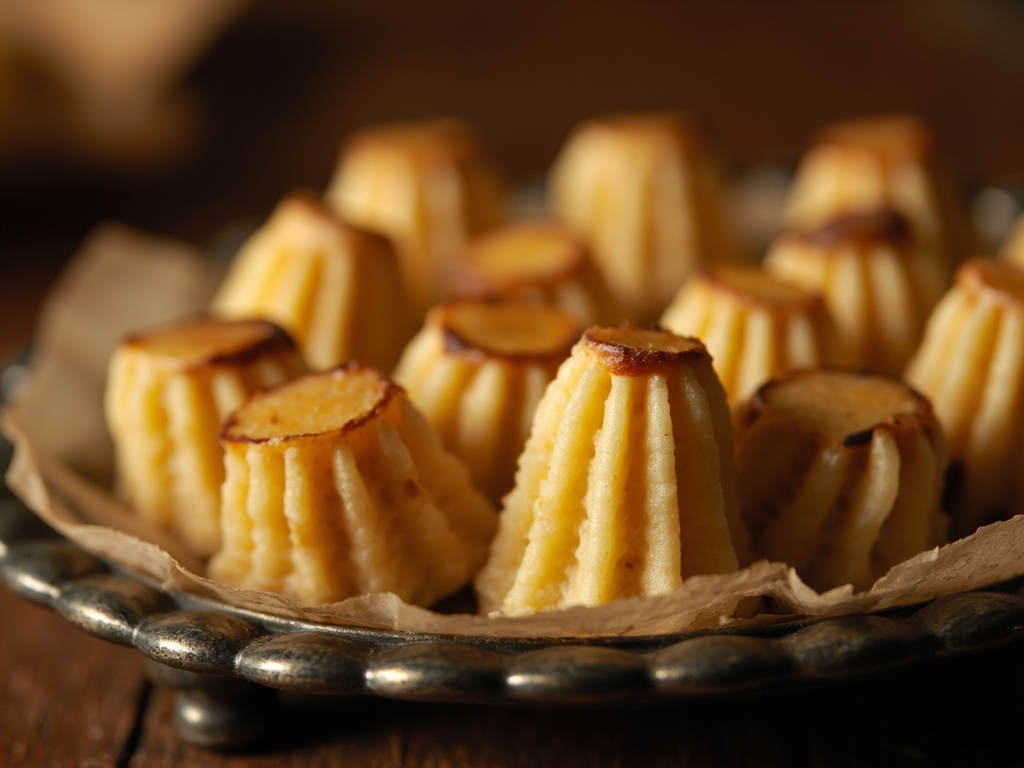
A fine paste of almonds and sugar, scented with rose water, shaped and then baked until the surface is lightly golden—the signature of Königsberg marzipan, as opposed to the white marzipan of Lübeck. A long-lasting sweet.
Here, behold a little masterpiece that rivals one of my piano fantasies! The marzipan of my dear Königsberg is not content to be pale and demure like that of Lübeck—no, it is put in the oven until a fine gilding crowns it, like dawn on the rooftops of the old city. As a child, I received it at New Year's Eve and made it last for weeks in a box, taking out my treasure each day to nibble a rose-scented crescent. Give it to those you love: it keeps long, like the most tenacious memories.
- •Amandes douces mondées — one pound (base)
- •Sucre fin — as much as almonds (sweetness and structure)
- •Eau de rose — a few drops (traditional flavor)
- •Blanc d'œuf — a little (binder and shine)
- •Sucre pour la bordure — a little (caramelized edge)
Königsberger Marzipan (golden marzipan of Königsberg)
A fine paste of almonds and sugar, scented with rose water, shaped and then baked until the surface is lightly golden—the signature of Königsberg marzipan, as opposed to the white marzipan of Lübeck. A long-lasting sweet.
Why this dish? Königsberg, Hoffmann's hometown, was famous throughout Germany for its distinctive marzipan, lightly browned in the oven and edged with a caramelized border. A festive sweet and precious gift that kept for weeks, this marzipan was a pride of East Prussia that he knew as a child.
Here, behold a little masterpiece that rivals one of my piano fantasies! The marzipan of my dear Königsberg is not content to be pale and demure like that of Lübeck—no, it is put in the oven until a fine gilding crowns it, like dawn on the rooftops of the old city. As a child, I received it at New Year's Eve and made it last for weeks in a box, taking out my treasure each day to nibble a rose-scented crescent. Give it to those you love: it keeps long, like the most tenacious memories.
Ingredients (period version)
- Amandes douces mondées — one pound (base)
- Sucre fin — as much as almonds (sweetness and structure)
- Eau de rose — a few drops (traditional flavor)
- Blanc d'œuf — a little (binder and shine)
- Sucre pour la bordure — a little (caramelized edge)
Ingredients
- Almond flour — 250 g (base)
- Icing sugar — 250 g (sweetness)
- Rose water — 1 tsp (flavor)
- Egg white — 1 (a little) (binder)
- Sugar + a little water — for glazing (golden edge)
Method
- Mix almond flour and icing sugar, incorporate rose water and just enough egg white to form a smooth, pliable dough.
- Roll out the dough to 1 cm thick and cut into disks or small shapes (hearts, crescents); slightly raise the edges.
- Place on a baking sheet and pass under a hot broiler for a few moments, watching carefully: the surface and edges should just turn golden (without burning).
- Let cool; optionally brush the edge with a little sugar syrup for a shiny border.
- Store in an airtight container: marzipan keeps for several weeks.
How it was made : Marzipan (almonds + sugar, inherited from the Middle East via the Mediterranean) was an expensive luxury. Königsberg made it a recognizable specialty by baking it to a golden color, unlike the white marzipan of Lübeck. It was shaped into decorative forms and offered as gifts during the holiday season.
The contemporary twist : Shape small hearts, brown them with a blowtorch, and present them in a box lined with tissue paper, a nod to the New Year's gifts of Hoffmann's childhood.
E.T.A. Hoffmann · Charactorium