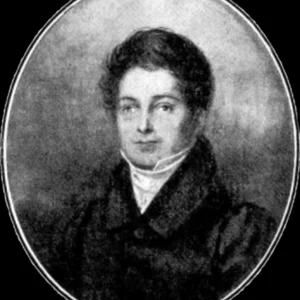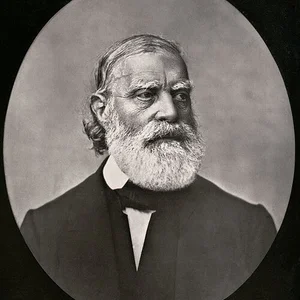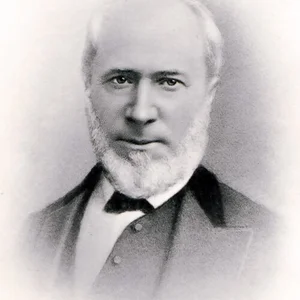

French physician and educator, a pioneer in the education of children with intellectual disabilities. A student of Itard, he developed a physiological method of education before emigrating to the United States, where he influenced Maria Montessori.
Édouard Séguin(1812 — 1880)
Édouard Séguin
France
6 min read
Frequently asked questions
Key Facts
- Born in 1812 in Clamecy and died in 1880 in New York
- A student of Jean Itard and Jean-Étienne Esquirol, whose work on educability he continued
- Published in 1846 'Moral Treatment, Hygiene, and Education of Idiots', a foundational work of special education
- Emigrated to the United States in 1850, where he founded and inspired several institutions for children with disabilities
- His physiological method directly influenced Maria Montessori's pedagogy in the early 20th century
Works & Achievements
First systematic account of his pedagogy, drawn from his lessons at the Hospice des Incurables.
His major French work, which founded the “physiological method” and made him an international reference.
An educational approach starting from the senses and movement, later taken up by Maria Montessori.
A synthesis of his American work, a reference text for special education in the United States.
Creation and organization of schools and associations for disabled children in the United States.
Work on clinical thermometry, illustrating his interest in precise measurement in medicine.
A pedagogical tool still used today in psychology and education to assess coordination.
Anecdotes
Édouard Séguin was a student of Jean Itard, the physician famous for having attempted to educate Victor, the “wild boy of Aveyron.” It was by inheriting this experience that, barely in his twenties, Séguin set out to educate children whom the medicine of his day regarded as “incurable.”
In 1840, Séguin achieved a result that was considered spectacular at the time: after eighteen months of work, a child who could neither speak nor use his hands managed to eat on his own, to write, and to name objects. For many physicians, this was proof that they had been wrong to judge these children uneducable.
Disappointed by the reception his ideas received in France and shaken by the political upheavals of 1848, Séguin emigrated to the United States in 1850. There he became a recognized pioneer and took part in founding institutions and associations devoted to special education.
His “physiological method” stressed the training of the senses and the muscles before intellectual instruction: touching, handling, walking in rhythm, distinguishing shapes. Half a century later, Maria Montessori drew directly on his writings to build her own pedagogy.
Séguin also took an interest in the measurement of the body and in precision: late in his life, he developed a medical thermometer and studied the use of temperature as a diagnostic tool, thus blending his taste for pedagogy with that for instrumental medicine.
Primary Sources
Idiocy is not a disease, but a condition in which the faculties have not developed; education alone can draw the child out of it.
The physiological method begins with the senses and movement, gradually rising toward intelligence and will.
Every exercise must have a purpose: to make the child act, and through action awaken in him attention and will.
The temperature of the body, measured with precision, is a faithful sign that guides the physician better than many an impression.
Key Places
Town in Burgundy where Édouard Séguin was born in 1812. He spent his childhood there before continuing his studies in Paris.
Parisian institution where Séguin put his method into practice with intellectually disabled children from the early 1840s.
Large Parisian hospital where Séguin worked with children and where part of his physiological teaching method took shape.
Capital where Séguin trained under Itard, published his treatise in 1846, and built his reputation before his departure.
City where Séguin settled after 1850, continued his work, founded institutions, and died in 1880.
State where Séguin helped organize the first American public schools for children with intellectual disabilities.
Typical Objects

Wooden tray pierced with cavities where the child must replace pieces of different shapes. This exercise develops hand coordination and shape recognition.

Frame fitted with laces, buttons and hooks used to learn the gestures of daily life. Séguin made it a tool for making the child self-reliant.

Instrument for measuring body temperature whose clinical use Séguin refined. He saw it as a precise sign for monitoring a patient's condition.

Surfaces on which children traced letters and numbers after training their hands. Writing came to crown the sensory exercises.

Beams, ladders and apparatus used to exercise walking, balance and muscular strength. For Séguin, the body had to be educated before the mind.

Rough or smooth tablets, objects of varying weights and sizes that the child compared by touch. This material directly inspired that of Maria Montessori.
School Curriculum
Vocabulary & Tags
Key Vocabulary
Daily Life
Morning
A physician and educator, Séguin began early with the observation and education of the children in his care. Each morning was paced by sensory and motor exercises, carefully recorded to track progress.
Afternoon
The afternoon was split between teaching, writing and language exercises, and the recording of his observations. He also received physicians and visitors who came to learn about his still-controversial method.
Evening
In the evening, Séguin read, wrote his treatises, and kept up an extensive correspondence with other scholars. It was often at night that he gave shape to the ideas drawn from his daily practice.
Food
Like the urban middle class of the 19th century, he ate bread, soups, meats, and vegetables, washed down with water-diluted wine. Meals were regular, structured occasions, a value he considered important for his pupils as well.
Clothing
He wore the sober attire of the physician and man of science of his day: a dark frock coat, a white high-collared shirt, and a knotted cravat. This austere appearance signaled his seriousness and his standing as a practitioner.
Housing
Séguin lived in urban dwellings, in Paris and later in New York, close to the hospitals and institutions where he worked. His living environment blended home, consulting room, and place of teaching.
Historical Timeline
Period Vocabulary
Liens externes & ressources
Références
Œuvres
Théorie et pratique de l'éducation des enfants arriérés et idiots
1842
Traitement moral, hygiène et éducation des idiots et des autres enfants arriérés
1846
Méthode physiologique d'éducation
vers 1846-1866
Idiocy: and its Treatment by the Physiological Method
1866
Participation à la fondation d'institutions américaines
années 1850-1876
Medical Thermometry and Human Temperature
1876
Planche à formes (seguin board)
XIXe siècle