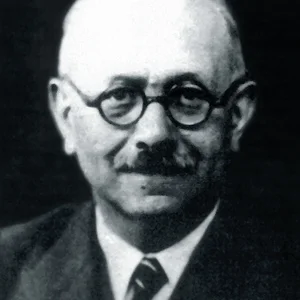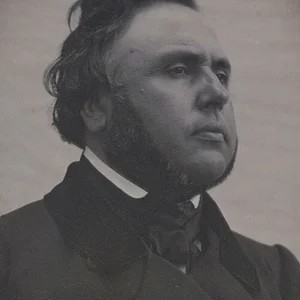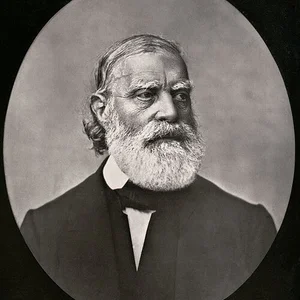

French chemist and naturalist (1794–1878), pioneer of cellular chemistry and histology. A committed republican, he took part in the revolutions of 1830 and 1848, was imprisoned for his political beliefs, and ran for the presidency of the Republic from his prison cell.
François-Vincent Raspail(1794 — 1878)
François-Vincent Raspail
France
8 min read
Frequently asked questions
Famous Quotes
« Science without conscience is but the ruin of the people's soul.»
Key Facts
- 1794: born in Carpentras
- 1825: early work on plant cells, a forerunner of cell theory
- 1830–1832: takes part in the July Revolution, imprisoned at Sainte-Pélagie
- 1848: runs for the presidency of the Republic from his prison cell, receiving 36,000 votes
- 1869: elected as a republican deputy to the National Assembly
Works & Achievements
Raspail's first major work on microchemistry, in which he describes his methods of cellular analysis under the microscope and his reagents for identifying organic components. A founding text of histochemistry.
A landmark work in which Raspail sets out his cell theory and his methods of microscopic chemistry, asserting that the cell is the fundamental unit of life — anticipating the later work of Schwann and Schleiden.
A firsthand account written from his successive imprisonments, in which Raspail denounces the inhumane conditions of detention and argues for a thorough reform of the penitentiary system.
A major scientific synthesis consolidating his research on cellular biology and the mechanisms of disease. This work represents the culmination of twenty years of microscopic study.
A popular medical guide aimed at working-class families, which sold over 100,000 copies and was regularly reprinted for decades. The work made Raspail the symbol of the democratization of healthcare in the nineteenth century.
Anecdotes
In December 1848, Raspail ran in the presidential election from his cell at the Fort de Vincennes, where he had been held since the insurrection of May 15. A republican and socialist candidate, he won around 37,000 votes against Louis-Napoléon Bonaparte, who carried the election with an overwhelming majority. This candidacy from behind bars symbolized his total and uncompromising commitment to the Republic.
A self-taught chemist of modest origins, Raspail was one of the first scientists to systematically use the microscope to analyze plant cells. As early as the 1825–1830s, he showed that cells contain starch by using iodine as a reagent, publishing pioneering work foreshadowing cell theory before Schwann and Schleiden formally established it. His lack of official credentials earned him repeated clashes with the Académie des sciences, which long refused to recognize his discoveries.
Convinced of the therapeutic virtues of camphor, Raspail made it the central remedy in his *Manuel annuaire de la santé*, which sold hundreds of thousands of copies. This medical guide written in plain language and aimed at poor families earned him the popular nickname of “doctor of the poor.” He answered the letters of destitute patients free of charge and received anyone who knocked at his door without asking for payment.
At his 1833 trial for republican activities, Raspail defended himself with such eloquence that his speeches were published and circulated throughout France as political manifestos. The hearings turned into a resounding republican platform, drawing enormous crowds. He was sentenced to prison, but emerged from each imprisonment more famous than when he had entered.
After the coup d’état of December 2, 1851, Raspail was forced into exile in Belgium along with thousands of French republicans. Returning to France after the amnesty, he was elected a deputy at the age of 74 in 1869 and sat among the opponents of the Empire. Well into his eighties, he continued to campaign for the amnesty of the Communards condemned after the Bloody Week of 1871.
Primary Sources
The cell is the primitive element of organization; it is within it that all phenomena of plant and animal life are prepared. Outside the cell, no organization is possible.
Our aim is to bring within reach of every family the basic resources of medicine and pharmacy, so that no one need fall victim to ignorance or poverty when confronted with illness.
The prison, as it is currently organized, does not reform the guilty — it worsens them; it does not repair the harm done to society, it multiplies it by returning to the streets individuals more degraded than when they were received.
I am a republican because the Republic is the only form of government consistent with reason and human dignity. I am not ashamed of my convictions; I will uphold them before every court in the world.
From the depths of my captivity, I answer the call of my fellow citizens. My republican principles and my devotion to the people have never wavered; that is the sole credential I bring before universal suffrage.
Key Places
Raspail's birthplace, born on January 29, 1794, into a modest family of Provençal origin. His working-class roots shaped his lifelong commitment to the underprivileged.
Raspail settled in Paris in 1822 and spent most of his scientific and political career there, frequenting laboratories, learned societies, and the clandestine republican circles of the Latin Quarter.
Raspail was imprisoned here on several occasions for his republican activities, notably in 1832 and 1835. This Parisian prison housed many political opponents of the July Monarchy.
It was from his cell at the Fort de Vincennes that Raspail ran in the presidential election of December 1848. He had been held there since his arrest during the demonstration of May 15, 1848.
Raspail's place of exile following the coup d'état of December 2, 1851. He lived there for several years, continuing his scientific work and maintaining ties with French republicans in exile.
Raspail settled in Arcueil in the final years of his life, in a house that became a place of republican pilgrimage. He died there on January 7, 1878, at the age of 83.
Typical Objects

Raspail was one of the first chemists to systematically use the microscope to analyze the inner structure of plant and animal cells. His microscope was the central tool behind all his discoveries in cellular chemistry.

Raspail firmly believed in the therapeutic properties of camphor and prescribed it in every form — ointment, tincture, fumigation — to his patients. Camphor became the hallmark of his popular medicine, so much so that his name remained long associated with it.

Raspail used iodine as a chemical reagent to reveal the presence of starch in plant cells, a microchemistry technique he pioneered. This simple and effective method is still used in biology to this day.

This popular medical guide, regularly reprinted and sold in hundreds of thousands of copies, was the object most associated with Raspail in the 19th-century imagination. Copies could be found in countless working-class and peasant households.

Raspail founded and edited several newspapers (*L'Ami du peuple*, *Le Réformateur*) to spread his republican and socialist ideas. For him, the pen was every bit as important as the scalpel or the test tube.

Raspail received thousands of letters from poor patients describing their symptoms and asking for his advice. He replied to every one of them free of charge, creating a unique form of epistolary medical practice unlike anything else in 19th-century France.
School Curriculum
Vocabulary & Tags
Key Vocabulary
Daily Life
Morning
Raspail rose early and devoted his mornings to scientific work: microscope observations, writing dissertations, and preparing chemical reagents. A rigorous autodidact, he worked in a modest but carefully equipped laboratory where he sometimes received students or young scholars.
Afternoon
His afternoons were divided between free medical consultations for poor patients and political activities. He answered his abundant correspondence from indigent patients, received workers' delegations, and wrote articles for his republican newspapers.
Evening
Evenings were often spent at political meetings, republican assemblies, and circles of activist friends. During his long years of imprisonment, he continued to write and read in his cell, refusing to let prison tear him away from his work.
Food
A man of modest origins, Raspail lived simply, in the manner of Parisian artisans of his time: bread, vegetables, soup, and little meat. In his *Manuel* he advocated a healthy and simple diet, accessible to all, and avoided alcohol, which he considered a social poison.
Clothing
Raspail dressed in the sober fashion of republican bourgeois: a black or dark-blue frock coat, white cravat, and top hat. His attire, devoid of extravagance, reflected his concern for popular dignity — neither ostentatious poverty nor bourgeois display.
Housing
In Paris, Raspail lived in apartments in the Latin Quarter, a neighborhood of intellectuals and students. His lodgings housed both his chemistry laboratory and his informal consulting room, always open to the most destitute; in his later years, his house in Arcueil became a gathering place for republican meetings.
Historical Timeline
Period Vocabulary
Liens externes & ressources
Références
Œuvres
Essai de chimie microscopique appliquée à la physiologie
1830
Nouveau système de chimie organique
1833
Lettres sur les prisons de Paris
1839
Histoire naturelle de la santé et de la maladie chez les végétaux et chez les animaux en général
1843
Manuel annuaire de la santé, ou Médecine et pharmacie domestiques
1845