 flip
flipSamovar tea with cherry jam
Samovar tea with cherry jam
Why this dish? Elsa's file says: she had kept 'the taste of tea drunk at all hours', a Slavic habit she maintained all her life in France. Tea was not just a hot drink but the heart of Russian sociability, the pretext for long conversations that nourished her work and her literary friendships.
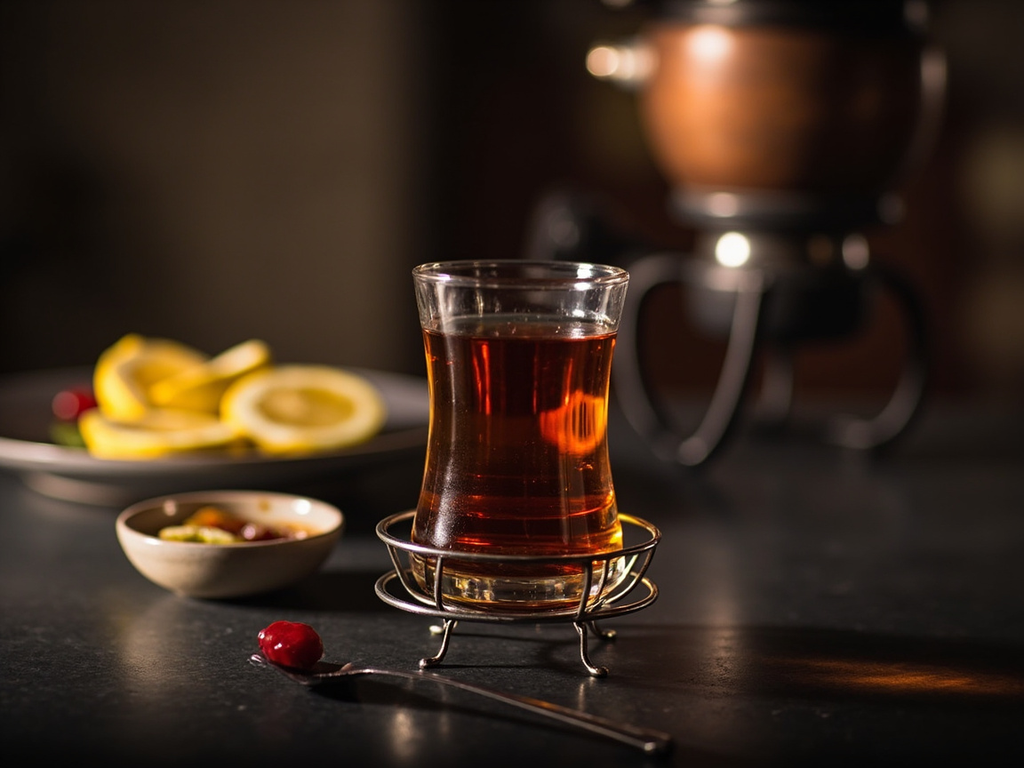
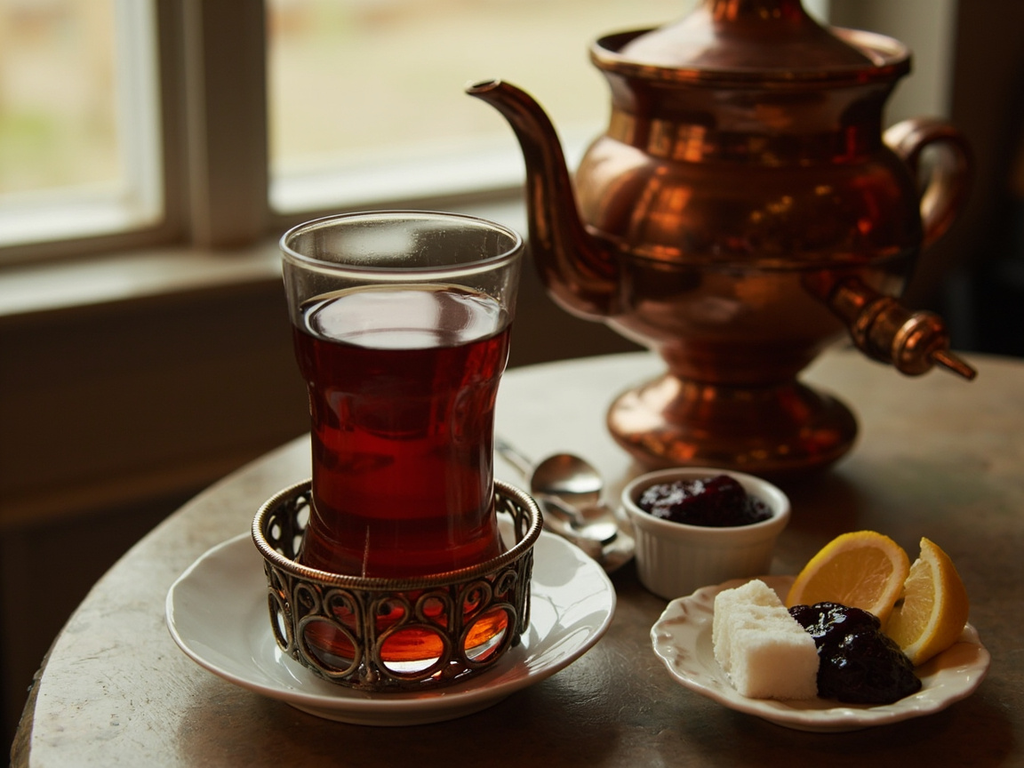
A strong black tea prepared in the Russian style: a concentrate (zavarka) brewed in a small teapot placed on the samovar, then diluted in each glass of boiling water. The cup is not sweetened: you hold a sugar cube between your teeth, or take a spoonful of cherry jam 'as an accompaniment', letting it melt in your mouth between sips.
Tea, you see, is not drunk like swallowing a medicine: it is lived. On the samovar, I let a very dark, almost stern brew steep, and each person poured their own stronger or weaker according to their mood that day. You do not sully the glass with melted sugar—no—you take the cherry jam with a small spoon, hold it on your tongue, and the boiling tea passes over it. That is how my finest conversations were held, the glass constantly refilled, until the samovar itself fell silent.
- •Black tea from China or Georgia — for a very strong concentrate (base of the tchaï)
- •Boiling water from the samovar — as needed (dilution)
- •Cherries — according to season (accompanying jam)
- •Sugar — in lumps, served separately (held between the teeth (vприкуску))
- •Lemon — a few slices (flavor, Russian style)
Samovar tea with cherry jam
A strong black tea prepared in the Russian style: a concentrate (zavarka) brewed in a small teapot placed on the samovar, then diluted in each glass of boiling water. The cup is not sweetened: you hold a sugar cube between your teeth, or take a spoonful of cherry jam 'as an accompaniment', letting it melt in your mouth between sips.
Why this dish? Elsa's file says: she had kept 'the taste of tea drunk at all hours', a Slavic habit she maintained all her life in France. Tea was not just a hot drink but the heart of Russian sociability, the pretext for long conversations that nourished her work and her literary friendships.
Tea, you see, is not drunk like swallowing a medicine: it is lived. On the samovar, I let a very dark, almost stern brew steep, and each person poured their own stronger or weaker according to their mood that day. You do not sully the glass with melted sugar—no—you take the cherry jam with a small spoon, hold it on your tongue, and the boiling tea passes over it. That is how my finest conversations were held, the glass constantly refilled, until the samovar itself fell silent.
Ingredients (period version)
- Black tea from China or Georgia — for a very strong concentrate (base of the tchaï)
- Boiling water from the samovar — as needed (dilution)
- Cherries — according to season (accompanying jam)
- Sugar — in lumps, served separately (held between the teeth (vприкуску))
- Lemon — a few slices (flavor, Russian style)
Ingredients
- Strong black tea (Russian Caravan, Georgian, or Assam) — 3 tsp (concentrate (zavarka))
- Simmering water — 1.5 L (kettle) (dilution in each glass)
- Pitted cherries — 500 g (jam)
- Sugar — 350 g (for jam) + lumps separately (sweetness)
- Lemon juice — 1 tbsp (balance for jam)
- Lemon slices — a few (serving, Russian style)
Method
- Prepare the jam: cook the pitted cherries with sugar and lemon juice over low heat for 30-40 minutes, until it coats a spoon; set aside in a jar.
- Make a tea concentrate (zavarka): steep the black tea in 25 cl of simmering water for 5 to 7 minutes in a small teapot.
- At serving time, pour a little concentrate into each glass (ideally a glass held in a metal glass-holder, the podstakannik), then top up with very hot water to the desired strength.
- Do not sweeten the glass: offer cherry jam with a small spoon and sugar lumps separately, plus a few lemon slices.
- Refill as long as the conversation lasts.
How it was made : The samovar, a large copper urn heated by charcoal, kept water boiling for hours and stood at the center of every Russian home. Tea was drunk 'vприкуску' (sugar held between the teeth) or with jam served separately in a small dish, the varenié. Drinking tea with lemon is so associated with Russia that the English long called it 'Russian tea'.
The contemporary twist : Lacking a samovar, a large insulated teapot and pretty glasses in filigree holders recreate the ritual; serve the cherry jam in a shared bowl with a spoon, for the spirit of shared varenié.
Sources : Audra Yoder, 'Tea Time in Romanov Russia: A Cultural History', studies on the samovar and Russian sociability · Lesley Chamberlain, The Food and Cooking of Russia, 1982
Elsa Triolet · Charactorium