 flip
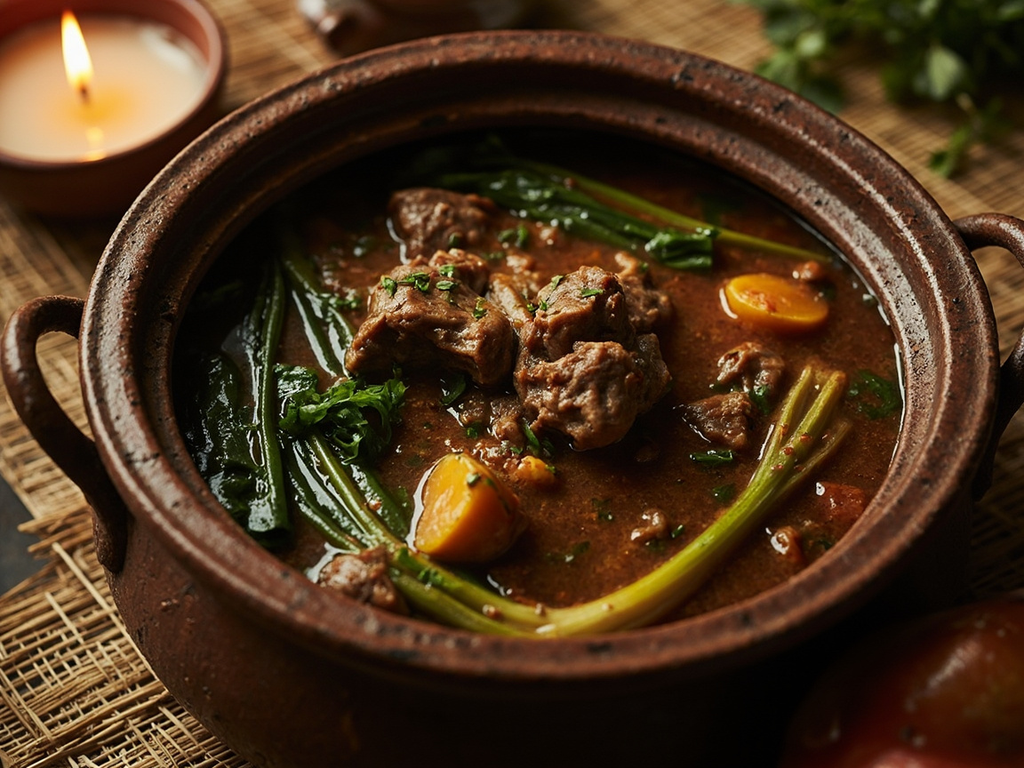
flipTuh'u — lamb stew with chard and leek
Tuh'u — lamb stew with chard and leek
Why this dish? Meat rations were reserved for major religious festivals and ritual banquets at the temple of Nanna: a fragrant lamb stew was the showpiece dish that a daughter of Sargon could offer to her guests and to her goddess Inanna.
A deep, rich lamb stew, simmered with leek, garlic, chard or beet, thickened with fat and barley flour, seasoned with coriander and cumin. The long, patient broth-cooking of great occasions.
When the new moon festival comes, I place the meat before Nanna before any man touches it. We brown the lamb in its own fat, throw in crushed leek, garlic, and onion, drown it all in water and cover with chard leaves. Cumin and coriander rise in smoke to the goddess's nostrils — and what the gods have breathed, my guests then eat, with joyful hearts.
- •Lamb shoulder — a fine piece (stew meat)
- •Lamb fat (fat tail) — as desired (cooking fat)
- •Leek and onion — several (aromatic base)
- •Garlic — a few cloves (flavor)
- •Chard or beet — an armful (leafy vegetable)
- •Coriander and cumin — to taste (spices)
- •Barley flour — a handful (thickener for broth)
- •Salt — to taste (seasoning)
Tuh'u — lamb stew with chard and leek
A deep, rich lamb stew, simmered with leek, garlic, chard or beet, thickened with fat and barley flour, seasoned with coriander and cumin. The long, patient broth-cooking of great occasions.
Why this dish? Meat rations were reserved for major religious festivals and ritual banquets at the temple of Nanna: a fragrant lamb stew was the showpiece dish that a daughter of Sargon could offer to her guests and to her goddess Inanna.
When the new moon festival comes, I place the meat before Nanna before any man touches it. We brown the lamb in its own fat, throw in crushed leek, garlic, and onion, drown it all in water and cover with chard leaves. Cumin and coriander rise in smoke to the goddess's nostrils — and what the gods have breathed, my guests then eat, with joyful hearts.
Ingredients (period version)
- Lamb shoulder — a fine piece (stew meat)
- Lamb fat (fat tail) — as desired (cooking fat)
- Leek and onion — several (aromatic base)
- Garlic — a few cloves (flavor)
- Chard or beet — an armful (leafy vegetable)
- Coriander and cumin — to taste (spices)
- Barley flour — a handful (thickener for broth)
- Salt — to taste (seasoning)
Ingredients
- Boneless lamb shoulder — 800 g, cubed (stew meat)
- Sesame oil or lamb fat — 3 tablespoons (cooking fat)
- Leek — 2, sliced (aromatic base)
- Onion — 1 large, chopped (aromatic base)
- Garlic — 4 cloves, crushed (flavor)
- Chard (or beets + their leaves) — 300 g (leafy vegetable)
- Ground coriander — 1 teaspoon (spice)
- Ground cumin — 1 teaspoon (spice)
- Barley flour — 1 tablespoon (thickener)
- Salt — to taste (seasoning)
Method
- Sear the lamb cubes in hot fat until browned on all sides.
- Add onion, leek, and garlic; sweat for 5 minutes.
- Cover with water, salt, add cumin and coriander. Bring to a simmer.
- Simmer covered over low heat for 1 hour 15 minutes.
- Add the chard (or diced beets + leaves) and cook 30 minutes more.
- Dissolve the barley flour in a little broth, stir back into the pot to thicken the sauce. Simmer 10 more minutes and adjust salt.
How it was made : The only known cuneiform recipes — the three Yale culinary tablets (Babylonian collection, ca. 1700 BCE, thus slightly later than Enheduanna) — describe about thirty meat stews of this type, including "tuh'u." Meat was cooked in water and fat with leek, garlic, onion, and herbs, without tomato or chili (unknown in the Old World).
The contemporary twist : Serve the stew over the barley flatbread (r1) which soaks up the broth, and finish with a drizzle of date syrup for a sweet-savory note true to Mesopotamian taste.
Sources : Yale Babylonian Collection, culinary tablets YBC 4644, 8958, 4648 · Jean Bottéro, The Oldest Cuisine in the World: Cooking in Mesopotamia, University of Chicago Press, 2004
Enheduanna · Charactorium