
Mary Read (1685-1721) was an English pirate who long concealed her sex beneath men's clothing. She served in the army and then aboard ships before joining the crew of the pirate Calico Jack Rackham, alongside Anne Bonny, in the Caribbean.
Mary Read(1685 — 1721)
Mary Read
royaume de Grande-Bretagne
8 min read
Frequently asked questions
Key Facts
- Born around 1685 in England, raised disguised as a boy by her mother
- First serves as a soldier or sailor disguised as a man before reaching the Caribbean
- Joins the crew of the pirate Calico Jack Rackham around 1720, where she fights alongside Anne Bonny
- Captured in November 1720 off the coast of Jamaica, tried and sentenced to death for piracy
- Escapes hanging by pleading her pregnancy, but dies in prison in April 1721, probably of fever
Works & Achievements
Enlisting under a male identity during the War of the Spanish Succession, Mary Read gained there the training and battlefield courage that would mark her whole life.
After revealing her sex to a fellow soldier and marrying him, she ran this inn with him; once widowed, she took up men's clothes and the sea again.
Alongside Anne Bonny, Mary Read became one of only two known women pirates of the “Golden Age,” an exceptional case that secured her place in history.
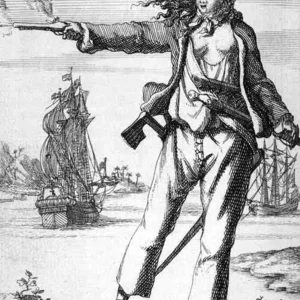
When the ship was captured, Read and Bonny fought on almost alone on the deck, a scene that became the very symbol of the two women pirates' courage.
Sentenced to death, she temporarily escaped the gallows by declaring herself pregnant; her trial remains a major source on female piracy.
Charles Johnson's account made Mary Read a legend and has, for three centuries, inspired novels, films, and portrayals of women pirates.
Anecdotes
According to the account of Captain Charles Johnson, Mary Read's mother, left alone and destitute, dressed her daughter as a boy very early on in order to pass her off to her mother-in-law as a deceased legitimate son, and thus keep drawing a pension. Mary kept this male disguise for much of her life — first out of necessity, then by choice.
As a young woman, Mary enlisted under a man's identity during the War of the Spanish Succession, serving in Flanders first in the infantry and then in the cavalry. Having fallen in love with one of her Flemish comrades, she revealed her secret to him; they married and ran an inn under the sign of the “Three Horseshoes,” near Breda. Widowed soon after, she once again took up men's clothes and the sea.
Having joined the crew of the pirate Calico Jack Rackham, Mary found there another woman in disguise, Anne Bonny. According to Johnson, Bonny, believing she was dealing with a handsome young sailor, had at first become enamored of Mary, who had to reveal to her that she too was a woman. The two pirates became inseparable.
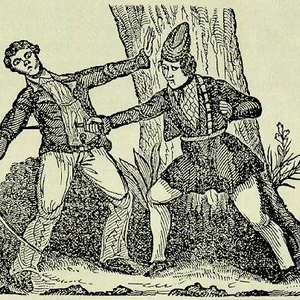
When Rackham's sloop was captured off Jamaica in October 1720, it is said that Mary Read and Anne Bonny were almost the only ones to fight on deck, while the men, drunk, had taken refuge in the hold. Mary is said to have fired down into the hold, cursing her own comrades to force them up to fight.
Sentenced to death by hanging at the end of November 1720, Mary Read escaped the gallows by declaring herself pregnant (“pleading the belly”), which suspended the execution. Questioned about the prospect of the gallows, she is said to have replied that she thought it no great hardship: without it, “every cowardly fellow would turn pirate.” She nevertheless died in prison a few months later, in 1721, probably of fever.
Primary Sources
As to hanging, she thought it no great hardship, for, were it not for that, every cowardly fellow would turn pirate, and so infest the seas, that men of courage must starve.
That the two Women, Prisoners at the Bar, were then on Board the said Sloop, and wore Men's Jackets, and long Trouzers, and Handkerchiefs tied about their Heads; and that each of them had a Machet and Pistol in their Hands, and cursed and swore at the Men.
Whereas John Rackum [...] and two Women, by name, Ann Fulford alias Bonny, and Mary Read, did [...] feloniously steal, take and carry away [...] a certain Sloop call'd the William.
Key Places
Birthplace of Mary Read, around 1685, into a humble family. It was here that, according to tradition, her mother raised her dressed as a boy.
Setting for the campaigns of the War of the Spanish Succession, where Mary Read served as a soldier. It was near Breda that she married and ran the inn known as the “Three Horseshoes.”
Chief haven of the Caribbean pirates, nicknamed the “Republic of Pirates.” It was from its harbor that Rackham stole the sloop William in 1720 with his crew, among them Mary Read.
Area where Rackham's sloop, lying at anchor, was surprised and boarded in October 1720 by the pirate hunter Jonathan Barnet. It was here that Mary Read fought her last battle on the deck.
Seat of the English colonial administration, where Mary Read was tried and condemned in November 1720. It was in the prison of St. Catherine parish that she died in 1721.
Typical Objects

A jacket, loose trousers and a scarf tied around the head that Mary Read wore to pass as a man, as described by witnesses at her trial. This disguise allowed her to serve as a soldier, then a sailor, and finally a pirate.

A short, broad blade, ideal for close combat on a deck. At the trial, a witness stated that she had seen Mary Read “a cutlass and a pistol in hand,” swearing at the men of the crew.

An individual firearm that fired only one shot before a long reload, so pirates often carried several at their belt. Mary Read held one during the capture of the sloop.

The shoulder firearm of early-18th-century soldiers. Mary Read used one while serving in the infantry and then the cavalry in Flanders, under a male identity.

A spirit made from sugar cane, produced in abundance in the West Indies and the basis of the pirates' daily drink. Rackham's crew is said to have been caught drunk during their capture, while Read and Bonny wanted to fight.

A code of rules signed by the members of a pirate crew, setting out the division of the loot, discipline, and compensation in case of injury. It was this contract that governed life aboard Rackham's ship.
School Curriculum
Vocabulary & Tags
Key Vocabulary
Tags
Daily Life
Morning
When she served aboard a ship, Mary Read's day began at dawn with the change of watch, the inspection of the sails, and the bailing of water from the hold. Like the rest of the crew, she had no idea that one of her shipmates was a woman: she took care to speak, swear, and work like a man.
Afternoon
The afternoon was spent maintaining the rigging, cleaning the weapons, and, during a chase, maneuvering to overtake a prey. At the moment of boarding, Mary proved to be among the most determined, cutlass and pistol in hand.
Evening
In the evening, the crew shared their meal, drank rum, and played dice or cards. It was during such a moment of relaxation, with the men drunk, that Rackham's band was caught off guard and captured, while Read and Bonny wanted to fight.
Food
They fed mainly on preserved provisions: sea biscuit, salted meat and fish, and sometimes turtles and fresh fruit taken during port calls. The main drink was rum from the Antilles, often diluted with water.
Clothing
Like the sailors, Mary Read wore a linen shirt, loose trousers, and a scarf tied around her head. This masculine outfit, described by witnesses at her trial, allowed her to conceal her sex among the crew.
Housing
Her “home” was the ship itself, a cramped little sloop where one slept right on the deck or in a hammock. On land, they lodged in the taverns and shacks of hideouts like Nassau; she ended her days in a prison in Jamaica.
Historical Timeline
Period Vocabulary
Liens externes & ressources
Références
Œuvres
Service militaire en Flandre (infanterie puis cavalerie)
vers 1701-1713
L'auberge des « Trois Fers à cheval », près de Bréda
vers 1713-1717
Engagement dans l'équipage de Calico Jack Rackham
1720
Le dernier combat sur le pont du sloop William
octobre 1720
Procès de Spanish Town et survie par « plaider son ventre »
novembre 1720