
Samuel “Black Sam” Bellamy (c. 1689-1717) was an English pirate of the golden age of piracy. Captain of the Whydah, a captured former slave ship, he is considered one of the wealthiest pirates in history before perishing in a shipwreck in 1717.
Samuel Bellamy(1689 — 1717)
Samuel Bellamy
royaume de Grande-Bretagne
7 min read
Frequently asked questions
Famous Quotes
« I am a free prince, and I have as much authority to make war on the whole world as he who has a hundred sail of ships at sea and an army of 100,000 men in the field.»
Key Facts
- Born around 1689 in England (Devon), he became a sailor and then turned to piracy around 1715-1716 in the Caribbean.
- In 1717, he captured the Whydah Gally, a British slave ship, and made it his flagship, laden with rich plunder.
- Nicknamed “Black Sam” and sometimes the “Robin Hood of the seas,” he amassed one of the greatest fortunes in piracy in less than two years.
- On 26 April 1717, the Whydah was wrecked in a storm off Cape Cod (Massachusetts); Bellamy perished along with most of his crew.
- The wreck of the Whydah was discovered in 1984 by Barry Clifford: it is the first authenticated pirate wreck.
Works & Achievements
Seizure of this brand-new slave ship turned into a flagship, a feat that made Bellamy one of the most feared pirate captains in the Caribbean.
Bellamy commanded several ships at once (the Whydah, the Mary Anne, the Anne Galley), forming a genuine small squadron.
In just about fifteen months, his fleet reportedly seized some fifty vessels, making him one of the richest pirates in history.
A crew governed by ship's articles, bringing together sailors from many nations and several dozen Africans, some freed from the captured ships.
A tirade denouncing the rich and the laws that protect them, reported in 1724, which forged his legend as the “Robin Hood of the seas”.
Uncovering of the site by Barry Clifford: the only authenticated pirate wreck, a unique source for understanding the real life of the buccaneers.
Anecdotes
In February 1717, in the Windward Passage near the Bahamas, Bellamy gave chase for nearly three days to a brand-new slave ship, the Whydah, and finally captured it. In a gesture typical of his reputation, he gave the defeated captain, Lawrence Prince, one of his own vessels and about twenty pounds of gold as compensation.
He was nicknamed “Black Sam” because, it is said, he tied back his long black hair with a black satin ribbon instead of wearing the powdered wig that was then in fashion. His crew styled themselves as “Robin Hood's men,” and Bellamy saw himself as an avenger of the seas who robbed the rich.
According to the General History of the Pyrates (1724), Bellamy is said to have delivered a now-famous speech to a captured captain, proclaiming himself a “free prince” and denouncing the rich: “They rob the poor under the cover of law, and we plunder the rich under the protection of our own courage.”
On April 26, 1717, a violent nor'easter drove the Whydah onto a sandbar off Cape Cod (Wellfleet, Massachusetts). The ship capsized during the night; Bellamy perished at around 28 along with nearly all of his ~145 men. Only two sailors from the Whydah survived.
Bellamy's crew was remarkably cosmopolitan and included several dozen Africans, some of whom had been freed from the holds of captured ships and had joined the pirates — a rare mix in the colonial world of the early 18th century.
In 1984, the explorer Barry Clifford located the wreck of the Whydah off Cape Cod. A bronze bell engraved “THE WHYDAH GALLY 1716,” recovered in 1985, makes it the only authenticated pirate wreck from the Golden Age.
Primary Sources
“I am a free prince, and I have as much authority to make war on the whole world as he who has a hundred ships at sea and an army of a hundred thousand men.”
The carpenter Thomas Davis, a survivor, testifies that the ship struck the sandbar during the night and that in less than a quarter of an hour the mainmast was carried overboard, causing the loss of almost the entire crew.
A moral account, written by the Puritan minister of Boston, of the wreck of “more than a hundred pirates” cast upon the coast of New England on 26 April 1717, and of the execution of the captured survivors.
A bronze bell cast in 1716, bearing the ship's name; recovered from the wreck in 1985, it constitutes the physical evidence that authenticated Bellamy's ship.
Key Places
County in southwest England where Samuel Bellamy was born around 1689, in a region turned toward the sea and fishing.
Pirate haven nicknamed the “Republic of Pirates,” a rear base where Bellamy joined other buccaneers such as Hornigold and Levasseur.
Site of the wreck of a Spanish fleet in 1715, whose gold drew Bellamy and Williams at the start of their adventure as treasure hunters.
Strait between Cuba and Hispaniola, a heavily traveled sea route, where Bellamy captured the Whydah in February 1717.
Sandy shore where the Whydah was wrecked in the storm of April 26, 1717, causing the death of Bellamy and almost his entire crew.
City where the surviving pirates were tried by the admiralty court in 1717; six of them were hanged there.
Typical Objects

A short, sturdy sword, ideal for close-quarters fighting on the crowded decks during a boarding. The emblematic weapon of the Golden Age pirates.

A single-shot firearm, often carried in pairs because it was slow to reload. Pirates tucked several into their belts before a boarding.

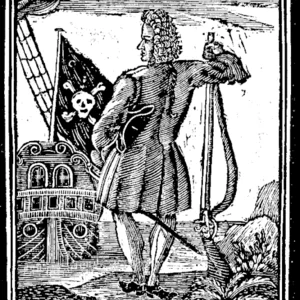
A flag hoisted to signal a pirate identity and terrify the prey into surrendering without a fight. Each captain flew his own emblem.

Instruments used to measure the height of the sun and hold a course. Indispensable for navigating the Atlantic and the Caribbean without coastal landmarks.

Spanish silver coins (the real de a ocho) that served as an international currency in the Americas. This was the loot pirates coveted most.

A written contract setting the rules of life on board and the division of the loot, signed by every pirate. It reflects the surprisingly egalitarian organization of these crews.

An English slave ship of 1716 captured by Bellamy and turned into a heavily armed flagship. Its wreck, found in 1984, is the only authenticated pirate wreck.
School Curriculum
Vocabulary & Tags
Key Vocabulary
Tags
Daily Life
Morning
At dawn, the watchmen scan the horizon from high atop the masts, on the lookout for a sail to attack. Life aboard is paced by chores: pumping out the bilge water, checking the rigging, polishing the weapons.
Afternoon
The afternoon is spent maintaining the ship: mending the sails, repairing the woodwork, sometimes careening the hull on a deserted beach. When a prey is spotted, the whole crew prepares feverishly to board it.
Evening
Once evening comes, the pirates relax: songs, music, games of dice and cards, and rounds of rum or punch. It is also the time for assembly votes, since important decisions are made by majority.
Food
They eat mostly very hard sea biscuit, salted meat and fish, supplemented by plundered provisions: fruit, turtles, poultry. Fresh water spoils quickly, hence the heavy use of rum and beer, and the constant risk of scurvy.
Clothing
The basic outfit is that of sailors: a linen shirt, wide trousers, a scarf and a hat. But the pirates loved to deck themselves out in refined stolen clothes; Bellamy, it is said, tied back his black hair with a satin ribbon rather than wearing a wig.
Housing
Aboard, space is cramped: they sleep in tightly packed hammocks, below deck, among the cannons and the goods. On land, in hideouts like Nassau, the pirates camp under tents and makeshift huts built from sails.
Historical Timeline
Period Vocabulary
Liens externes & ressources
Références
Œuvres
Capture du Whydah
février 1717
Constitution d'une flotte pirate
1716-1717
Une cinquantaine de navires capturés
1716-1717
Un équipage égalitaire et cosmopolite
1716-1717
Le discours du « prince libre »
1717
Redécouverte de l'épave du Whydah
1984