 flip
flipRoasted Agave Heart in an Earth Oven
Roasted Agave Heart in an Earth Oven
Why this dish? During his journey, Estevanico tasted roasted agave offered by the desert peoples, mentioned among his known foods. Roasting the agave heart in a pit of hot stones was a ritual of festive sharing, transforming a fibrous, bitter plant into caramelized, sweet flesh.
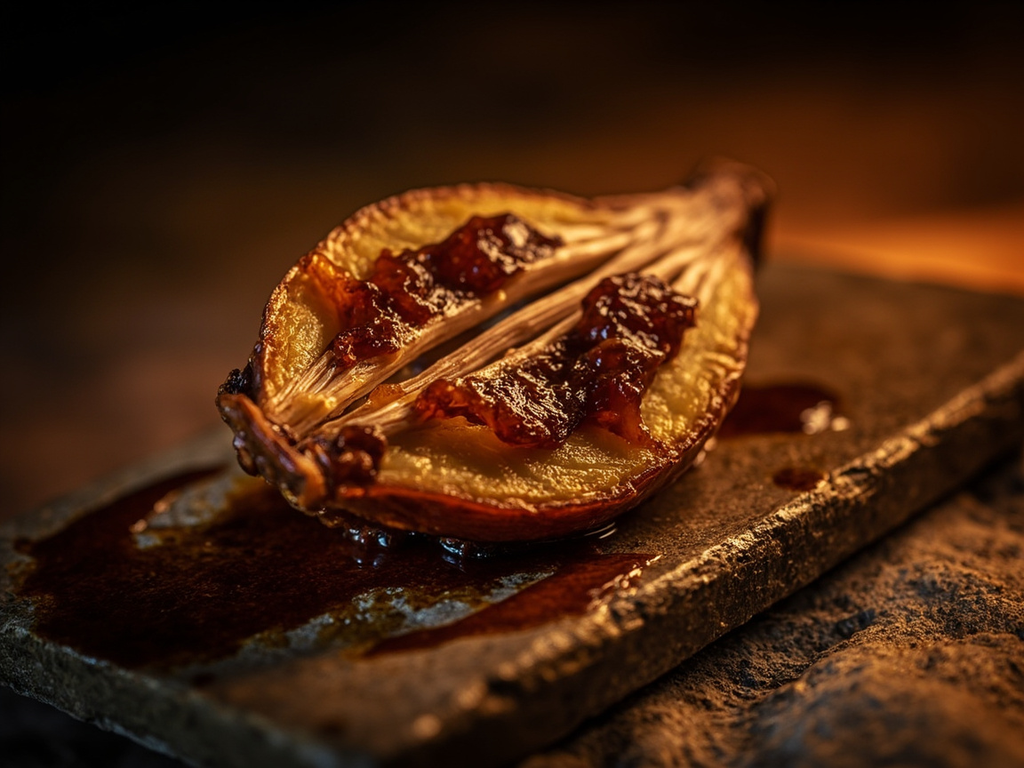
The fleshy heart of the agave (the *piña*), buried for one to two days over hot stones covered with earth. The long, slow cooking transforms the fibers into melting, sweet, smoky flesh with bitter molasses notes. A feast in itself.
You would not believe that a plant so hard and bitter could become so sweet. The desert peoples dug a large pit, piled stones that they heated red-hot, placed the trimmed agave hearts on them, then covered everything with earth for two days and two nights. When they opened the pit, the flesh was brown, sweet like candied fruit, smoky like a campfire—and the whole group gathered to break it. I shared many famines, but those days of open pit were among my rare feasts in those lands.
- •Trimmed agave heart (piña de maguey) — one whole heart (sole ingredient, source of sugar)
- •River stones — to cover the pit floor (accumulate and distribute heat)
- •Earth and agave leaves — to cover (insulation and steaming)
Roasted Agave Heart in an Earth Oven
The fleshy heart of the agave (the *piña*), buried for one to two days over hot stones covered with earth. The long, slow cooking transforms the fibers into melting, sweet, smoky flesh with bitter molasses notes. A feast in itself.
Why this dish? During his journey, Estevanico tasted roasted agave offered by the desert peoples, mentioned among his known foods. Roasting the agave heart in a pit of hot stones was a ritual of festive sharing, transforming a fibrous, bitter plant into caramelized, sweet flesh.
You would not believe that a plant so hard and bitter could become so sweet. The desert peoples dug a large pit, piled stones that they heated red-hot, placed the trimmed agave hearts on them, then covered everything with earth for two days and two nights. When they opened the pit, the flesh was brown, sweet like candied fruit, smoky like a campfire—and the whole group gathered to break it. I shared many famines, but those days of open pit were among my rare feasts in those lands.
Ingredients (period version)
- Trimmed agave heart (piña de maguey) — one whole heart (sole ingredient, source of sugar)
- River stones — to cover the pit floor (accumulate and distribute heat)
- Earth and agave leaves — to cover (insulation and steaming)
Ingredients
- Agave or maguey heart (from Mexican grocery) — or substitute with large sweet potato or parsnip pieces — 500 g (sweet base to caramelize)
- Agave syrup — 2 tablespoons (enhances authentic caramel note)
- Liquid smoke (optional) or grill cooking — a few drops (reminiscent of earth oven)
- Pinch of salt — 1 pinch (balance)
Method
- Cut the agave heart (or sweet potato/parsnip substitute) into large chunks.
- Brush with agave syrup, add a pinch of salt, and if you want the smoky flavor, a few drops of liquid smoke.
- Wrap in parchment paper then aluminum foil, and bake at 150°C for 2 to 3 hours (low temperature mimics the pit).
- The flesh is ready when dark brown, melting, and caramelized. Pull apart the fibers and suck the sweet juice, as was done around the pit.
How it was made : Pit-roasting of agave (mezcal in the sense of roasted plant) in an underground oven—the *horno*—is attested for millennia throughout the Sonoran Desert and the Southwest. Stones were heated in a pit, the hearts were placed on them, covered with leaves then earth, and cooked for 24 to 48 hours. The cooking converts hard fibers into sugars: the same principle that later gave mezcal and tequila.
The contemporary twist : Serve the caramelized fibers shredded on a slate, with a drizzle of agave syrup and a pinch of smoked salt, like a 'pit dessert' to share.
Sources : Gary Paul Nabhan, Gathering the Desert (1985) · William B. Doelle, Archaeology of Agave Hornos in the Southwest
Estevanico · Charactorium