 flip
flipGrand Venison Pie in Crust
Grand Venison Pie in Crust
Why this dish? Francis I was a passionate hunter: it is said he had Chambord built to hunt stag in the Sologne forest. The game brought back from his hunts ended up in monumental pies, centerpieces of his banquets where dozens of dishes were counted.
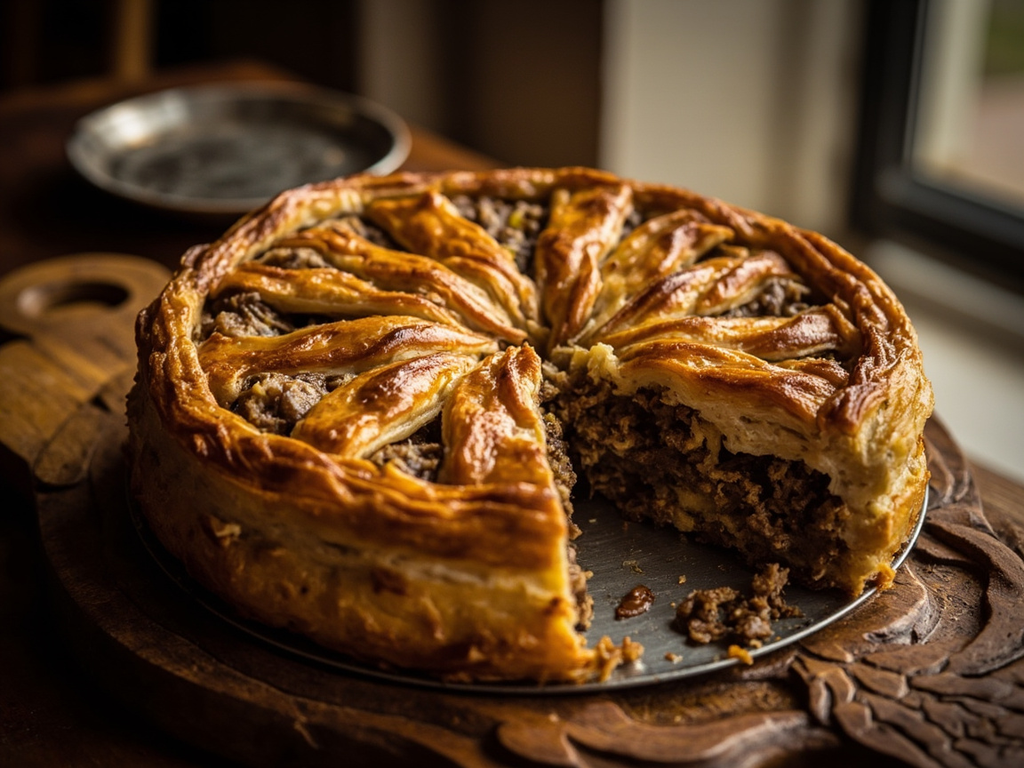
A firm, golden crust enclosing a stuffing of venison and bacon, perfumed with warm spices and sharpened with a dash of verjuice. It is sliced at table to reveal the tender meat, like a chest being opened.
Come now, approach my table without ceremony! This pie I love above all, for the meat comes from my own hunts in Sologne, where I often chased the stag until nightfall. My master cook minces it finely with bacon, covers it with ginger and grains of paradise, moistens it with a stream of sharp verjuice, then seals it in its crust as one seals a letter with the royal seal. Believe me, nothing gladdens a hungry king more than a fine pie broken at the knife's point.
- •Venison (or wild boar) meat — a fine shoulder piece (game meat, heart of the pie)
- •Fat bacon — as needed (moisture and binder for the stuffing)
- •Fine wheat flour — as needed (firm pastry)
- •Lard — a good amount (pastry fat)
- •Eggs — a few (bind and glaze pastry)
- •Fine spices (ginger, pepper, cloves, nutmeg) — generously (court perfume)
- •Grains of paradise (melegueta pepper) — a pinch (signature spice, peppery warmth)
- •Verjuice — a dash (acidity that awakens the meat)
- •Salt — to taste (seasoning)
Grand Venison Pie in Crust
A firm, golden crust enclosing a stuffing of venison and bacon, perfumed with warm spices and sharpened with a dash of verjuice. It is sliced at table to reveal the tender meat, like a chest being opened.
Why this dish? Francis I was a passionate hunter: it is said he had Chambord built to hunt stag in the Sologne forest. The game brought back from his hunts ended up in monumental pies, centerpieces of his banquets where dozens of dishes were counted.
Come now, approach my table without ceremony! This pie I love above all, for the meat comes from my own hunts in Sologne, where I often chased the stag until nightfall. My master cook minces it finely with bacon, covers it with ginger and grains of paradise, moistens it with a stream of sharp verjuice, then seals it in its crust as one seals a letter with the royal seal. Believe me, nothing gladdens a hungry king more than a fine pie broken at the knife's point.
Ingredients (period version)
- Venison (or wild boar) meat — a fine shoulder piece (game meat, heart of the pie)
- Fat bacon — as needed (moisture and binder for the stuffing)
- Fine wheat flour — as needed (firm pastry)
- Lard — a good amount (pastry fat)
- Eggs — a few (bind and glaze pastry)
- Fine spices (ginger, pepper, cloves, nutmeg) — generously (court perfume)
- Grains of paradise (melegueta pepper) — a pinch (signature spice, peppery warmth)
- Verjuice — a dash (acidity that awakens the meat)
- Salt — to taste (seasoning)
Ingredients
- Boneless venison shoulder (or braising beef) — 800 g (main meat)
- Pork belly / fat bacon — 250 g (softness of stuffing)
- Flour — 400 g (pastry)
- Lard or butter — 180 g (pastry)
- Eggs — 2 (+1 for glaze) (bind and glaze)
- Cold water — 10 cl (pastry)
- Ginger, pepper, cloves, nutmeg mixture — 2 tsp (spices)
- Grains of paradise (or substitute pepper + cardamom) — 1 pinch (signature spice)
- Verjuice (or green grape juice / a little green apple juice) — 5 cl (acidity)
- Salt — 1.5 tsp (seasoning)
Method
- Chop with a knife (or roughly blend) the venison and bacon to keep some texture. Mix with spices, grains of paradise, salt and verjuice. Let rest 1 hour in the fridge.
- Prepare the pastry: rub flour with lard, add eggs and water, knead quickly into a firm dough. Rest 30 minutes.
- Roll out two-thirds of the pastry, line a springform pan. Fill with well-packed stuffing.
- Cover with remaining pastry, seal edges, cut a chimney in the center. Glaze with egg.
- Bake 1h30 at 170°C, until deeply golden. Let cool slightly before slicing.
How it was made : At the time, the crust (the "coffin") served mainly as a waterproof container for cooking and preserving the meat; it was sometimes eaten, sometimes not. Pies could thus travel for several days. The stuffing was heavily spiced because spices, exorbitantly expensive, displayed the master's rank.
The contemporary twist : Serve the sliced pie on an oak board with a small bowl of verjuice jelly, and call it "The Coffer of Chambord" for the staging.
Sources : Le Viandier de Taillevent (medieval and Renaissance cookbook) · Le Ménagier de Paris (c. 1393) · Platine en françois — translation of Platina, De honesta voluptate (1505)
Francis I · Charactorium