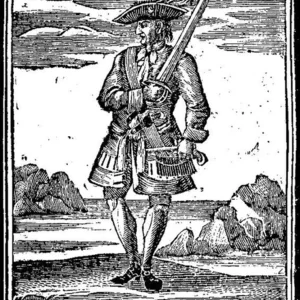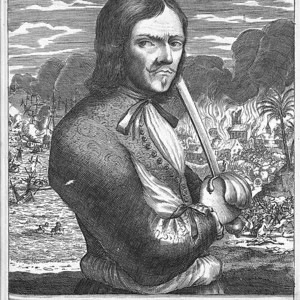

French buccaneer of the 17th century, born in Les Sables-d'Olonne, who terrorized Spain's possessions in the Caribbean. A leader of the Brethren of the Coast, he remained infamous for the extreme cruelty he inflicted on his prisoners during his raids.
François l'Olonnais(1630 — 1667)
François l'Olonnais
France
7 min read
Frequently asked questions
Key Facts
- Born around 1630 in Les Sables-d'Olonne (the source of his nickname), he came to the West Indies as an indentured servant and then became a buccaneer
- Around 1666-1667, he plundered and ransomed the Spanish towns of Maracaibo and Gibraltar on Lake Maracaibo (in present-day Venezuela)
- Famed for his legendary cruelty toward his captives (torture, mutilation), as recorded in the accounts of the time
- Died around 1669 in the Darién region (Isthmus of Panama), killed by indigenous peoples after a shipwreck
- His story was immortalized by Alexandre Exquemelin in 'The Buccaneers of America' (1678)
Works & Achievements
Seizure of a rich Spanish vessel that established his reputation and allowed him to outfit his own expeditions.
Gathering of several ships and six to seven hundred buccaneers, one of the largest privateering expeditions of the era.
Capture of one of the main Spanish strongholds in Venezuela, which remained l'Olonnais's most famous exploit.
Plunder and ransom of this town on Lake Maracaibo, confirming his dominance over the region.
His last great land campaign, marked by hard fighting against Spanish troops before his fortunes declined.
Anecdotes
François l'Olonnais was not really his name: he was actually born Jean-David Nau. The nickname "l'Olonnais" comes from his hometown, Les Sables-d'Olonne. Like many poor men of his time, he crossed the Atlantic around 1650 as an "indentured servant" — that is, a worker bound by a thirty-six-month contract — before becoming a buccaneer once he was free.
In 1666, l'Olonnais assembled a fleet of several hundred men and seized the wealthy city of Maracaibo, then Gibraltar on the great lake nearby (in present-day Venezuela). He held the inhabitants for ransom and sailed off laden with an enormous haul, which made him one of the most feared leaders of the Brethren of the Coast.
According to the surgeon Exquemelin, who lived among the buccaneers, l'Olonnais was so cruel to his Spanish prisoners that his reputation alone was enough to terrorize entire towns. It is said that he tortured his captives to make them confess where the gold was hidden, for instance by tightening a cord around their heads. These accounts, written to impress readers, made him the very symbol of the savagery of piracy.
Before becoming a captain, l'Olonnais is said to have narrowly survived a shipwreck near Campeche, in Spanish Mexico. According to Exquemelin, to escape the soldiers who were finishing off the survivors, he supposedly smeared himself with blood and hid among the corpses until nightfall, then fled in disguise.
The end of l'Olonnais reads like a moral lesson. Around 1668, his ship was wrecked on the wild coasts of the Darién (between present-day Panama and Colombia). The region's indigenous peoples captured him and put him to death. Exquemelin writes that "no trace" remained of this dreaded man, as though justice had finally been done for his victims.
Primary Sources
He drew his cutlass, opened the breast of one of these poor Spaniards and, tearing out his heart, began to bite and gnaw at it like a ravenous wolf, saying to the others: “I will treat you all the same way if you do not show me another road.”
He was accustomed to torment his prisoners: when he could not get them to confess where the money was, he would tie a cord around their heads and twist it until their eyes started out of their heads.
The natives of the Darién tore him to pieces, throwing his limbs into the fire and his ashes to the wind, so that no trace nor memory might remain of so loathsome a creature.
Monsieur d'Ogeron, governor of Tortuga, gave him a ship so that he might harry the Spaniards, and l'Olonnais put to sea with a crew of men of his own kind.
Key Places
Fishing port in Poitou (present-day Vendée) where l'Olonnais was born and which gave him his nickname.
A small island off the north coast of Hispaniola (present-day Haiti), a major haunt of the Brethren of the Coast and the launching base for l'Olonnais's expeditions.
A Spanish town on the coast of present-day Venezuela, captured and plundered by l'Olonnais in 1666.
A town at the far end of Lake Maracaibo, sacked and held for ransom by l'Olonnais in 1667.
A coastal region between present-day Panama and Colombia where l'Olonnais was shipwrecked and met his death around 1668.
Liens externes & ressources
Références
Œuvres
Prise d'un navire espagnol au large de Cuba
v. 1665
Constitution d'une flotte de course
1666
Sac de Maracaibo
1666
Sac de Gibraltar
1667
Expédition de San Pedro (Honduras)
1667