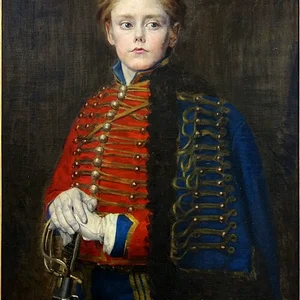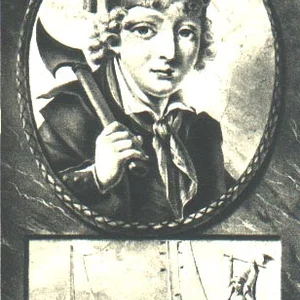

Revolutionary child-soldier born in Avignon in 1780, killed at age 13 on July 23, 1793, while attempting to cut the moorings of Federalist boats on the Durance river. Proclaimed a martyr of the Republic by the National Convention, his name was included among the heroes decreed for pantheonization, though the transfer never took place.
Joseph Agricol Viala(1778 — 1793)
Joseph Agricol Viala
France
9 min read
Frequently asked questions
Key Facts
- Born on August 26, 1780, in Avignon, into a family of small craftsmen
- Enlisted at age 13 in a battalion of Republican volunteers (1793)
- Killed on July 23, 1793, while attempting to cut the moorings of counter-revolutionary Federalist boats on the Durance river
- The National Convention decreed his transfer to the Panthéon in 1794, a decision that was never carried out
- His name is engraved on the Arc de Triomphe among the soldiers of the Revolution
Works & Achievements
A heroic gesture consisting of attempting to cut the moorings of Federalist boats under enemy fire. This act, elevated to the highest achievement by the Convention, alone established the status of martyr of the Republic that history accorded him.
Several songs and poems were composed by the poets of Year II to celebrate Viala at civic festivals and in schools, spreading his heroic image throughout every commune in France and passing on the example of self-sacrifice to younger generations.
An official legislative text declaring Viala and Barra worthy of the honors of the Panthéon — a major political act that constituted the primary institutional consecration of Viala's memory.
David, the Revolution's official painter, was commissioned to immortalize Viala in a large allegorical composition. The project was left unfinished due to the fall of Robespierre on 9 thermidor Year II, which brought the republican iconographic program to an end.
Representations of Viala were made and displayed at revolutionary festivals organized by popular societies throughout the South of France, contributing to the construction of a genuine republican cult of heroic youth.
Anecdotes
On July 23, 1793, the Federalist forces from Vaucluse attempted to ferry their boats across the Durance to join the insurgents of Marseille. Joseph Agricol Viala, just 13 years old, plunged into the river under enemy fire to cut the moorings of the vessels. Struck by a bullet, he died on the bank, instantly becoming the symbol of youth sacrificed for the Republic.
Viala's death was swiftly brought before the National Convention by Bertrand Barère, on behalf of the Committee of Public Safety. Within weeks, the young man from Avignon became as famous as Joseph Barra, the other child-martyr of the Revolution who died in the Vendée; both boys were celebrated together at civic festivals and in republican schools.
The painter Jacques-Louis David, official painter of the Revolution and member of the Convention, was commissioned to immortalize Viala in a grand canvas intended to extol republican virtues. The project was never completed: the fall of Robespierre on 9 Thermidor Year II put an end to the official cult of young martyrs, and David himself was imprisoned just a few days later.
By decree of the Convention of 3 Messidor Year II (June 21, 1794), Viala was declared worthy of the honors of the Panthéon alongside Barra. Robespierre was to deliver the pantheonization speech on 10 Thermidor — he was arrested the day before. Neither child was ever interred in the Panthéon, as their cult was abruptly cut short by the Thermidorian Reaction.
Under the Third Republic, Jules Ferry revived the cult of revolutionary child heroes to instill in younger generations a love of the fatherland. Streets, schools, and monuments were dedicated to Viala throughout the south of France. School textbooks made him one of the canonical examples of sacrifice for the homeland, alongside the young drummer Bara, aimed at primary school pupils.
Primary Sources
Young Viala, thirteen years of age, wished to defend the Republic against the Federalist traitors. He ran to the banks of the Durance, cut the cables of the enemy boats under a hail of bullets, and died carrying out this heroic act for the fatherland.
The National Convention, having heard the report of its Committee of Public Safety, decrees that the young Barra and Viala, who died in defense of the Republic, have earned the honors of the French Pantheon, and that a national celebration shall be organized in their memory.
Citizen Barère presented a moving account of the heroic death of young Viala, a thirteen-year-old child who fell while attempting to cut the cables of the boats armed by the Federalists on the Durance. The Assembly voted by acclamation to honor his memory.
Barra and Viala died for the fatherland. Barra chose death before surrendering to the enemy; Viala perished while trying to cut the cables of the enemy boats. These sublime children understood the Republic even before their years had given them the right to do so.
Key Places
Viala's birthplace, a former papal enclave annexed by France in 1791 following a controversial vote. He grew up amid fierce tensions between republicans and royalists, particularly during the Glacière massacres of 1791.
The river where Viala met his death on July 23, 1793, while attempting to cut the moorings of Federalist boats. This site of sacrifice became a Revolutionary memorial, invoked in speeches and patriotic songs of Year II.
The secular republican temple where the Convention decreed that Viala would be interred alongside the great men of the nation. The pantheonization ceremony, scheduled for 10 Thermidor Year II, never took place due to the arrest of Robespierre the day before.
The sovereign assembly where Barère delivered his report on Viala's death, transforming a local incident into a national symbol. The Convention there decreed funeral honors and the pantheonization of the young martyr.
Typical Objects

A cutting tool that Viala reportedly used to sever the moorings of Federalist boats on the Durance river. This humble object, transformed into a heroic instrument, symbolizes the founding act of his status as a martyr of the Republic.

A blue-white-red patriotic badge worn by committed republicans since 1789, pinned to the hat or lapel. Wearing the cockade signified allegiance to the Revolution and the Republic, and refusing to wear one could cost a person their life.

A red woolen cap worn by the sans-culottes and republican volunteers as a symbol of liberty, borrowed from Antiquity. It became the emblem of the French Republic, depicted on busts of Marianne.

The standard flintlock rifle issued to the armies of the Republic and distributed to national volunteers for the defense of the territory. The central weapon of the Revolutionary Wars, its handling was taught in battalions of young National Guardsmen.

A percussion instrument used to coordinate troop movements and summon the population to civic gatherings. Young drummers between the ages of 10 and 16 were a common sight in the Revolutionary armies.

An official document proclaiming the honors rendered to Viala and Barra, posted in every commune across France. These printed texts served to spread republican propaganda and build the civic cult of the martyrs.
School Curriculum
Vocabulary & Tags
Key Vocabulary
Daily Life
Morning
Son of a modest family from Avignon, Joseph Viala gets up early like all children of common background during the Revolution. Boys in his situation help with household chores and crafts before school, in a city torn by political tensions between republicans and counter-revolutionaries since its annexation to France in 1791.
Afternoon
In the afternoon, the children of Avignon in 1793 live in a city in turmoil: clashes between factions, the passage of militias and volunteers, news from the armies shouted in the squares. Viala, like the young people of his background, can take part in drills of the local National Guard or attend sessions of the popular societies open to citizens of all ages.
Evening
In the evening, the family gathers around a frugal meal. Political discussions are everywhere: the Revolution enters every home through newspapers, town criers, and decrees posted on walls. Children are immersed in an atmosphere blending patriotic exaltation, fears of civil war, and dread of reprisals.
Food
The diet of the Avignon working classes relies on bread, often rationed in wartime, garden vegetables, olive oil, legumes, and salted pork, which is more rarely accessible. Poor harvests combined with military requisitions make food shortages frequent and queues at bakeries common in 1793.
Clothing
Viala wears the simple clothes of children from the southern common people: a coarse white linen shirt, long sans-culotte trousers or short breeches, a rough wool jacket, clogs or bare feet in summer. The tricolor cockade is pinned to his hat to show his republican allegiance, an essential badge of unity in a divided city.
Housing
The Viala family lives in a working-class house in Avignon, a dense city with narrow streets in the former papal enclave. Workers' and artisans' homes are cramped, with several people sharing a few dark rooms, sparse furniture—a common bed, a table, a chest—and a courtyard shared with neighbors.
Historical Timeline
Period Vocabulary
Liens externes & ressources
Références
Œuvres
Acte de sabotage sur la Durance
23 juillet 1793
Hymnes et poèmes révolutionnaires à la gloire de Viala
1793-1794
Décret d'honneur de la Convention nationale
3 messidor an II (21 juin 1794)
Projet de tableau par Jacques-Louis David
1794 (non achevé)
Bustes et effigies dans les fêtes civiques
1793-1794