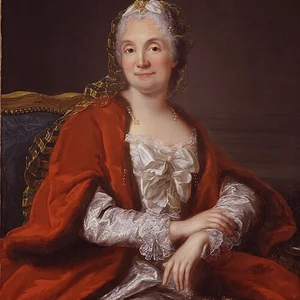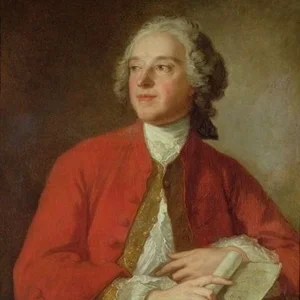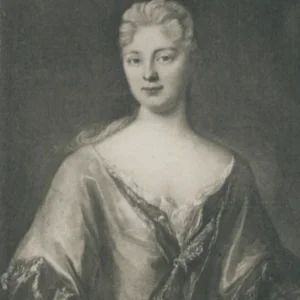

A Savoyard baroness, Françoise-Louise de Warens (1699-1762) is famous for taking in and protecting the young Jean-Jacques Rousseau. She gave him a home at Les Charmettes, near Chambéry, and played a decisive role in his intellectual and emotional education.
Françoise-Louise de Warens(1699 — 1762)
Françoise-Louise de Warens
Suisse
5 min read
Frequently asked questions
Key Facts
- Born in 1699 in Vevey, in the Vaud region of Switzerland.
- Converted to Catholicism around 1726 and settled in Annecy, in Savoy.
- Met Jean-Jacques Rousseau in Annecy in 1728 and became his protectress.
- Gave Rousseau a home at Les Charmettes, near Chambéry, during the 1730s.
- Died in 1762 in Chambéry, in poverty.
Works & Achievements
By taking in the penniless adolescent, she gave him a home and a protection that changed the course of his life.
She encouraged his reading, his practice of music, and his study of the sciences, playing a decisive role in his intellectual awakening.
The way of life she created became the model of natural, rural happiness that Rousseau celebrated in his work.
She threw herself into many projects (trade, mines, remedies, soap-making), showing an entrepreneurial spirit rare for a woman of her time.
A central figure in the early books of the *Confessions*, she became a notable figure in French autobiographical literature.
Anecdotes
In 1726, Madame de Warens took in a 16-year-old adolescent at Annecy, Jean-Jacques Rousseau, sent to her by a priest. She would affectionately nickname him “Little One” and all his life he would call her “Maman,” even after they became lovers.
Having converted to Catholicism at the age of 27, she received a pension from the King of Sardinia for her role in the conversion of other Protestants. It was in this capacity that she directed the young Rousseau to the hospice for catechumens in Turin.
At Les Charmettes, near Chambéry, she led an idyllic country life with Rousseau that he would describe as the purest happiness of his existence in his *Confessions*. There he collected plants, read, played music, and studied under her influence.
Passionate about schemes and experiments, Madame de Warens constantly ruined herself in risky ventures: businesses, mines, the manufacture of soaps or remedies. Her taste for alchemy and improbable undertakings ended up squandering her fortune.
Neglected and impoverished, she died in poverty at Chambéry in 1762, the very year Rousseau published *Émile* and *The Social Contract*. He saw her only rarely after their separation, but kept a tender gratitude toward her.
Primary Sources
I saw a woman full of grace... What did I feel at that sight! I thought I beheld the loveliest face, the most beautiful blue eyes, the most dazzling complexion.
Here begins the brief happiness of my life; here come the peaceful but fleeting moments that have given me the right to say that I have truly lived.
Today, Palm Sunday, marks precisely fifty years since I first met Madame de Warens.
Key Places
Town on the shore of Lake Geneva, in the Vaud region, where Françoise-Louise was born into a Protestant family.
It was in her house in Annecy that Madame de Warens first welcomed the young Rousseau in 1728.
Country house south of Chambéry where she lived with Rousseau during the happy years immortalized in the *Confessions*.
Capital of the Duchy of Savoy where she settled, ran her affairs, and died in poverty in 1762.
Capital of the Kingdom of Sardinia, toward which she directed Rousseau for his conversion at the hospice for catechumens.
Typical Objects
A collection of dried, classified plants, the product of long botanical walks at Les Charmettes. Botany was a passion she shared with Rousseau.
A distillation apparatus used for her experiments in chemistry and the making of remedies. Madame de Warens was passionate about the practical sciences and secret recipes.
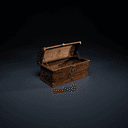
A keyboard instrument on which music was made at Les Charmettes. Rousseau, a musician and music copyist, shared with her this love of singing and music.
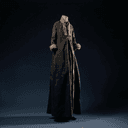
An aristocratic woman's garment of the 18th century, with a boned bodice and wide pleats down the back. The attire of a Savoyard baroness of good society.
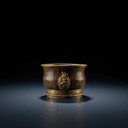
An annuity paid by the King of Sardinia as a reward for her conversion and her role with the catechumens. A fragile source of income, quickly swallowed up by her schemes.

A Catholic religious work tied to her conversion and to the spiritual education she gave Rousseau. Faith held an ambivalent place in her life.
School Curriculum
Vocabulary & Tags
Key Vocabulary
Daily Life
Morning
An early riser, Madame de Warens devotes her mornings to managing her household and her affairs, receiving suppliers and business associates. At Les Charmettes, she enjoys the garden and walks through the Savoyard countryside.
Afternoon
Her afternoons are divided between correspondence, her business ventures, and her experiments in chemistry and pharmacy. She gladly gathers plants and oversees the education of her young protégé.
Evening
Evenings bring the household together around music, singing, and reading. They discuss religion, philosophy, and the sciences by candlelight.
Food
Her table reflects 18th-century Savoyard cooking: bread, soups, garden vegetables, fruit, mountain cheeses, and a little meat. At Les Charmettes, the fresh produce of the countryside is gladly enjoyed.
Clothing
A baroness of good society, she wears French-style gowns with a boned bodice, petticoats, and carefully arranged headdresses. Her appearance remains elegant despite her growing financial difficulties.
Housing
She lives in middle-class houses in Annecy and then Chambéry, and above all in the modest but charming residence of Les Charmettes, surrounded by vineyards and gardens on the hillsides.
Historical Timeline
Period Vocabulary
Liens externes & ressources
Références
Œuvres
Accueil et protection de Jean-Jacques Rousseau
à partir de 1728
Formation intellectuelle de Rousseau
1731-1740
Vie aux Charmettes
vers 1735-1740
Entreprises économiques en Savoie
années 1730-1750
Inspiration littéraire des Confessions
publié en 1782