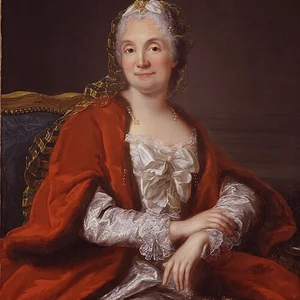

A Parisian salon hostess of the 18th century, she presided over one of the most influential salons of the Enlightenment, welcoming d'Alembert, Diderot, Fontenelle, and Montesquieu. A generous patron of the arts and a remarkable letter-writer, she played a central role in spreading Enlightenment ideas across Europe.
Madame Geoffrin(1699 — 1777)
Marie-Thérèse Rodet Geoffrin
France
7 min read
Frequently asked questions
Key Facts
- 1699: Born in Paris into a bourgeois family
- 1740s: Opening of her celebrated salon on the rue Saint-Honoré, which became a hub of the Enlightenment
- She financed and supported the publication of Diderot and d'Alembert's Encyclopédie
- 1766: Journey to Poland at the invitation of King Stanisław August Poniatowski, whom she had welcomed in her salon
- 1777: Death in Paris, leaving an extensive body of correspondence that bears witness to her European influence
Works & Achievements
More than two hundred letters exchanged with the future king of Poland, who called Madame Geoffrin 'maman'. This correspondence is an exceptional document on the relations between the French Enlightenment and the courts of Central Europe.
Madame Geoffrin contributed financially to the publication of the illustrations in Diderot and d'Alembert's *Encyclopédie*, thereby supporting the most ambitious intellectual undertaking of the Age of Enlightenment.
Her weekly salon — bringing together artists on Mondays and men of letters on Wednesdays — was for nearly thirty years the leading intellectual hub in Paris, shaping the spread of Enlightenment ideas across Europe.
Madame Geoffrin commissioned and purchased paintings from numerous artists, furthering their careers and demonstrating her commitment to the visual arts beyond literature and philosophy alone.
Madame Geoffrin maintained an epistolary relationship with Empress Catherine II, herself a great patron of the philosophers, illustrating the reach of her network among enlightened sovereigns across Europe.
Anecdotes
Madame Geoffrin had a legendary way of ending the interminable conversations of her salon: she would calmly but firmly utter the phrase 'Voilà qui est bien', signaling to her guests that the evening was drawing to a close. This unmistakable signal was so well known that the regulars awaited it with a kind of wary respect — no philosopher, however brilliant, dared oppose it.
A generous patron, Madame Geoffrin contributed financially to the publication of the engraved plates for Diderot and d'Alembert's Encyclopédie, one of the most ambitious intellectual undertakings of the century. In doing so, she took a real risk: the work was banned by the King's Council in 1759, and her public support for the philosophes earned her criticism from conservative circles.
In 1766, at the age of 67, Madame Geoffrin undertook an extraordinary journey to Warsaw to visit her protégé Stanisław August Poniatowski, whom she called 'my son' and who called her 'my mother.' This several-week journey by carriage across Europe caused a sensation: a Parisian bourgeoise received like a queen at the courts of Austria and Poland.
Madame Geoffrin organized her dinners according to a strictly fixed schedule: Mondays were reserved for painters and sculptors, Wednesdays for men of letters and philosophers. This arrangement allowed her to blend arts and ideas while preventing either group from monopolizing the other's discussions, making her salon a true crossroads of thought and creation.
Madame Geoffrin's daughter, Madame de la Ferté-Imbault, was deeply hostile to the philosophers her mother entertained. She went so far as to found a parody society, the Order of Perseverance, to mock the philosophical gatherings. The tension between mother and daughter illustrated the rifts that the Enlightenment was creating even within Parisian bourgeois families.
Primary Sources
I am your mother, my son, and I love you as such. Your happiness is as dear to me as if it were my own.
She had read little, studied little; but she had observed a great deal, retained a great deal, both about people and things, and she judged everything with a natural sagacity that more than compensated for formal learning.
Madame Geoffrin possessed a genuine kindness, an unassuming generosity, and a gift for hospitality that put everyone at ease. People came to her home not to shine, but to think freely.
Madame Geoffrin has the gift of pleasing and of bringing out the best in others; her salon is the gathering place of all the distinguished minds Paris has to offer.
Key Places
It was in this Parisian townhouse that Madame Geoffrin held her celebrated salon from 1749 to 1777, welcoming the greatest minds of the Enlightenment at her Monday and Wednesday dinners.
Born in Paris in 1699 into a bourgeois family, Marie-Thérèse Rodet spent her entire life there, embodying the model of the Parisian salonnière at the heart of the Age of Enlightenment.
Madame Geoffrin was received with great ceremony by King Stanisław August Poniatowski at the Royal Castle of Warsaw during her 1766 journey, an event that made her an international celebrity.
On her way to Warsaw in 1766, Madame Geoffrin stopped in Vienna where she was received by Empress Maria Theresa — a testament to the European reputation of her salon.
Liens externes & ressources
Références
Œuvres
Correspondance avec Stanisław August Poniatowski
1750-1777
Financement des planches de l'Encyclopédie
1751-1772
Salon littéraire et artistique de la rue Saint-Honoré
1749-1777
Mécénat artistique (commandes à Boucher, Vien et autres peintres)
1750-1777
Correspondance avec Catherine II de Russie
1764-1777
See also
Related Characters
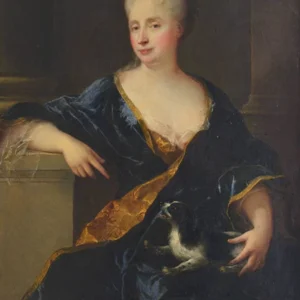
Anne Thérèse de Marguenat de Courcelles, marquise de Lambert
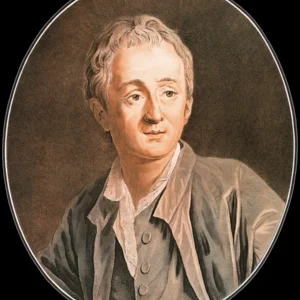
Denis Diderot
1713 — 1784
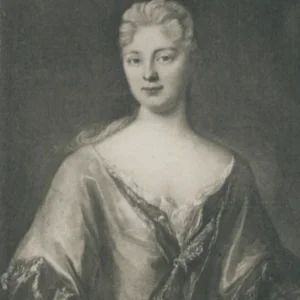
Françoise-Louise de Warens
1699 — 1762
Jean-Jacques Rousseau
1712 — 1778
Madame de Staël
1766 — 1817
Montesquieu
1689 — 1755