
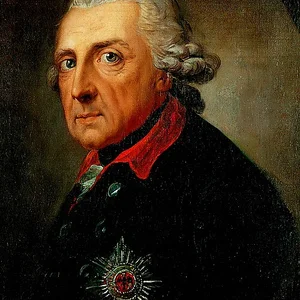
King of Prussia from 1740 to 1786, Frederick II was both a formidable war leader and a reforming sovereign. A figure of enlightened despotism, he corresponded with Voltaire and made Prussia a major European power.
Frederick the Great
Frederick II of Hohenzollern, known as Frederick the Great
6 min read
Frequently asked questions
Famous Quotes
« I am the first servant of the State.»
Key Facts
- Ascends to the throne of Prussia in 1740
- Triggers the War of the Austrian Succession and conquers Silesia (1740-1742)
- Leads Prussia during the Seven Years' War (1756-1763)
- Takes part in the First Partition of Poland in 1772
- Has the Sanssouci Palace built at Potsdam (1745-1747) and dies in 1786
Works & Achievements
A political essay refuting Machiavelli's *The Prince* and defending a moral conception of power, published with the help of **Voltaire**.
The lasting annexation of the wealthy province, which turned **Prussia** into a great European power.
A masterpiece of German rococo designed under the king's direction, which became the symbol of enlightened despotism.
Abolition of judicial torture, religious tolerance, support for agriculture, and the codification of Prussian law.
Historical memoirs in which **Frederick** recounts and justifies his wars and his policies.
Discipline, maneuvers, and the tactic of the oblique order that made the Prussian army a military model in Europe.
Sonatas and concertos composed by the king himself, testaments to his musical refinement.
Systematic encouragement to grow the potato in order to prevent famines throughout the kingdom.
Anecdotes
As a teenager, Frederick struggled to bear the military discipline imposed by his father, the “Soldier King” Frederick William I. In 1730, he tried to flee to England with his friend Hans Hermann von Katte. The plot failed: the king had Katte beheaded beneath the windows of the prison where Frederick was held, forcing him to witness the execution.
Frederick was a passionate music lover and an accomplished flautist. He composed around a hundred sonatas and several concertos for flute himself, and gave concerts almost every evening at his palace of Sanssouci in Potsdam.
For years the king kept up a correspondence with Voltaire, whom he invited to his court from 1750 to 1753. Their intellectual friendship ended in a spectacular falling-out, but they continued to write to each other from afar for decades.
Nicknamed “der alte Fritz” (Old Fritz) by his soldiers, Frederick shared the life of his troops on campaign, sleeping in a tent and eating the same food. His presence on the battlefield, notably at Leuthen in 1757, became legendary.
A great lover of dogs, Frederick owned many Italian greyhounds whose company he often preferred to that of humans. He asked to be buried beside them on the terrace of Sanssouci, a wish that was only granted in 1991, more than two centuries after his death.
Primary Sources
Today I venture to defend humanity against this monster who seeks to destroy it; I dare to set reason and justice against sophistry and crime.
A prince is the first servant and the first magistrate of the State.
I beg you to come and grace my court; you will be most welcome, and I shall have the pleasure of conversing with the greatest genius of our age.
Ambition, self-interest, the desire to have people speak of me prevailed, and war was resolved upon.
Key Places
Capital of the Kingdom of Prussia, where Frederick was born in 1712 and the seat of royal power.
Rococo summer residence built by Frederick, the setting for his concerts, his reading, and his philosophical conversations. He died there in 1786.
Fortress where the young Frederick was imprisoned in 1730 after his attempt to flee, and where his friend Katte was executed.
Village in Silesia where Frederick won one of his most brilliant victories against the Austrian army in 1757.
A wealthy province conquered from Austria in 1740-1742, the central stake of Frederick's wars and the key to Prussian power.
Castle where Frederick, as crown prince, spent happy years of reading, music, and correspondence before his accession to the throne.
Typical Objects

Frederick's favorite instrument, which he played every evening and for which he composed. It symbolizes his image as a music-loving, cultivated king.

The officer's weapon and a symbol of military command. Frederick led his armies in person on the battlefield.

The blue military coat, which Frederick wore almost constantly, became the emblem of the iron discipline of the Prussian army.

Frederick owned a vast collection of precious snuffboxes, often adorned with diamonds, which he always kept on his person.

Frederick wrote letters, essays, and poems in French, corresponding notably with Voltaire and the philosophers of the Enlightenment.

In his final years, the old king worn out by his campaigns leaned on a cane, which became a defining feature of “Old Fritz.”
School Curriculum
Vocabulary & Tags
Key Vocabulary
Daily Life
Morning
Frederick rose very early, often before dawn, around four or five in the morning. He read his dispatches, dictated orders to his secretaries and governed his kingdom with methodical rigor, handling the affairs of state himself.
Afternoon
The afternoon was devoted to military matters, troop inspections and audiences. On campaign, he spent hours on horseback among his soldiers, studying maps and preparing his maneuvers.
Evening
In the evening, at Sanssouci, Frederick gathered a select circle of scholars and philosophers for witty dinners held in French. He would then give a concert at which he himself played the flute.
Food
The king enjoyed very spicy, highly seasoned cooking that blended French and Italian influences. He liked rich dishes and the fruit from his greenhouses, and he drank coffee that he sometimes brewed with champagne, heedless of his health.
Clothing
Frederick almost always wore a plain blue military uniform, often worn and stained with tobacco, scorning the sartorial splendor of other courts. A cane and a tricorne completed his familiar silhouette.
Housing
He lived mainly at Sanssouci, a single-story rococo palace surrounded by terraced gardens and vineyards in Potsdam. There he lived in refined yet relatively modest surroundings for a king, preferring the countryside to the palace in Berlin.
Historical Timeline
Period Vocabulary
Liens externes & ressources
Références
Œuvres
Anti-Machiavel
1740
Conquête et organisation de la Silésie
1740-1763
Palais de Sans-Souci
1745-1747
Réformes du despotisme éclairé
1740-1786
Histoire de mon temps
1746
Réorganisation de l'armée prussienne
1740-1786
See also
Related Characters
Frederick II the Great
1712 — 1786
Philippe II d'Orléans
Anne Thérèse de Marguenat de Courcelles, marquise de Lambert
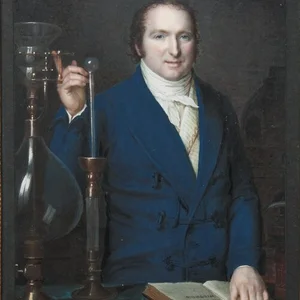
Antoine François de Fourcroy
1755 — 1809
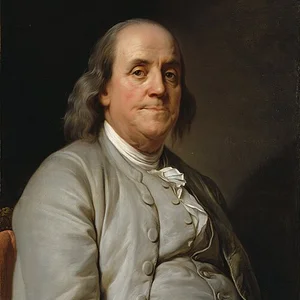
Benjamin Franklin
1706 — 1790
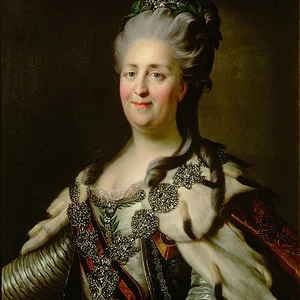
Catherine II of Russia
1729 — 1796