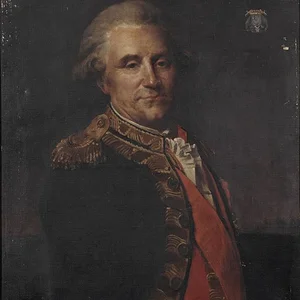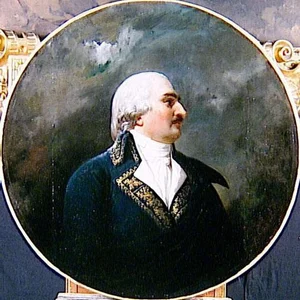

A French general of the First Empire, Gabriel Louis de Caulaincourt distinguished himself during the Napoleonic Wars. He died heroically at the Battle of the Moskva in September 1812, during the Russian campaign.
Gabriel Louis de Caulaincourt(1749 — 1808)
Gabriel Louis de Caulaincourt
France
7 min read
Frequently asked questions
Key Facts
- Divisional general under the Napoleonic First Empire
- Appointed senator by Napoleon I
- Killed at the Battle of the Moskva (Borodino) on 7 September 1812
- Elder brother of Armand de Caulaincourt, diplomat and Napoleon's Minister of Foreign Affairs
Works & Achievements
The military action for which Caulaincourt is best remembered: leading his cuirassiers, he stormed the central position of the Russian lines at the cost of his own life. This episode became one of the defining symbols of the sacrifice made by Napoleonic officers during the Russian campaign.
Caulaincourt took part in the great military campaigns of the Empire — Austerlitz, Jena, Eylau, Wagram — forging a reputation as a courageous and dependable cavalry officer, before reaching his culmination in the tragic Russian campaign.
Having lived through the Revolution without emigrating, Caulaincourt placed his military experience in the service of republican France and then the Consulate, building an uncommon career that earned him the trust of Napoleon Bonaparte.
Anecdotes
Gabriel Louis de Caulaincourt was the father of Armand de Caulaincourt, one of Napoleon's most loyal diplomats. While the son excelled in the salons of Europe in the service of imperial diplomacy, the father distinguished himself on the battlefield at the head of his cavalry, forming an exceptional family duo serving the Empire on two very different fronts.
On September 7, 1812, at the Battle of the Moskva (also known as Borodino), Caulaincourt was ordered to storm the Great Redoubt, a formidable fortified position held by several thousand soldiers and dozens of cannons. He charged at the head of his cuirassiers through a hail of fire and managed to breach the enemy palisades, but fell mortally wounded at the very moment his troops were seizing the position.
Napoleon, upon learning of Caulaincourt's death at the Battle of Borodino, is said to have declared that the victory had cost him one of his finest cavalry officers. That battle was one of the deadliest of the entire Napoleonic era: more than 70,000 soldiers on both sides fell in a single day, without any decisive strategic outcome.
Born into an old noble family from Picardy, Gabriel Louis de Caulaincourt had begun his military career under the *Ancien Régime*, before living through the Revolution and rallying to Napoleon's cause. This trajectory — from monarchy to Empire by way of the Revolutionary Wars — illustrates the remarkable adaptability of certain nobles during an era of extreme upheaval.
Primary Sources
My father was the first to charge the redoubt, leading his squadrons in an admirable surge. He did not survive the victory he had just won at the cost of his life.
Caulaincourt fell while crossing the Russian entrenchments, at the head of his cuirassiers. His death was a cause of mourning for the entire army, which saw in him one of those officers whose courage inspires soldiers to the point of self-sacrifice.
General Caulaincourt distinguished himself through exemplary bravery during the assault on the great redoubt. His death is a painful loss for the imperial army.
The death of General Caulaincourt deprives the army of one of its most valiant cavalry officers. See to it that his memory is honored as he deserves.
Key Places
A village in Picardy from which the Caulaincourt family takes its name and titles. The ancestral seat of the lineage, it embodies the provincial roots of this old noble family in the service of France.
On 7 September 1812, on the plains near the village of Borodino, 120 km west of Moscow, Gabriel Louis de Caulaincourt led a heroic charge of his cuirassiers against the Great Redoubt and was killed in action. The site is now a memorial museum.
Napoleon's imperial residence and the military command center of the Empire. It was here that major strategic decisions were made and that generals such as Caulaincourt received their campaign orders.
The ultimate objective of the 1812 campaign, Moscow was reached by the Grande Armée just days after the battle in which Caulaincourt perished. The city was set ablaze, and the military victory failed to compel the Tsar to negotiate, sealing the campaign's fate.
Typical Objects

The primary weapon of Napoleonic cuirassiers and cavalry generals, this slightly curved-bladed sabre was highly effective for striking while charging on horseback. It symbolized an officer's rank and was often richly engraved for generals.

A metal breastplate covering the torso, worn by cuirassiers and their officers. It offered protection against sabre blows and long-range musket fire, but could not stop a point-blank shot.

A pair of pistols tucked into the holsters attached to the horse's saddle, serving as a last resort in close-quarters combat. Cavalry officers routinely carried them during charges, as a complement to their sabre.

An essential optical instrument for a general observing enemy positions from his command post. During the Russian campaign, it allowed commanders to assess the formidable Russian defenses before ordering a charge.

The distinctive hat of senior Empire officers, worn facing forward or crosswise depending on rank and occasion. Decorated with feathers and the tricolor cockade, it allowed soldiers to instantly identify their general on the battlefield.

An indispensable strategic planning tool for Napoleonic generals, used to anticipate troop movements and visualize terrain. During the Russian campaign, the available maps often proved inaccurate given the vastness of the territory.
School Curriculum
Vocabulary & Tags
Key Vocabulary
Daily Life
Morning
On campaign, General Caulaincourt rose before dawn, often at the sound of the bugle or drum. He received reports from his staff officers, studied terrain maps, and reviewed his cavalry to assess their readiness before any maneuver or engagement.
Afternoon
His afternoons were devoted to cavalry drills, command conferences with other generals, and rides between the various positions. In the field, he rode alongside his men, using his spyglass to evaluate enemy positions and coordinate the movements of his units.
Evening
In the evening, senior officers gathered around a shared meal, discussing strategy and issuing orders for the following day. Caulaincourt wrote his reports by candlelight before taking a few hours' rest, often in a tent or a requisitioned house.
Food
On campaign, Napoleonic officers frequently lived on sparse rations: hardtack biscuits, boiled or grilled meat, dried legumes, and brandy. The Russian campaign was particularly grueling in terms of supply, as the vast distances made provisioning extremely difficult from the height of summer 1812 onward.
Clothing
On duty, Caulaincourt wore the uniform of a divisional general: a blue coat with gold embroidery, epaulettes, leather breeches, and knee-boots. In the field during charges, he wore a cuirass over his coat and a grey cloak or greatcoat to protect himself from the harsh weather of the Russian plains.
Housing
In peacetime, Imperial generals were housed in private mansions in Paris or on their family estates. On campaign, Caulaincourt slept in officers' tents pitched at the bivouac, or requisitioned inns and bourgeois homes at stopping points along the march, in keeping with the customs of Napoleonic warfare.
Historical Timeline
Period Vocabulary
Liens externes & ressources
Références
Œuvres
Charge et prise de la Grande Redoute de Borodino
7 septembre 1812
Participation aux campagnes napoléoniennes (1799-1812)
1799-1812
Service militaire sous la Révolution et le Consulat
1789-1799