 flip
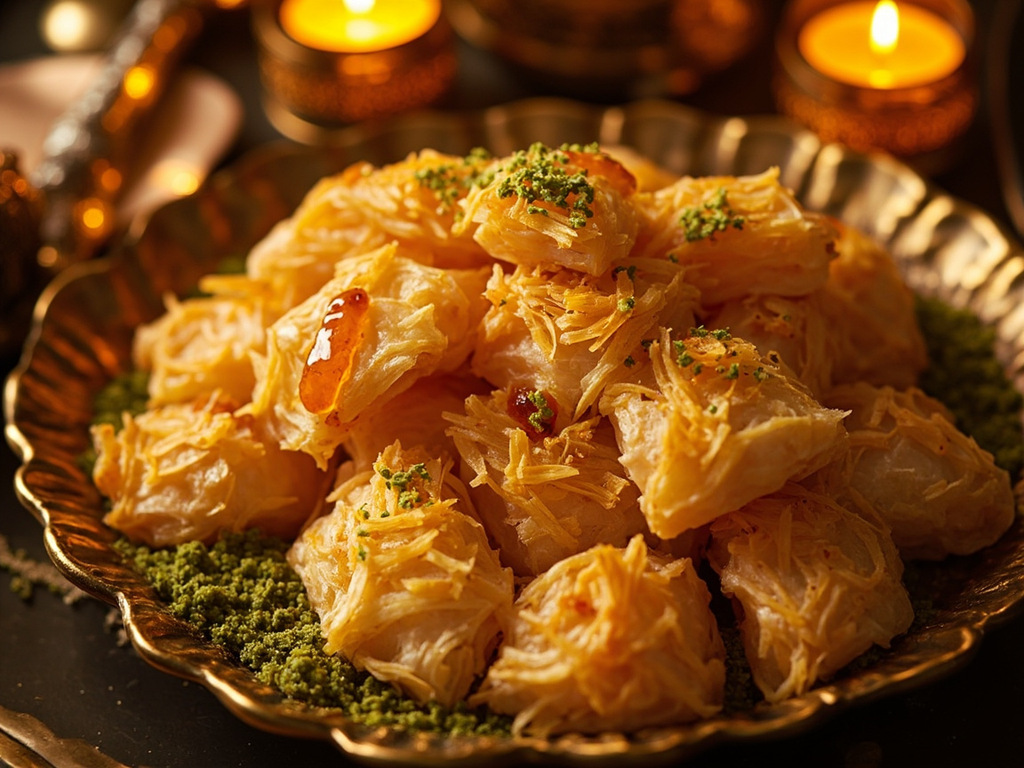
flipKonafa with Syrup, Forbidden Sweetness
Konafa with Syrup, Forbidden Sweetness
Why this dish? Nasser loved oriental pastries with honey and syrup; but the diabetes of his later years forced him to gradually give up these sweets. Konafa, queen of Egyptian festive desserts, embodies the pleasure he had to sacrifice — a man of power defeated by his own health.
Crisp strands of pastry, golden with butter, filled with nuts or cream, and drenched upon leaving the oven with a syrup perfumed with orange blossom. The dessert for grand occasions and Ramadan nights, all contrast of hot crispness and melting sugar.
Ah, konafa… Come closer, but don't tell my doctor. All my life I loved sweets, honey pastries on festive evenings, syrup that sticks to the fingers. And then the sugar in my blood caught up with me, and I had to give it up — I who never backed down from anything. Take a piece for me, my friend: let youth taste what illness took from me. One commands a people, but one does not command one's own body.
- •Angel-hair pastry (konafa) — one large round (base)
- •Clarified butter (samna) — generously (browning)
- •Walnuts or ground almonds — a good handful (filling)
- •Sugar and water — for the syrup (syrup)
- •Orange blossom water — a few drops (flavoring)
Konafa with Syrup, Forbidden Sweetness
Crisp strands of pastry, golden with butter, filled with nuts or cream, and drenched upon leaving the oven with a syrup perfumed with orange blossom. The dessert for grand occasions and Ramadan nights, all contrast of hot crispness and melting sugar.
Why this dish? Nasser loved oriental pastries with honey and syrup; but the diabetes of his later years forced him to gradually give up these sweets. Konafa, queen of Egyptian festive desserts, embodies the pleasure he had to sacrifice — a man of power defeated by his own health.
Ah, konafa… Come closer, but don't tell my doctor. All my life I loved sweets, honey pastries on festive evenings, syrup that sticks to the fingers. And then the sugar in my blood caught up with me, and I had to give it up — I who never backed down from anything. Take a piece for me, my friend: let youth taste what illness took from me. One commands a people, but one does not command one's own body.
Ingredients (period version)
- Angel-hair pastry (konafa) — one large round (base)
- Clarified butter (samna) — generously (browning)
- Walnuts or ground almonds — a good handful (filling)
- Sugar and water — for the syrup (syrup)
- Orange blossom water — a few drops (flavoring)
Ingredients
- Kadaïf / konafa pastry — 400 g (base)
- Melted butter — 150 g (browning)
- Chopped walnuts or pistachios — 200 g (filling)
- Sugar — 300 g (syrup)
- Water — 200 ml (syrup)
- Lemon juice — 1 tsp (syrup balance)
- Orange blossom water — 1 tsp (flavoring)
Method
- Prepare the syrup: cook sugar, water, and lemon for 10 min, flavor with orange blossom water, let cool.
- Crumble the konafa pastry and thoroughly coat with melted butter.
- Press half into a dish, spread the nuts, cover with the remaining pastry, pressing down.
- Bake at 180°C for 30-40 min until deep golden and crisp.
- Upon removing from the oven, pour the cold syrup evenly over the hot pastry (hot on cold: the secret to crispness).
- Let rest 10 min, sprinkle with pistachios, cut into diamonds.
How it was made : Konafa was cooked on large copper trays in neighborhood ovens, especially during Ramadan when pastry makers worked at night. The spun dough was poured onto a hot rotating plate to form its characteristic threads, a skill passed from master to apprentice.
The contemporary twist : An individual version in a small mold, with a warm cream (qishta) center, pistachio crumbles — and for Nasser, a reduced-sugar syrup version that his diabetes might have tolerated.
Sources : Claudia Roden, A Book of Middle Eastern Food · Anissa Helou, Sweet Middle East
Gamal Abdel Nasser · Charactorium