 flip
flipChallah, the Braided Shabbat Bread
Challah, the Braided Shabbat Bread
Why this dish? Heschel wrote an entire book on Shabbat, which he called "a palace in time." On his table, as in every Jewish home, two challot covered with a cloth awaited the blessing: they recall the double portion of manna that fell on the eve of the holy day in the desert.
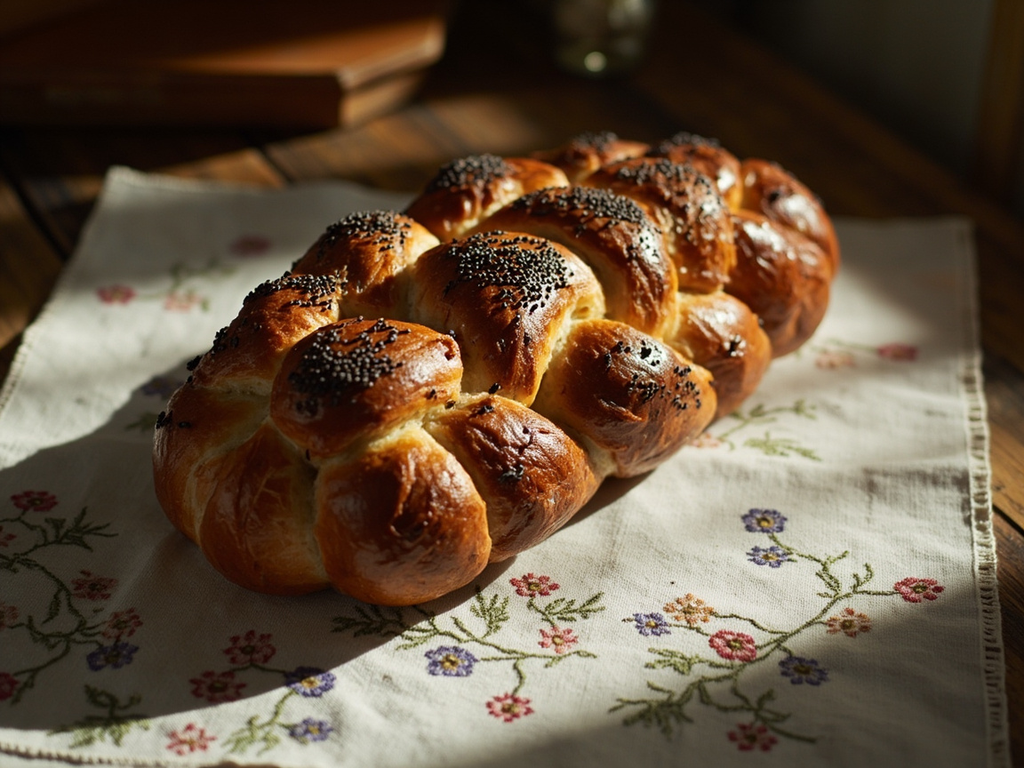
A slightly sweet brioche with a stringy crumb, egg-glazed and braided into several strands. Two are placed side by side, veiled with an embroidered cloth until the blessing over the bread.
You see, Shabbat is not a day you take; it's a day you welcome like a queen. My mother would cover the two loaves with a fine cloth, and she said it was so as not to make them blush: for the bread, that Friday, must wait until the wine is blessed before it. You knead, you braid, you let it rise in peace — and in that very waiting, time already becomes holy.
- •Sifted wheat flour — a large bowl (base of the dough)
- •Baker's yeast — a piece (leavening)
- •Eggs — a few (richness and glaze)
- •Honey — a spoonful (light sweetness)
- •Oil — a drizzle (softness)
- •Salt — a generous pinch (seasoning)
- •Poppy seeds — as desired (decoration)
Challah, the Braided Shabbat Bread
A slightly sweet brioche with a stringy crumb, egg-glazed and braided into several strands. Two are placed side by side, veiled with an embroidered cloth until the blessing over the bread.
Why this dish? Heschel wrote an entire book on Shabbat, which he called "a palace in time." On his table, as in every Jewish home, two challot covered with a cloth awaited the blessing: they recall the double portion of manna that fell on the eve of the holy day in the desert.
You see, Shabbat is not a day you take; it's a day you welcome like a queen. My mother would cover the two loaves with a fine cloth, and she said it was so as not to make them blush: for the bread, that Friday, must wait until the wine is blessed before it. You knead, you braid, you let it rise in peace — and in that very waiting, time already becomes holy.
Ingredients (period version)
- Sifted wheat flour — a large bowl (base of the dough)
- Baker's yeast — a piece (leavening)
- Eggs — a few (richness and glaze)
- Honey — a spoonful (light sweetness)
- Oil — a drizzle (softness)
- Salt — a generous pinch (seasoning)
- Poppy seeds — as desired (decoration)
Ingredients
- All-purpose flour (T55) — 500 g (base of the dough)
- Active dry yeast — 7 g (leavening)
- Eggs — 2 + 1 for glaze (richness and glaze)
- Honey — 2 tbsp (light sweetness)
- Neutral oil — 60 ml (softness)
- Warm water — 200 ml (hydration)
- Salt — 1.5 tsp (seasoning)
- Poppy seeds — 2 tbsp (decoration)
Method
- Dissolve the yeast in warm water with the honey, let foam for 10 minutes.
- Mix flour and salt, add the 2 eggs, oil, and the yeast mixture. Knead for 10 minutes until smooth and elastic.
- Cover with a cloth and let double in volume, about 1.5 hours in a warm place.
- Punch down, divide into 3 or 6 strands, roll into ropes, and braid; pinch ends well.
- Let rise again for 45 minutes. Brush with beaten egg, sprinkle with poppy seeds.
- Bake at 180°C for 25 to 30 minutes: the bread should sound hollow when tapped on the bottom.
How it was made : In the shtetl, the dough was kneaded on Thursday evening or Friday morning, and a small piece was removed and burned as an offering, the challah, which gave its name to the bread. The six-strand braid symbolized the twelve showbreads of the Temple when two loaves were placed on the table.
The contemporary twist : An "inverted babka" version: roll a strand filled with poppy seed paste or cinnamon for a marbled heart, without taking anything away from the simplicity of the blessing.
Sources : Claudia Roden, The Book of Jewish Food (1996) · Gil Marks, Encyclopedia of Jewish Food (2010)
Abraham Joshua Heschel · Charactorium