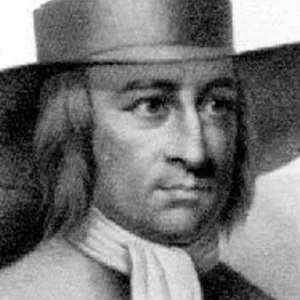

Seventeenth-century English preacher, founder of the Religious Society of Friends, commonly known as the Quakers. He advocated a direct and inward experience of God, without clergy or rituals, grounded in the “inner light” present in every human being.
George Fox(1624 — 1691)
George Fox
royaume d'Angleterre
6 min read
Frequently asked questions
Famous Quotes
« Be patterns, be examples in all countries, places, islands, and nations wherever you go.»
Key Facts
- Born in 1624 in Drayton-in-the-Clay (now Fenny Drayton), England
- Around 1647, has a decisive spiritual experience and begins preaching the “inner light”
- Founds the Quaker movement (Religious Society of Friends) from the 1650s onward
- Imprisoned several times for his religious convictions and his refusal to swear oaths
- Died in 1691 in London
Works & Achievements
Fox structured a religious movement founded on the “inner light,” without clergy or sacraments, which survives today on every continent.
A spiritual autobiography recounting his visions and struggles, which became a classic of English religious literature.
The founding text of Quaker pacifism, affirming the refusal of all war and all armed violence.
Fox set up a structure of regular meetings to manage the community, support the persecuted, and coordinate the movement.
Fox spread Quakerism throughout the colonies, contributing to its lasting establishment in Pennsylvania and beyond.
Fox wrote hundreds of letters and tracts spreading his doctrine of spiritual equality and simplicity.
Anecdotes
Around 1647, after years of wandering and spiritual doubt, George Fox said he heard an inner voice assuring him that "there is One, even Christ Jesus, that can speak to thy condition." This experience became the heart of his preaching: everyone can reach God directly, without priest or intermediary.
In 1650, brought before a judge in Derby, Fox told him to "tremble (to quake) at the word of the Lord." The magistrate Gervase Bennet then mockingly nicknamed him a "Quaker
a "trembler" — and that nickname stayed attached to the movement forever.
In 1652, from the summit of Pendle Hill in Lancashire, Fox claimed to have had a vision of "a great people to be gathered." He came down to preach in the region and converted hundreds of people there, laying the foundations of the Quaker movement.
Fox refused to remove his hat before nobles and judges and addressed everyone with the familiar "thee" and "thou
rich and poor alike. For him, all human beings were equal before God — an attitude deemed scandalous that earned him mockery, blows, and prison.
Because he refused to swear oaths
citing the Gospel (
swear not at all
)
Fox spent several years in prison in all
under very harsh conditions
notably at Lancaster and Scarborough
without ever abandoning his convictions.
Primary Sources
And when all my hopes in them and in all men were gone... I heard a voice which said, 'There is one, even Christ Jesus, that can speak to thy condition'.
Justice Bennet of Derby was the first that called us Quakers, because I bade them tremble at the word of the Lord.
All bloody principles and practices we do utterly deny, with all outward wars and strife and fightings with outward weapons, for any end or under any pretence whatsoever.
Walk cheerfully over the world, answering that of God in every one.
Key Places
George Fox's native village, where he grew up in a modest Puritan family and was first apprenticed to a shoemaker.
The hill where, in 1652, Fox had a vision of a “great people to be gathered,” the event that triggered the expansion of the Quaker movement.
The home of Margaret Fell, which became the administrative and spiritual centre of the early Quakers, nicknamed the “cradle of Quakerism.”
One of the many places where Fox was imprisoned in very harsh conditions for his refusal to swear oaths and for his preaching.
Fox was imprisoned here in a cell exposed to rain and wind, on the Yorkshire coast, around 1665–1666.
The city where Fox spent his final years, organised the movement, and died in 1691.
Typical Objects

Fox refused to remove it before the powerful, a gesture of defiance asserting the equality of all before God. The “hat honour” became a symbol of Quaker resistance.

Fox knew vast portions of the Scriptures by heart and drew on them constantly. For him, personal reading of the Bible took precedence over the authority of the clergy.

An autobiographical account dictated by Fox recounting his visions, his travels and his imprisonments. Published after his death, it became a founding text of the Quakers.

Fox and the early Quakers dressed in simple garments, without ornament or bright colour, to mark their rejection of luxury and vanity.

Fox walked thousands of kilometres on foot across England, Wales, Ireland and America. Sturdy walking shoes were the indispensable tool of the itinerant preacher.

The Quakers distributed printed tracts and epistles on a massive scale to spread their ideas despite persecution. The printing press was an essential weapon of the movement.
School Curriculum
Vocabulary & Tags
Key Vocabulary
Tags
Daily Life
Morning
Fox often began his day with a long period of silence and inner reflection, waiting for the “light” to inspire him. As an itinerant preacher, he would frequently set off at dawn to walk to the next village or gathering.
Afternoon
His afternoons were devoted to open-air preaching, in marketplaces, in fields, or by interrupting the services of the established Churches. He debated with ministers and gathered small groups of converts around him.
Evening
In the evening, Fox dictated or wrote letters and epistles to support the scattered communities. Often lodged with sympathizers, he carried on spiritual discussions late into the night.
Food
A believer in plain living, Fox ate simply: bread, cheese, soup, and weak beer — the ordinary fare of the English countryside. In prison, he had to make do with meager and sometimes unwholesome rations.
Clothing
He wore plain, sturdy leather clothing suited for walking, with no ornamentation. The Quakers cultivated a simple appearance, rejecting bright colors, lace, and any sign of wealth.
Housing
Having no fixed home during his itinerant years, Fox stayed with Friends, on farms, or in inns. He also spent long stretches in cold, damp prison cells; toward the end of his life, he lived mainly in London.
Historical Timeline
Period Vocabulary
Liens externes & ressources
Références
Œuvres
Fondation de la Société religieuse des Amis (Quakers)
à partir de 1652
The Journal of George Fox
publié en 1694
A Declaration from the Harmless and Innocent People of God, called Quakers
1660-1661
Organisation des « Meetings » mensuels et annuels
années 1660-1670
Voyages missionnaires en Amérique et aux Antilles
1671-1673
Épîtres et pamphlets
1650-1690