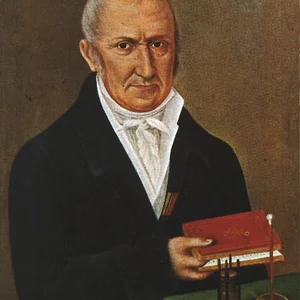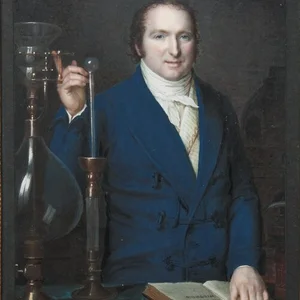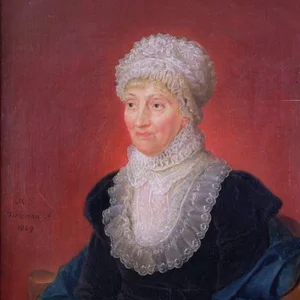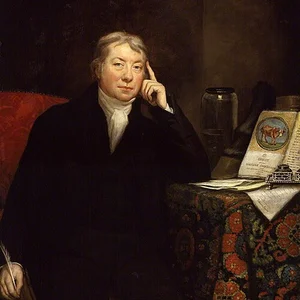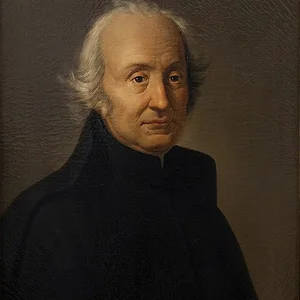

Giuseppe Piazzi was an Italian astronomer and mathematician, a priest of the Theatine order. He is famous for discovering Ceres in 1801, the first asteroid (now classified as a dwarf planet) in the belt located between Mars and Jupiter.
Giuseppe Piazzi(1746 — 1826)
Giuseppe Piazzi
6 min read
Frequently asked questions
Key Facts
- Born on 16 July 1746 in Ponte in Valtellina, died on 22 July 1826 in Naples
- Founded the Palermo Observatory in 1790 and became its director
- Discovered Ceres on 1 January 1801, the first identified object in the asteroid belt
- Published an important star catalogue (1803, expanded in 1814) listing more than 7,000 stars
- Measured the proper motion of the star 61 Cygni, contributing to precision astrometry
Works & Achievements
Piazzi creates and equips one of the most modern observatories in Europe, fitted with Ramsden's great circle.
The first discovery of an asteroid, opening up a whole new field of astronomy; Ceres is today classified as a dwarf planet.
A memoir in which Piazzi recounts and documents his discovery of the new celestial body.
A precise survey of several thousand stars, hailed as one of the finest catalogues of its time.
An expanded version raising the number of stars to more than 7,600, honoured by the Institut de France.
Piazzi reveals the very large proper motion of the star 61 Cygni, one of the closest to the Sun.
Anecdotes
In the very first night of the 19th century, on January 1, 1801, Piazzi pointed his telescope toward the constellation of Taurus and noticed a tiny point of light that appeared on no star chart. On the following nights, the object moved: he had just discovered Ceres, the first asteroid in history.
Piazzi named his discovery “Ceres Ferdinandea,” in honor of the Roman goddess of the harvest, protector of Sicily, and of King Ferdinand of Naples, his patron. The scholarly community ultimately kept only the name Ceres, deeming the tribute to the king too political.
A few weeks after his discovery, Piazzi fell ill and lost track of Ceres, which disappeared behind the Sun. The object seemed lost forever, until a young German mathematician, Carl Friedrich Gauss, invented a method of orbit calculation that made it possible to find it again exactly where he had predicted, at the end of 1801.
To build his vast star catalog, Piazzi observed and measured the position of more than 7,600 stars, painstaking work carried out night after night for years from the Palermo observatory, which he had founded himself.
By comparing his measurements with those of earlier astronomers, Piazzi noticed that the star 61 Cygni was moving abnormally fast compared to the others. It was nicknamed “Piazzi's Flying Star”; we now know it is one of the stars closest to Earth.
Primary Sources
La sera del primo gennaio di quest'anno [1801], cercando io le stelle dell'ottava classe del catalogo del Sig. la Caille, ne trovai una che precedeva la 87 del medesimo catalogo, ed era da quella diversa.
Mean positions of the principal fixed stars, determined from observations made at the Royal Observatory of Palermo, presented in order of right ascension.
I announced this star as a comet, but the fact that it is accompanied by no nebulosity and that its motion is so slow and rather uniform has made me think on several occasions that it might be something better than a comet.
Key Places
Village in the Lombard Alps where Giuseppe Piazzi was born in 1746.
Observatory founded by Piazzi in 1790 atop the Palace of the Normans; it was from here that he discovered Ceres on 1 January 1801.
City where Piazzi spent most of his career as an astronomer and university professor.
City where Piazzi oversaw the creation of a new observatory and where he died in 1826.
English capital where Piazzi traveled to have his precision instruments built, notably by the optician Jesse Ramsden.
Typical Objects

Large precision astronomical instrument built by the English optician Jesse Ramsden, the centerpiece of the Palermo observatory. It allowed the position of stars in the sky to be measured with unprecedented accuracy.

A lens-based instrument used to magnify the image of celestial objects. It was with such a telescope that Piazzi spotted the movement of Ceres among the fixed stars.

A highly regular astronomical clock used to precisely time the instant a star crosses the instrument's field of view. Measuring time was essential for calculating celestial coordinates.

Registers in which Piazzi recorded, night after night, the measured positions of thousands of stars. These tables formed the raw material of the famous Palermo catalogue.

The religious garment worn by Piazzi, who was ordained a priest of the Theatine congregation. It is a reminder that many astronomers of the time were men of the Church.

An instrument fixed in the north-south plane, used to time the passage of stars across the meridian. It was essential for compiling precise catalogues such as the one made in Palermo.
School Curriculum
Vocabulary & Tags
Key Vocabulary
Daily Life
Morning
A Theatine priest, Piazzi often began his day with prayer and religious services. The morning was then devoted to teaching at the University of Palermo and to correspondence with other European astronomers.
Afternoon
The afternoon was used for calculations: reducing the previous night's observations, checking star positions, and preparing the tables for his catalogue. It was long and painstaking mathematical work.
Evening
An astronomer's real day began at nightfall. Piazzi would climb up to the observatory, adjust the Ramsden circle, and note, hour after hour, the passage of the stars across the meridian, sometimes until dawn.
Food
His diet was the simple fare of a clergyman from southern Italy: bread, vegetables, olive oil, fish and Sicilian fruit, accompanied by local wine. Religious fast days called for leaner meals.
Clothing
Piazzi wore the black cassock of the Theatine priests. For the long nights of observation in winter, he wrapped himself in warm clothing, for the domes and terraces of observatories were freezing cold.
Housing
He lodged in buildings attached to the observatory, set atop the Palace of the Normans in Palermo, a vast edifice overlooking the city that enjoyed clear, open skies.
Historical Timeline
Period Vocabulary
Liens externes & ressources
Références
Œuvres
Fondation de l'Observatoire royal de Palerme
1790
Découverte de Cérès
1er janvier 1801
Della scoperta del nuovo pianeta Cerere Ferdinandea
1802
Catalogue d'étoiles de Palerme (1re édition)
1803
Catalogue d'étoiles de Palerme (2e édition)
1814
Identification de l'« étoile volante » 61 Cygni
1804