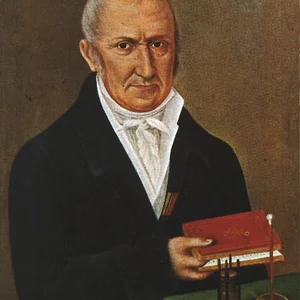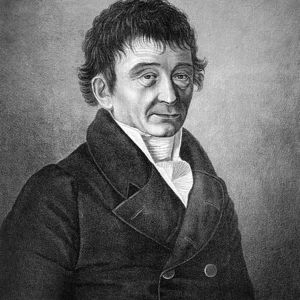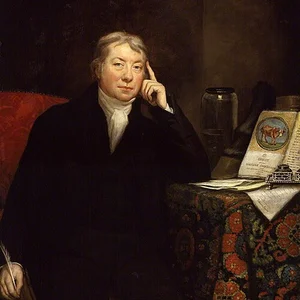

English physician and scientist (1749-1823), pioneer of vaccination. In 1796, he developed the first vaccine in history by inoculating cowpox to protect against human smallpox.
Edward Jenner(1749 — 1823)
Edward Jenner
Royaume-Uni de Grande-Bretagne et d'Irlande
6 min read
Frequently asked questions
Key Facts
- Born on 17 May 1749 in Berkeley (Gloucestershire, England)
- In 1796, inoculated cowpox into young James Phipps, the first vaccination in history
- Published his major work on smallpox vaccination (variolae vaccinae) in 1798
- The word “vaccine” derives from the Latin vacca (cow), in reference to his method
- Died on 26 January 1823 in Berkeley
Works & Achievements
A naturalist's study revealing that the young cuckoo ejects its hosts' eggs ; it earned Jenner his election to the Royal Society.
A founding experiment proving that inoculation with cowpox protects against human smallpox — the birth of vaccination.
A major work setting out the method and the evidence for vaccination ; one of the most influential texts in the history of medicine.
A sequel to the *Inquiry*, answering objections and refining the practice of vaccination on the basis of new cases.
A third memoir consolidating the data and confirming the lasting effectiveness of vaccine protection.
Through his correspondence and his shipments of vaccine fluid, Jenner helped spread the vaccine across Europe, the Americas and as far as Asia.
Anecdotes
On 14 May 1796, Jenner inoculated cowpox (the cattle version of smallpox) taken from the hand of a milkmaid, Sarah Nelmes, into an eight-year-old boy named James Phipps. A few weeks later, he exposed the child to real smallpox: Phipps did not fall ill. The experiment, bold and risky, founded vaccination.
The word “vaccine” comes from the Latin vacca, meaning cow: Jenner called his method variolae vaccinae, “the smallpox of the cow.” That is why, even today, we speak of a “vaccine” for every disease, even though the term recalls this first remedy drawn from the udders of cattle.
Before becoming a famous doctor, Jenner was a passionate naturalist. He observed that the young cuckoo, barely hatched, pushes the eggs of its adoptive parents out of the nest. This discovery about the cuckoo's behaviour earned him election to the Royal Society in 1788, well before his work on smallpox.
In the garden of his house at Berkeley, Jenner had a small rustic hut built, which he nicknamed the “Temple of Vaccinia.” There he vaccinated the poor of the region free of charge, convinced that his remedy should benefit everyone, rich and destitute alike.
Admiration for Jenner crossed borders and even wars. Napoleon, though at war with England, had a medal struck in his honour and agreed to release English prisoners at the scholar's personal request, declaring that one could refuse nothing to such a benefactor of humanity.
Primary Sources
What renders the cow-pox virus so extremely singular, is, that the person who has been thus affected is for ever after secure from the infection of the small-pox.
The more accurately to observe the progress of the infection, I selected a healthy boy, about eight years old, for the purpose of inoculation for the cow-pox.
The joy I felt at the prospect before me of being the instrument destined to take away from the world one of its greatest calamities... was so excessive that I found myself in a kind of reverie.
Key Places
Jenner's native village, where he lived and practised for most of his life. It was there, in his house The Chantry, that he conducted his experiments on cowpox.
Jenner studied surgery and anatomy there under the great John Hunter, who instilled in him a taste for observation and experimentation.
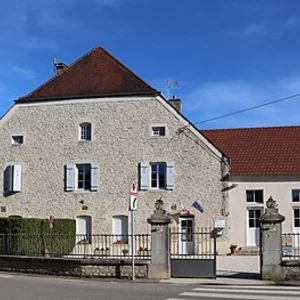
Jenner's house in Berkeley, with a hut in its garden where he vaccinated the poor free of charge. Today it houses a museum dedicated to the scientist.
A spa town in Gloucestershire where Jenner owned a second residence and received a wealthy clientele who came to take the waters.
Edward Jenner's burial place, where he rests in the chancel of the parish church of his native village.
Typical Objects

Small pointed metal blade used to lightly cut the skin in order to deposit the cowpox there. It was the central instrument of the first vaccination.

Jenner meticulously recorded every observation and every patient in notebooks. This systematic record-keeping method was the foundation of the scientific approach behind his discovery.

Optical instrument used to observe tissues and biological materials. Jenner, a man of the Enlightenment curious about nature, used it for his scientific studies.

Small glass phial holding the cowpox pus collected from pustules. Jenner sent it by post to colleagues all across Europe to spread vaccination.

An 18th-century gentleman's outfit: a dark cloth coat, waistcoat, breeches and powdered wig. Jenner practised in the English countryside dressed as a respectable notable.

A case containing lancets, scalpels and the instruments needed for treatment. Jenner carried it to visit his patients on the farms and in the villages of Gloucestershire.
School Curriculum
Vocabulary & Tags
Key Vocabulary
Tags
Daily Life
Morning
A country doctor, Jenner rose early to visit his patients in the farms and villages of Gloucestershire, often on horseback along muddy roads. His mornings combined consultations, bloodletting, and caring for the sick.
Afternoon
Afternoons were divided between the study of nature — birds, fossils, plants — and his medical research. He recorded his observations, examined milkmaids who had caught cowpox, and prepared his experiments.
Evening
In the evening, Jenner corresponded with other scholars, wrote up his papers, and welcomed friends and colleagues. A music lover, he played the violin and the flute, and sometimes composed poems.
Food
Like the English gentry of the 18th century, he ate roast meats, game, bread, cheeses, and vegetables from the garden, washed down with beer, wine, or tea, the fashionable drink of the day.
Clothing
He wore the dress of the Georgian gentleman: a dark cloth frock coat, a waistcoat, knee breeches, stockings, buckled shoes, and a powdered wig for formal occasions.
Housing
Jenner lived at The Chantry, a comfortable stone house in Berkeley surrounded by a garden, where he had set up his famous vaccination hut, the Temple of Vaccinia.
Historical Timeline
Period Vocabulary
Liens externes & ressources
Références
Œuvres
Observations sur le comportement du coucou
1788
Première vaccination de James Phipps
1796
An Inquiry into the Causes and Effects of the Variolae Vaccinae
1798
Further Observations on the Variolae Vaccinae
1799
A Continuation of Facts and Observations relative to the Variolae Vaccinae
1800
Diffusion mondiale de la vaccination
1800-1820