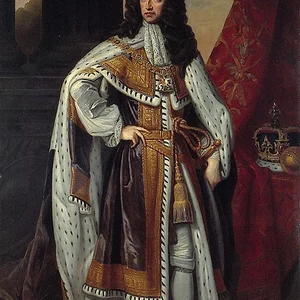

Stadtholder of the United Provinces from 1672, William III of Orange became King of England, Scotland, and Ireland in 1689 following the Glorious Revolution that overthrew James II. A Protestant champion, he devoted his reign to containing the power of Louis XIV.
William III of Orange(1650 — 1702)
William III of Orange-Nassau
Provinces-Unies, royaume d'Angleterre
6 min read
Frequently asked questions
Key Facts
- Becomes Stadtholder of Holland and Zeeland in 1672 in the face of the French invasion
- Marries Mary Stuart, daughter of James II, in 1677
- Lands in England in November 1688, sparking the Glorious Revolution
- Crowned king in 1689 alongside Mary II and accepts the Bill of Rights limiting royal power
- Fights Louis XIV during the War of the League of Augsburg (1688-1697)
Works & Achievements
A strategy of deliberate flooding that halted the French invasion and saved the Republic, making William a national hero.
The peaceful overthrow of James II and the installation of a Protestant monarchy, a founding event in English constitutional history.
By subscribing to the Declaration of Rights, William laid the foundations of the British parliamentary monarchy.
A law guaranteeing freedom of worship to Protestant dissenters, reflecting his commitment to religious tolerance.
A European coalition organised by William to contain the expansionism of Louis XIV.
An institution created during his reign to finance the war, the origin of the modern British financial system.
The treaty by which Louis XIV finally recognised William as the legitimate king of England.
Anecdotes
When he was born in November 1650, William was already fatherless: William II of Orange had died of smallpox eight days earlier. The little prince thus grew up under the guardianship of his mother and grandmother, in a Republic that was wary of the House of Orange.
In 1672, the “disaster year” (rampjaar), the armies of Louis XIV invaded the United Provinces. To halt the French advance, William had the dikes opened and deliberately flooded the land: this Dutch “water line” saved Amsterdam and made him the nation's hero.
In 1677, William married his cousin Mary Stuart, daughter of the future King James II of England. This Protestant marriage, at first political, closely bound the destinies of the United Provinces and England and paved the way for his accession to the English throne.
In 1688, during the Glorious Revolution, William landed in England with an enormous fleet — far larger than the Spanish Invincible Armada — driven toward the coast by a “Protestant wind.” King James II fled without any real battle, and William and Mary were crowned jointly.
William died in 1702 from a fall off his horse: his mount stumbled on a molehill. His Jacobite enemies long raised an ironic toast to “the little gentleman in the black velvet waistcoat” — that is, the mole.
Primary Sources
That the pretended power of suspending the laws, or the execution of laws, by regal authority, without consent of Parliament, is illegal.
We have no other aim than to have a free and lawful Parliament summoned, so that the liberties and laws of the kingdom may be preserved.
The penalties laid against Protestant dissenters attending their worship shall no longer apply to those who take the prescribed oaths.
The boundless greatness of France threatens the liberty of all Europe, and it is our duty to set a just resistance against it.
Key Places
William's birthplace and the seat of power of the United Provinces, where he held the office of stadtholder.
Capital of the kingdom where William and Mary were proclaimed sovereigns in 1689; the seat of English power.
The port where William landed on 5 November 1688 with his fleet, the starting point of the Glorious Revolution.
Site of the Battle of the Boyne in 1690, where William defeated the forces of James II, a decisive victory that is still commemorated today.
A royal residence that William had enlarged by Christopher Wren; he enjoyed its air away from the smoke of London because of his asthma.
Typical Objects

Symbol of the dual monarchy of William III and Mary II, crowned together in 1689, a unique case of shared sovereignty in England.

Founding document accepted by William and Mary, limiting royal power in favor of Parliament and guaranteeing fundamental liberties.

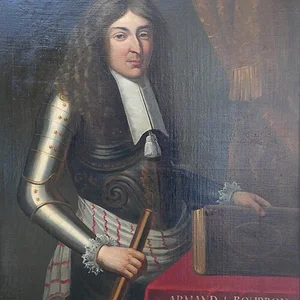
William, a war leader for nearly all his life, is often depicted in a cuirass, commander's baton in hand, on the battlefield.

The color orange, taken from the House of Orange-Nassau, became the symbol of the Protestant camp and remains tied to its legacy, notably in Northern Ireland.

Immense armada of ships that carried William's army to England, the decisive instrument of the Glorious Revolution.

Affixed to official acts, it authenticated the king's decisions and symbolized the exercise of sovereign power.
School Curriculum
Vocabulary & Tags
Key Vocabulary
Tags
Daily Life
Morning
Suffering from asthma and frail health, William rose early and fled the foul air of London for his country palaces such as Hampton Court or Kensington. The morning was devoted to reading the diplomatic and military dispatches arriving from all over Europe.
Afternoon
The afternoon was spent in councils with his ministers and in audiences, but William preferred action: in times of war, he spent entire seasons on campaign, on horseback alongside his troops on the continent.
Evening
Little inclined toward the pomp of the court, he supped soberly with a small circle of trusted Dutch confidants. He enjoyed hunting and gardens rather than balls and worldly entertainments.
Food
The royal table offered meats, game, fish, and wines, but William ate in moderation. His delicate health led him toward sobriety, far from the banquet excesses of many sovereigns of his time.
Clothing
He wore the aristocratic dress of the late 17th century: a justaucorps coat, breeches, a long curled wig, and often a cuirass during military appearances. The color orange, emblem of his house, accompanied him at ceremonies.
Housing
King of several realms, he resided in the English royal palaces (Whitehall, Kensington, Hampton Court), which he had refurbished, as well as in his estates in the United Provinces such as Het Loo Palace, whose Dutch-style gardens he loved.
Historical Timeline
Period Vocabulary
Liens externes & ressources
Références
Œuvres
Défense des Provinces-Unies (ligne d'eau de Hollande)
1672
Glorieuse Révolution
1688
Acceptation du Bill of Rights
1689
Acte de Tolérance
1689
Ligue d'Augsbourg / Grande Alliance
1689
Soutien à la fondation de la Banque d'Angleterre
1694
Paix de Ryswick
1697