 flip
flipSole à la normande for literary dinners
Sole à la normande for literary dinners
Why this dish? Flaubert regularly came up to Paris for the Magny dinners and suppers at Brébant's with Sainte-Beuve, Turgenev, the Goncourts, Sand and Zola. Sole à la normande, the glory of the great tables of the Second Empire, is exactly the kind of creamy, lavish relevé served at these gatherings where one ate as well as one gossiped.
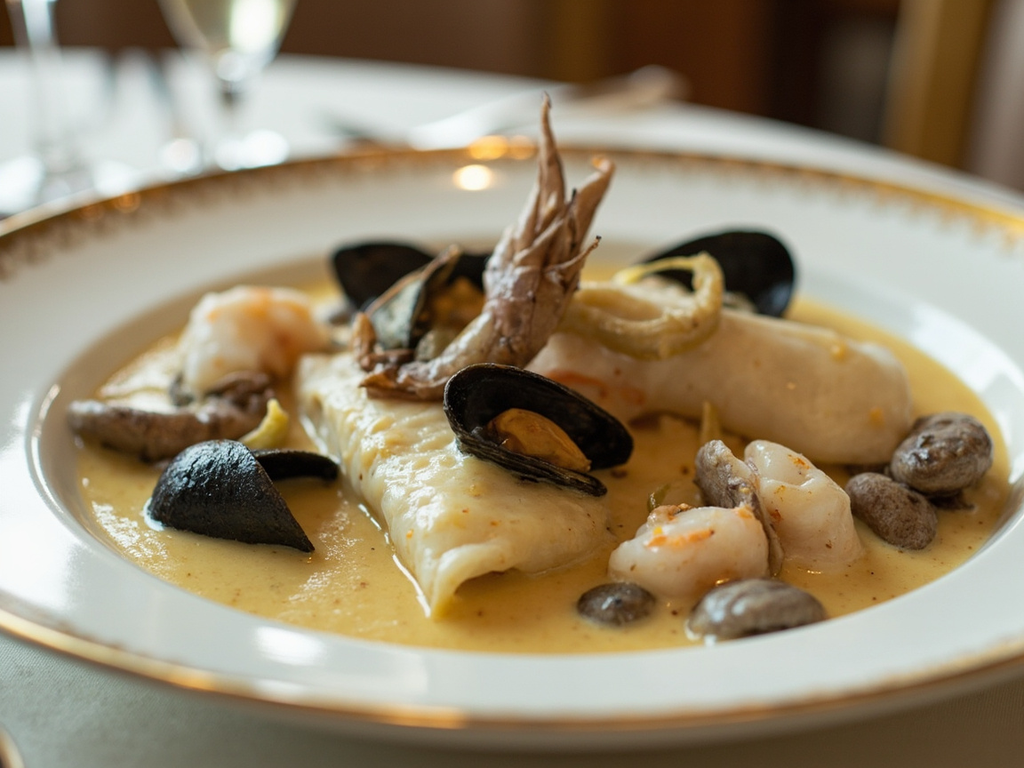
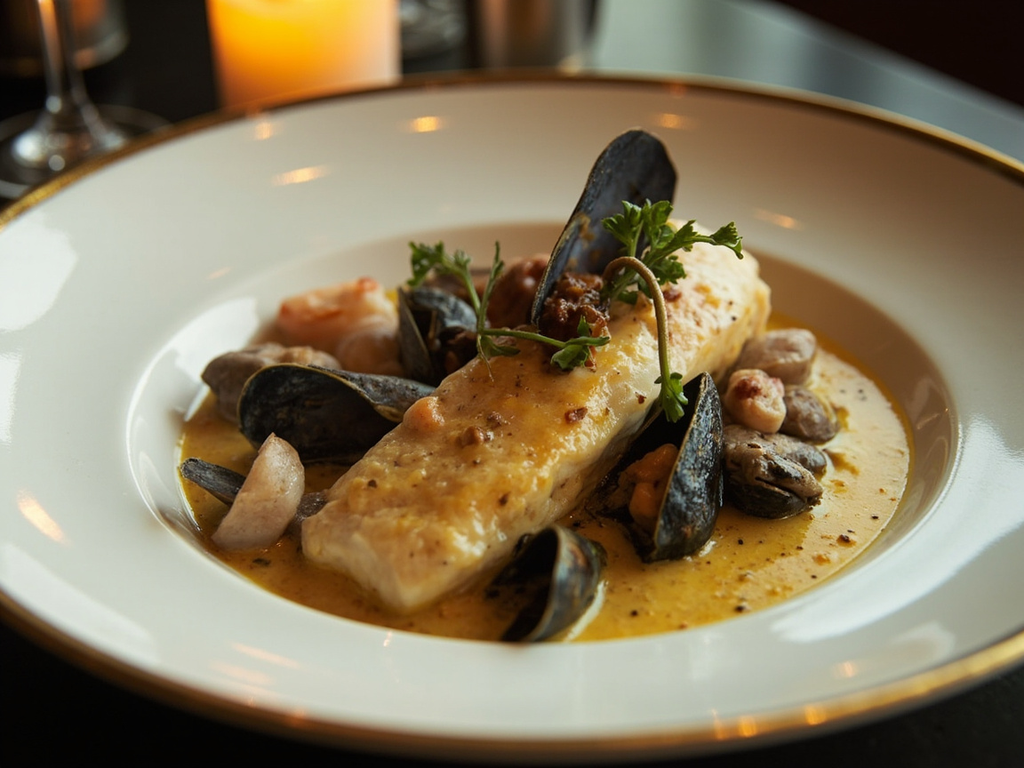
A fine sole poached then coated in a butter, cream and reduced cider sauce, garnished with mussels, shrimp and mushrooms. The grand showpiece of Norman cuisine, designed to impress a table of writers.
You see, I never believed one could think well on an empty stomach: stupidity begins when you're hungry. At Magny's, they served us this sole napped with cream as one serves a polished page — nothing excessive, but everything in its place. I wanted it white, not overcooked, the mussels nicely glossy around it, and that sauce where the cider hints at itself without showing off. They put the same care into it as into a sentence: it must flow, and yet hold. And believe me, after such a relevé, the witticisms came more easily.
- •Whole sole — one large per guest (centerpiece)
- •Barfleur mussels — a good pint (briny garnish)
- •Grey shrimp — a handful (garnish)
- •Button mushrooms — a few (garnish)
- •Farm butter — as needed (binding)
- •Thick cream — a large bowl (creaminess)
- •Cider — a glass (cooking base)
Sole à la normande for literary dinners
A fine sole poached then coated in a butter, cream and reduced cider sauce, garnished with mussels, shrimp and mushrooms. The grand showpiece of Norman cuisine, designed to impress a table of writers.
Why this dish? Flaubert regularly came up to Paris for the Magny dinners and suppers at Brébant's with Sainte-Beuve, Turgenev, the Goncourts, Sand and Zola. Sole à la normande, the glory of the great tables of the Second Empire, is exactly the kind of creamy, lavish relevé served at these gatherings where one ate as well as one gossiped.
You see, I never believed one could think well on an empty stomach: stupidity begins when you're hungry. At Magny's, they served us this sole napped with cream as one serves a polished page — nothing excessive, but everything in its place. I wanted it white, not overcooked, the mussels nicely glossy around it, and that sauce where the cider hints at itself without showing off. They put the same care into it as into a sentence: it must flow, and yet hold. And believe me, after such a relevé, the witticisms came more easily.
Ingredients (period version)
- Whole sole — one large per guest (centerpiece)
- Barfleur mussels — a good pint (briny garnish)
- Grey shrimp — a handful (garnish)
- Button mushrooms — a few (garnish)
- Farm butter — as needed (binding)
- Thick cream — a large bowl (creaminess)
- Cider — a glass (cooking base)
Ingredients
- Sole fillets (or lemon sole) — 4 fillets (centerpiece)
- Mussels — 500 g (briny garnish)
- Peeled shrimp — 150 g (garnish)
- Button mushrooms — 200 g (garnish)
- Butter — 80 g (binding)
- Thick crème fraîche — 20 cl (creaminess)
- Dry cider — 15 cl (cooking base)
- Shallot — 1 (aromatic)
- Egg yolk — 1 (final binding)
Method
- Open the mussels over high heat with the shallot and cider; strain and reserve the juice.
- Gently poach the sole fillets in this mussel juice diluted with water, without boiling. Keep warm.
- Sauté the mushrooms in butter; add the shrimp and shelled mussels.
- Reduce the poaching liquid, add the cream, let thicken, then bind off the heat with the egg yolk and a knob of butter.
- Arrange the fillets, place the garnish around, coat with the pearly sauce and serve immediately.
How it was made : Codified in the great 19th-century cookbooks, sole à la normande was born in Parisian restaurants that championed Norman terroir (cream, cider, seafood from the English Channel). It was presented as a spectacular dish, sometimes garnished with croutons, oysters and crayfish for the wealthiest tables.
The contemporary twist : Serve it deconstructed on individual plates, the fillet rolled, the sauce foamed with a siphon and a mussel placed like a signature — a nod to Flaubert's obsessive perfectionism.
Sources : Jules Gouffé, Le Livre de cuisine (1867) · Edmond et Jules de Goncourt, Journal (dîners Magny) · Gustave Flaubert, Correspondance (Gallimard, Pléiade)
Gustave Flaubert · Charactorium