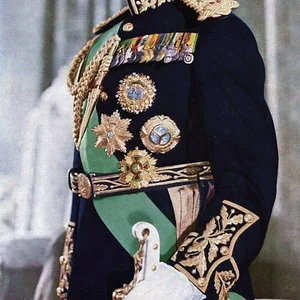

The last emperor of Ethiopia (1930-1974), he modernized his country and resisted the Italian Fascist invasion. A messianic figure of the Rastafari movement, he was overthrown by a military coup in 1974.
Frequently asked questions
Famous Quotes
« Until the color of a man's skin is of no more significance than the color of his eyes, there will be war.»
Key Facts
- Crowned emperor (Negus) of Ethiopia in 1930
- Speech to the League of Nations in 1936 denouncing the Italian invasion of Ethiopia
- Exiled from 1936 to 1941 during the Italian occupation, then restored to the throne
- Co-founder of the Organisation of African Unity (OAU) in Addis Ababa in 1963
- Overthrown by the Derg military coup in 1974, died in 1975
Works & Achievements
The country's first constitutional text, which began the modernization of its institutions while enshrining imperial power.
A historic plea for collective security and against fascist aggression, which became a global symbol of the resistance of small nations.
Measures undertaken as early as his regency to ban the slave trade and slavery, completed by a decree in 1942.
The creation of the country's first modern institution of higher education, a cornerstone of his educational policy.
Co-founding of the pan-African organization, whose headquarters were established in Addis Ababa, making Ethiopia a symbol of African independence.
Memoirs in which the emperor sets out his vision of his reign and of Ethiopia's modern history.
Anecdotes
At his coronation in 1930
Haile Selassie received impressive titles:
King of Kings,
Conquering Lion of the Tribe of Judah
and "Elect of God." The lavish ceremony drew journalists from around the world and royal delegations from across Europe.
In 1936
after fascist Italy under Mussolini invaded Ethiopia
the emperor delivered a famous speech before the League of Nations in Geneva. There he denounced the use of toxic gas against civilians and warned:
It is us today. It will be you tomorrow.
Without ever seeking or claiming it, Haile Selassie became a messianic figure for the Rastafari movement that emerged in Jamaica in the 1930s. His birth name, Ras Tafari Makonnen, gave its name to this spirituality, which sees in him a descendant of King Solomon and the Queen of Sheba.
In April 1966, during his official visit to Jamaica, an immense crowd of Rastafarians welcomed him at the airport in pouring rain. The event was so intense that the surprised emperor remained in the plane for a while; this day is commemorated each year by Rastas as "Grounation Day.
Haile Selassie kept a menagerie at the palace and was especially fond of lions, the symbols of the dynasty. Photographs show him surrounded by tame lions, reinforcing his image as the "Lion of Judah.
Primary Sources
I have come to claim that justice that is due to my people… It is us today. It will be you tomorrow.
Memoirs dictated by the emperor recounting his rise to power, his reforms, and the resistance to the Italian occupation.
The person of the Emperor is sacred, his dignity inviolable, and his power indisputable.
A first-person account in which the emperor justifies his political choices and his struggle for Ethiopia's independence.
Key Places
Historic city in eastern Ethiopia near which Tafari Makonnen was born in 1892. His father was governor there.
Capital of Ethiopia, center of imperial power and seat of the Organisation of African Unity founded in 1963. Site of the emperor's coronation, government, and death.
Orthodox church where Haile Selassie was crowned emperor in 1930. A major site of Ethiopian spirituality.
Imperial residence built for the emperor's jubilee. Center of court life and administration.
Seat of the League of Nations where the emperor delivered his famous 1936 appeal for international justice.
Spa town where Haile Selassie lived in exile from 1936 to 1941, at the villa Fairfield, during the Italian occupation.
Typical Objects

Lavishly ornamented gold crown worn at the coronation of 1930, a symbol of the Solomonic dynasty. It embodies the sacred authority of the emperor, the “Elect of God.”

Emblem of imperial Ethiopia depicting a lion bearing a cross and a banner. It links the emperor to the biblical lineage of King Solomon and became a central symbol of Rastafari.

Ceremonial staff held by the emperor during major ceremonies. It embodies the power of command and the continuity of the Ethiopian monarchy.

Ornate mantle adorned with gold thread and traditional motifs, worn at major official events. It set the emperor apart from the rest of the court.

Cross with the openwork design characteristic of the Ethiopian Orthodox Church, the faith of which the emperor was the protector. It connects imperial power to a long Christian tradition.

The Ethiopian tricolor whose colors were adopted by many Pan-African movements and by Rastafari. Under Selassie, it often bore the Lion of Judah at its center.
School Curriculum
Vocabulary & Tags
Key Vocabulary
Daily Life
Morning
The emperor rose early and often began his day with prayer, faithful to the Ethiopian Orthodox Church of which he was the protector. He then received advisers and ministers to handle affairs of state.
Afternoon
Afternoons were devoted to public and private audiences: the emperor listened to the petitions of his subjects, settled disputes, and met with foreign diplomats and dignitaries. He placed great importance on protocol.
Evening
In the evening, he dined at court, sometimes in the company of distinguished guests, then withdrew to read files or to receive visitors privately. He liked to surround himself with his animals, including his famous lions.
Food
The imperial table offered traditional Ethiopian cuisine: injera (a flatbread made from teff) served with spicy stews (wat). As the Church imposed many days of fasting, vegetarian dishes were common. The emperor was known for his temperance.
Clothing
For ceremonies, he wore capes embroidered with gold, decorated uniforms, and the imperial crown. In daily life, he favored plain military attire or elegant Western clothing, marking both tradition and modernity.
Housing
He resided in the palaces of Addis Ababa, notably the Jubilee Palace, vast residences with gardens, guards, and a menagerie. The architecture blended Ethiopian and European influences.
Historical Timeline
Period Vocabulary
Liens externes & ressources
Références
Œuvres
Première Constitution écrite de l'Éthiopie
1931
Discours à la Société des Nations
1936
Abolition progressive de l'esclavage
années 1920-1942
Fondation de l'Université Haïlé-Sélassié-Ier (aujourd'hui université d'Addis-Abeba)
1950
Organisation de l'unité africaine (OUA)
1963
My Life and Ethiopia's Progress (autobiographie)
publiée à partir de 1973