 flip
flipLinsensuppe of Exile (Lentil Soup with Vinegar)
Linsensuppe of Exile (Lentil Soup with Vinegar)
Why this dish? Between fleeing Germany in 1933, the precarious years in Paris, and internment at Camp Gurs, Arendt experienced the cuisine of exile: few resources, foods that keep, dishes that nourish for a long time. Lentil soup, a humble German Eintopf that lasts for days and reheats well, is the dish of that crossing.
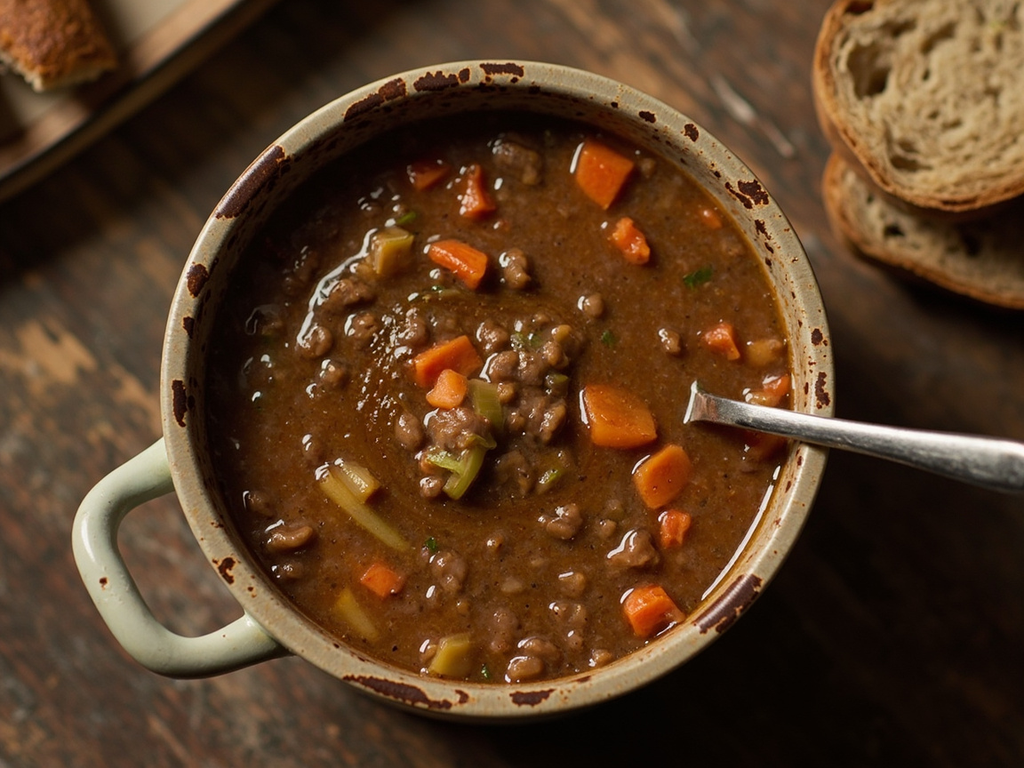
A thick soup of brown lentils, root vegetables, and a splash of vinegar at the end — the German touch that wakes everything up. Comforting, economical, and better the next day.
There is a cuisine you don't learn in fine houses: that of exile, where you cook what keeps and what costs almost nothing. The lentil, you see, has saved more stateless persons than many speeches. I let it simmer for a long time, with whatever the market would give, and — this is the German trick — a dash of vinegar at the end, which lifts everything and makes you forget the poverty of the rest. The next day it was even better: a dish that waits, as we waited, is a dish that consoles.
- •Brown lentils — two large handfuls (nourishing base)
- •Onion, carrot, celery — whatever you have (pot vegetables)
- •Smoked bacon (if available) — a piece (umami and fat)
- •Bay leaf — one (aroma)
- •Vinegar — a dash (final acidity, signature)
- •Stale bread — as appetite dictates (accompaniment)
Linsensuppe of Exile (Lentil Soup with Vinegar)
A thick soup of brown lentils, root vegetables, and a splash of vinegar at the end — the German touch that wakes everything up. Comforting, economical, and better the next day.
Why this dish? Between fleeing Germany in 1933, the precarious years in Paris, and internment at Camp Gurs, Arendt experienced the cuisine of exile: few resources, foods that keep, dishes that nourish for a long time. Lentil soup, a humble German Eintopf that lasts for days and reheats well, is the dish of that crossing.
There is a cuisine you don't learn in fine houses: that of exile, where you cook what keeps and what costs almost nothing. The lentil, you see, has saved more stateless persons than many speeches. I let it simmer for a long time, with whatever the market would give, and — this is the German trick — a dash of vinegar at the end, which lifts everything and makes you forget the poverty of the rest. The next day it was even better: a dish that waits, as we waited, is a dish that consoles.
Ingredients (period version)
- Brown lentils — two large handfuls (nourishing base)
- Onion, carrot, celery — whatever you have (pot vegetables)
- Smoked bacon (if available) — a piece (umami and fat)
- Bay leaf — one (aroma)
- Vinegar — a dash (final acidity, signature)
- Stale bread — as appetite dictates (accompaniment)
Ingredients
- Brown or green lentils — 250 g (base)
- Onion — 1 (aromatic)
- Carrots — 2 (sweetness)
- Celery stalk — 1 (aromatic base)
- Smoked bacon lardons (or optional for veg version) — 100 g (umami)
- Broth — 1.2 L (cooking liquid)
- Bay leaf — 1 (aroma)
- Wine or cider vinegar — 1 to 2 tbsp (final acidity)
Method
- Sauté the diced onion, carrot, and celery in a little fat (with the bacon lardons if using).
- Add the rinsed lentils, bay leaf, and broth. Bring to a simmer.
- Let it simmer covered for 35–45 minutes, until lentils are tender and soup is thick.
- Adjust salt, remove the bay leaf.
- Off the heat, add the vinegar — taste and adjust: it makes all the difference.
- Serve with bread. Even better reheated the next day.
How it was made : The Eintopf — literally "one pot" — is the quintessential German one-pot meal: economical, nourishing, made to simmer and keep for several days. Lentil soup brightened with vinegar is a classic variant, a weekday and subsistence dish, especially valuable in times of scarcity and exile.
The contemporary twist : A vegetarian version (no bacon, smoked with a little smoked paprika) and a drizzle of olive oil on top; served in a chipped enamel bowl that embraces the aesthetic of making do.
Sources : Tradition de l'Eintopf / Linsensuppe, cuisine populaire allemande · Cuisine de subsistance des réfugiés européens, années 1930-1940
Hannah Arendt · Charactorium