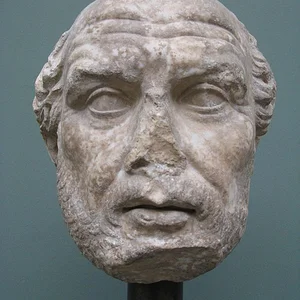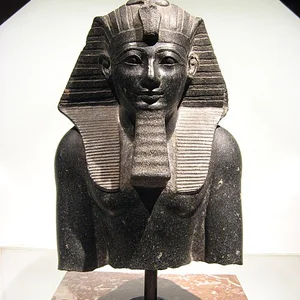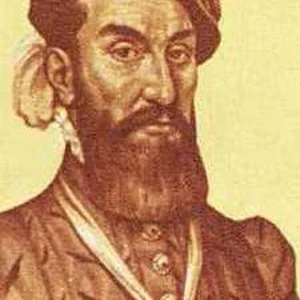

A Carthaginian explorer of the 5th century BC, Hanno led an expedition along the West African coast with a fleet of sixty ships. His voyage, recorded in the Periplus of Hanno, is one of the earliest accounts of African exploration from antiquity.
Hanno the Navigator(500 av. J.-C. — 500 av. J.-C.)
Hanno
civilisation carthaginoise
8 min read
Frequently asked questions
Key Facts
- 5th century BC: Hanno led an expedition of 60 penteconters and approximately 30,000 colonists along the African coast
- Foundation of several colonies on the northwest African coast (present-day Morocco)
- First European or Carthaginian to possibly reach the Gulf of Guinea or Cameroon
- His account, the Periplus of Hanno, survives in Greek and is a major geographical document of antiquity
- Mention of creatures called 'gorillas' (probably chimpanzees or gorillas) encountered during his voyage
Works & Achievements
A travel account inscribed on bronze in the Punic language and displayed at the temple of Baal in Carthage, preserved through a Greek translation. It is the oldest account of African exploration from Antiquity and one of the few texts of Punic origin to have survived.
The first colony founded during the voyage, on the Atlantic coast of present-day Morocco. It reflects the Carthaginian strategy of establishing trading posts to control Atlantic commercial routes.
A commercial island settlement serving as a relay point for the trade of gold, ivory, and hides with African populations. Cerne became a bridgehead for further exploration southward.
During his expedition, Hanno founded seven coastal settlements (including Thymiaterion, Karikon Teichos, Gytte, Akra, Melitta, Arambys, and Cerne), extending Carthaginian influence over several thousand kilometres of Atlantic coastline.
Anecdotes
Hannon commanded an impressive fleet of sixty penteconters — large ships with fifty oarsmen — carrying approximately thirty thousand men and women destined to found new colonies. This expedition was one of the greatest maritime undertakings of Antiquity, financed and organized by the Carthaginian state to extend its commercial influence along the African coasts.
During his journey, Hannon spotted an immense mountain that spewed flames at night, visible from far out to sea. His sailors, seized with terror, named it the “Chariot of the Gods” (Theon Ochema in Greek). This spectacular sight most likely corresponds to Mount Cameroon, a still-active volcano rising to over 4,000 metres.
Near the end of the expedition, Hannon and his men discovered an island inhabited by creatures covered in hair that their African interpreters called “Gorillai.” The sailors managed to capture three females after a difficult struggle and brought their skins back to Carthage, where they were displayed in the temple of Baal. It is from this account that the word “gorilla” entered European languages in the 19th century.
Hannon had the account of his voyage inscribed on a bronze tablet and displayed it in the temple of Baal Hammon in Carthage, so that any citizen could read it. This document — the Periplus of Hanno — survived through a Greek translation and stands today as one of the rare first-hand accounts of African exploration in Antiquity.
Before reaching the unknown regions, Hannon founded several colonies along the Atlantic coast of present-day Morocco, including Thymiaterion and the island depot of Cerne, which served as a forward base for trade with local populations. These settlements enabled the exchange of ivory, hides, and exotic animals for Phoenician manufactured goods.
Primary Sources
The Carthaginians resolved that Hanno should sail beyond the Pillars of Heracles and found cities of Libyo-Phoenicians. He therefore set out with sixty ships of fifty oars and about thirty thousand men and women, with provisions and other equipment.
Hanno, at the height of Carthage's power, was commissioned to circumnavigate Africa, and left an account of that voyage which is still in our hands.
Hanno the Carthaginian sailed from Carthage through the Pillars of Heracles into the Outer Sea, voyaging toward eastern Libya, and recorded what he had seen.
Hanno, sent on a mission by the Carthaginians, explored the coasts of Africa as far as the known limits and brought back accounts of the peoples and places he had encountered there.
Key Places
Capital of the Punic commercial empire on the coast of present-day Tunisia. It was from Carthage that Hanno was commissioned by the Senate to lead his expedition, and where the account of his voyage was displayed on a bronze tablet.
The gateway between the Mediterranean and the Atlantic, regarded in Antiquity as the edge of the known world. Hanno sailed through this strait to venture into the uncharted waters of the Atlantic.
An ancient Phoenician colony on the Atlantic coast of Morocco, mentioned in the Periplus as a stop where Hanno took on local guides who spoke the languages of the African coastal peoples.
A trading-post island founded by Hanno off the African coast (probably in present-day Mauritania or Western Sahara), which became a center of commercial exchange with the local Berber populations.
The volcanic mountain that Hanno saw spewing flames into the night, identified by most modern historians with Mount Cameroon — likely the southernmost point reached by the expedition.
Liens externes & ressources
Références
Œuvres
Le Périple d'Hannon
Ve siècle av. J.-C.
Fondation de Thymiaterion
Vers 500 av. J.-C.
Fondation de l'île de Cerne
Vers 500 av. J.-C.
Fondation de sept colonies sur l'Atlantique africain
Vers 500 av. J.-C.