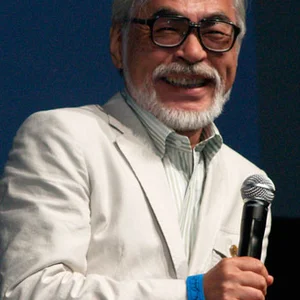

Hayao Miyazaki is a Japanese director, screenwriter, and animator of animated films, born in 1941. A co-founder of Studio Ghibli, he is one of the world's masters of animated cinema, famous for works such as *Princess Mononoke* and *Spirited Away*.
Frequently asked questions
Key Facts
- Born on January 5, 1941, in Tokyo, Japan.
- Co-founds Studio Ghibli in 1985 with Isao Takahata and Toshio Suzuki.
- Directs *Princess Mononoke* in 1997, a huge success in Japan.
- *Spirited Away* (2001) wins the Academy Award for Best Animated Feature in 2003.
- Receives an Honorary Academy Award for his lifetime achievement in 2014.
Works & Achievements
Miyazaki's first feature film, featuring the thief Lupin III. He already showcases his sense of pacing and adventure.
An ecological tale of a princess in a world scarred by war. Its success made the creation of Studio Ghibli possible.
A gentle tale about two sisters and a forest spirit. Totoro became the emblem of Studio Ghibli.
An epic saga about the conflict between humans and the spirits of nature. A huge success that revealed Ghibli to the entire world.
A little girl trapped in the world of spirits must grow up to save her parents. Won the Golden Bear in Berlin and the Oscar for Best Animated Feature.
Adapted from a novel, this film blends magic, war, and love around a castle that travels from place to place. It confirmed Miyazaki's international fame.
A fictionalized biography of a Japanese aeronautical engineer. A more adult film, after which Miyazaki announced his retirement.
A poetic and personal work about grief and imagination. It earned him a second Oscar for Best Animated Feature.
Anecdotes
Hayao Miyazaki's father ran a family business with his uncle, Miyazaki Airplane, which manufactured parts (notably rudders) for Zero fighter planes during World War II. This childhood surrounded by flying machines explains why flight and aircraft appear again and again in his films, from *Nausicaä* to *Porco Rosso*.
As a teenager, Miyazaki discovered *Hakujaden* (*The Tale of the White Serpent*), released in **1958**, the very first feature-length Japanese animated film in color. Deeply moved by the film, he decided to become an animator, though he had at first dreamed of drawing manga.
In **2003**, *Spirited Away* won the Oscar for Best Animated Feature, but Miyazaki refused to travel to Hollywood to collect it: it was his way of protesting the war waged by the United States in Iraq. He later said he did not want to attend a ceremony in a country at war.
Known as a perfectionist, Miyazaki draws and corrects much of the artwork in his films himself, checking thousands of drawings one by one. At Studio Ghibli, he is known for preparing ramen or coffee for his teams during long workdays.
Miyazaki has announced his retirement several times, notably after *The Wind Rises* in **2013**. Yet he returned to work to direct *The Boy and the Heron*, released in **2023**, which earned him a second Oscar at over **80** years old.
Primary Sources
I want to make a film that tells children: “It's good to be alive.”
A multi-volume story about a princess living in a post-apocalyptic world, written and drawn by Miyazaki alongside his films.
I know I've said this many times before, but this time I'm serious: this feature film marks the end of my career.
Key Places
Hayao Miyazaki's birthplace, where he was born in 1941. Post-war Tokyo shaped his childhood.
The town where his family took refuge to escape the bombings during the war. These memories would later nourish his outlook on nature and the countryside.
Miyazaki studied political science and economics here, while drawing a great deal. It was here that his desire to make animation took shape.
Headquarters of the studio founded in 1985, where Miyazaki designs and directs his films. It is his daily workshop.
A museum opened in 2001, conceived by Miyazaki himself, which introduces visitors to the behind-the-scenes world of animation.
Landscapes of forests and rice paddies near Tokyo that inspired the world of *My Neighbor Totoro*. Miyazaki has campaigned for their preservation.
Typical Objects
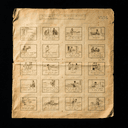
A series of small drawings that tell the film shot by shot, with the dialogue and the movements. Miyazaki draws these boards himself — the true skeleton of every film.

A transparent acetate sheet on which the characters are painted before being filmed frame by frame. The emblematic tool of traditional hand-drawn animation, dear to Miyazaki.

The illustrator's tools, which Miyazaki uses for his sketches and his softly colored backgrounds. He favors working by hand rather than on the computer.

A desk lit from below that allows the animator to trace and retouch overlaid drawings. It is the animator's daily workbench.

Airplanes, airships, and fantastical contraptions appear in nearly all his films. Flight becomes a symbol of freedom and escape, a legacy of his childhood spent around airplanes.
School Curriculum
Vocabulary & Tags
Key Vocabulary
Daily Life
Morning
Miyazaki arrives early at Studio Ghibli and often begins his day by observing the sky and nature, a source of inspiration. He then settles at his drawing table to work on storyboards and sketches.
Afternoon
The afternoon is devoted to intensive drawing: he personally corrects many of his animators' images and discusses shots with his team. A perfectionist, he checks every detail of the movement and the backgrounds.
Evening
He works late, stretching his days even longer when a film is nearing its release. In the evening, he enjoys taking coffee breaks and talking with his collaborators about the project's progress.
Food
He is described as eating simply, enjoying ramen noodles and everyday Japanese dishes. He sometimes prepares tea, coffee, or noodles himself for his team.
Clothing
Miyazaki is recognizable by his round glasses, white beard, and his apron or work smock. He dresses in a plain and practical way, like a man of the workshop.
Housing
He lives in the Tokyo area, near his studio in Koganei. A lover of nature, he also has a cabin-studio that serves as his working retreat.
Historical Timeline
Period Vocabulary
Liens externes & ressources
Références
Œuvres
Le Château de Cagliostro
1979
Nausicaä de la vallée du vent
1984
Mon voisin Totoro
1988