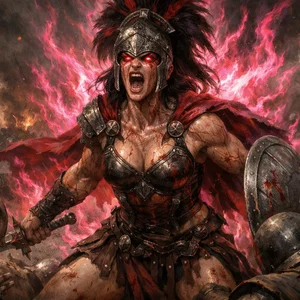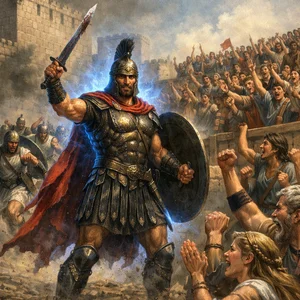

Prince of Troy and eldest son of King Priam, Hector is the greatest Trojan warrior of the Trojan War according to the Greek tradition handed down by Homer. Husband of Andromache and father of Astyanax, he embodies martial honor and love of his homeland. He kills Patroclus before being defeated by Achilles, whose fury leads him to drag Hector's body around the city walls.
Hector
Hector
Troie
9 min read
Frequently asked questions
Famous Quotes
« I would feel deep shame before the Trojan men and the Trojan women with their trailing robes, if like a coward I were to shrink aside from the fighting. (Iliad, VI, attributed by Homer)»
« One omen alone is good: to fight in defense of one's homeland. (Iliad, XII, attributed by Homer)»
Key Facts
- Eldest son of King Priam and Queen Hecuba, prince and military commander of Troy
- Husband of Andromache and father of young Astyanax — their farewell scene is one of the most celebrated passages in the Iliad (Book VI)
- Kills Patroclus, Achilles' closest companion, while Patroclus is wearing Achilles' own armor (Iliad, Book XVI)
- Killed in single combat by Achilles beneath the walls of Troy (Iliad, Book XXII)
- His body, dragged around the city walls, is finally returned to Priam in exchange for ransom (Iliad, Book XXIV)
Works & Achievements
Hector is the military backbone of the Trojan resistance throughout the siege: he organizes sorties, coordinates allies from across Anatolia, and holds the army together.
Taking advantage of Achilles' absence, Hector breaks into the fortified Greek camp and sets fire to a ship — the high-water mark of his military career, which forces Patroclus to leave the camp to protect the fleet.
A single combat arranged to spare both sides a bloody battle: Hector and Ajax fight each other for an entire day without a decisive outcome, and their final exchange of gifts embodies the Homeric ideal of warrior virtue.
Hector slays Patroclus — disguised as Achilles — after Apollo has weakened him, seizing Achilles' divine armor. This pivotal act triggers Achilles' return to battle and, by chain of consequence, Hector's own death.
Hector's death and funeral form the closing scene of the Iliad: his burial with great ceremony and the laments of Andromache, Hecuba, and Helen make him the most human and most moving figure in the entire epic.
Anecdotes
In the most moving farewell scene of the Iliad (Book VI), Hector prepares to return to battle and leans toward his son Astyanax to embrace him. The infant bursts into tears, terrified by the helmet adorned with a horsehair plume. Hector removes his helm with a laugh, embraces the child, then prays to Zeus to make his son a great warrior — not knowing that Astyanax will be hurled from the walls after the fall of Troy.
Hector kills Patroclus believing he is facing Achilles himself: the Greek hero was wearing his friend's armor to terrify the Trojans. As he dies, Patroclus prophesies that this victory will be Hector's undoing, for Achilles, mad with grief, will break his withdrawal to avenge him. Hector replies that he will leave it to the gods — unaware that his own death is now sealed.
After killing Hector beneath the walls of Troy (Book XXII), Achilles pierces the corpse's ankles, threads leather straps through them, and ties the body to his chariot. Before the eyes of Priam, Hecuba, and Andromache watching from the ramparts, he drags the body through the dust around the city for twelve days. The gods, outraged by this desecration, miraculously preserve the body intact.
Old King Priam performs an act of extraordinary courage: he crosses enemy lines alone, at night, to beg Achilles to return his son's body (Book XXIV). He kisses the hands of the man who killed Hector and invokes the memory of Achilles' own father. Achilles, deeply moved, accepts the ransom and grants an eleven-day truce for the funeral rites — the final verses of the Iliad describe the solemn burial of Hector.
During a duel with the great Ajax (Book VII), the two warriors fight until nightfall with neither gaining the upper hand. Heralds intervene to separate the combatants before full darkness falls. As a sign of mutual respect, Hector gives Ajax his sword and purple belt, while Ajax in return gives him a scarlet baldric — a chivalric gesture that illustrates the warrior code of honor woven throughout the Homeric epic.
Primary Sources
Then great Hector said to his wife: “Do not grieve too much for me in your heart. No man will send me to Hades before the hour fixed by fate.”
Achilles struck him in the throat with his bronze spear, where the neck lay bare between the shoulder-guards. Hector fell in the dust, and Achilles exulted.
Priam approached, clasped Achilles' knees, and kissed his terrible hands — those murderous hands that had slain so many of his sons.
Hector appeared to me in a dream, bathed in dark dust, his swollen feet pierced by the thongs — as he had been dragged behind Achilles' chariot.
Hector killed Patroclus after stripping him of his armor, but Apollo had first struck Patroclus in the back to sap his strength before the fatal blow.
Key Places
The royal city defended by Hector, surrounded by high ramparts. This is where his entire life unfolds: his birth, his marriage to Andromache, his battles to defend his family, and his death beneath the walls.
The main gate of Troy opening onto the battlefield, the symbolic site where Hector bids farewell to Andromache and Astyanax, and where he faces Achilles in their fateful final duel.
The vast alluvial plain at the foot of Troy where most of the battles of the *Iliad* take place. Hector commands the Trojan armies here and performs his greatest feats of valor on this ground.
Hector drives the Greeks back to their fortified camp on the coast and sets fire to an enemy ship — his moment of greatest glory in the epic, just before the return of Achilles.
Two sources at the foot of the walls — one warm, one cold — near which Hector is finally caught by Achilles after circling the city three times in flight, as told in the *Iliad*.
Liens externes & ressources
Références
Œuvres
Défense de Troie pendant neuf ans
vers -1250 à -1240 (tradition)
Percée des murs du camp grec et incendie d'un navire
chant XV-XVI de l'Iliade
Duel avec Ajax le Grand
chant VII de l'Iliade
Mort de Patrocle
chant XVI de l'Iliade
Funérailles solennelles (récit de l'Iliade)
chant XXIV de l'Iliade