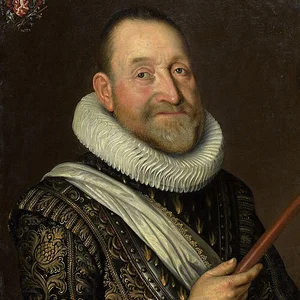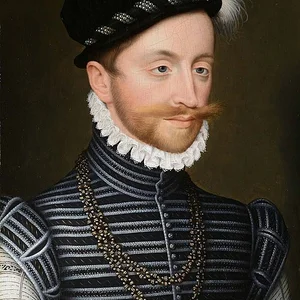

Henri I de Montmorency (1534-1614) was a great French lord and military commander, governor of Languedoc for half a century. A Marshal and then Constable of France, he played a major role during the Wars of Religion and in the service of Henry IV.
Henri I de Montmorency(1534 — 1614)
Henri I de Montmorency
France
5 min read
Frequently asked questions
Key Facts
- Born in 1534, son of the Constable Anne de Montmorency
- Appointed governor of Languedoc, an office he held for about 51 years
- Made Marshal of France in 1567, then Constable of France in 1593
- Builder of the Château de la Grange des Prés at Pézenas, a sumptuous residence
- Died in 1614, a figure of the high nobility during the Wars of Religion
Works & Achievements
Nearly half a century at the head of this vast southern province, which he kept relatively at peace amid the Wars of Religion.
He brought together moderate Catholics and Protestants of the South around a policy of conciliation, foreshadowing the appeasement of the Edict of Nantes.
Raised to one of the kingdom's highest military dignities, in recognition of his role in the royal armies.
The supreme military dignity, placing him at the head of King Henry IV's armies; he was one of the last to hold it.
His rallying to the king and his authority in Languedoc helped to establish Henry IV's power durably in the south of the kingdom.
Anecdotes
The younger son of Constable Anne de Montmorency, Henri long bore the title of Lord of Damville, by which he was first known. He gradually succeeded his illustrious father at the summit of the State, becoming a Marshal of France as early as 1566, at only 32 years old.
Appointed governor of Languedoc, he ruled there for nearly half a century, so much so that he was sometimes nicknamed the “king of Languedoc.” During the Wars of Religion, his authority there was so strong that he governed almost like a prince independent of royal power.
A moderate Catholic, he became the leader of the party of the “Politiques” (or “Malcontents”), who rejected the fanaticism of both camps and sought a negotiated peace between Catholics and Protestants. This conciliatory stance earned him as many admirers as enemies in a France torn apart.
After the accession of Henri IV, to whom he rallied, he was raised to the highest military dignity of the kingdom: Constable of France in 1593. He was one of the last great nobles to hold this prestigious title, which placed its bearer at the head of the armies.
His lineage met a tragic fate: his son Henri II de Montmorency, born to him late in life, was beheaded in 1632 on Richelieu's orders for having rebelled against Louis XIII, bringing an end to the senior branch of this great family.
Primary Sources
So as to leave no occasion for troubles and disputes among our subjects, we have permitted and do permit those of the so-called Reformed religion to live and dwell throughout all the towns and places of this our kingdom.
Marshal de Damville, governor of Languedoc, held that province in such obedience that nothing was done there except by his command.
Damville, wavering between the parties, strove to keep Languedoc at peace while the rest of the kingdom burned in the wars.
Key Places
The Montmorency residence north of Paris, embellished by his father, Constable Anne. The cradle of the family's power.
A sumptuous Renaissance dwelling built by the Montmorency family, north of Paris. A symbol of the house's prestige.
A great city of Languedoc, the heart of Henri de Montmorency's provincial governorship for nearly fifty years.
A town in Languedoc where the province's governors often resided. Henri I de Montmorency died there in 1614.
The site of the 1567 battle between the Catholic royal army and the Protestants, where the house of Montmorency fought.
Typical Objects

The supreme symbol of the kingdom's military command, handed by the king to the Constable of France. Henri received it in 1593.

Insignia of the rank of Marshal of France, covered in velvet and strewn with fleurs-de-lys. Henri carried it from 1566.

Renaissance knight's armor, often engraved and gilded for a great lord. It protected the mounted combatant during battles.

A portable firearm widespread in the armies of the Wars of Religion. It gradually transformed warfare, reducing the role of the heavy cavalry.

Insignia of the most prestigious order of chivalry, created by Henri III in 1578 and reserved for the high nobility. It marked membership in the kingdom's elite.

The wax seal and documents through which the governor exercised his authority over Languedoc. They authenticated administrative orders and decisions.
School Curriculum
Vocabulary & Tags
Key Vocabulary
Daily Life
Morning
As a great lord and governor, his morning often began with a Mass, then with the reception of secretaries and messengers. There he read dispatches and petitions arriving from all across Languedoc.
Afternoon
The afternoon was devoted to the affairs of the province: audiences, councils with his officers, inspection of the troops or the fortifications. In times of war, he might be on horseback, on military campaign.
Evening
The evening gathered his household and his nobility around a meal and conversation. Music, games and political discussions filled these hours, where alliances and loyalties were forged.
Food
A great lord's table was lavish: roasted meats (game, poultry, beef), white bread, wines of Languedoc, costly spices. The luxury of the dishes displayed the rank and hospitality of the master.
Clothing
He wore garments of rich fabric — doublet, breeches, starched ruff, embroidered cloak — in the fashion of the Valois court. On ceremonial days he added damascened armour and badges of honour.
Housing
He lived in vast châteaux: Chantilly and Écouen to the north, and provincial residences in Languedoc. These homes blended Renaissance comfort, ceremonial halls and defensive function.
Historical Timeline
Period Vocabulary
Liens externes & ressources
Références
Œuvres
Gouvernement du Languedoc
vers 1563-1614
Direction du parti des « Politiques »
à partir de 1574
Charge de maréchal de France
1566
Charge de connétable de France
1593
Pacification du Midi sous Henri IV
années 1590