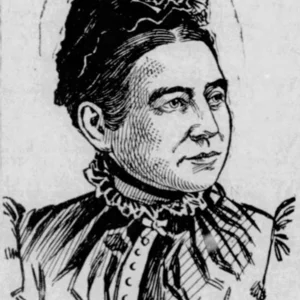

Maria Beasley (1836-1904) was an American inventor and entrepreneur. She is famous for perfecting the life raft and for designing a barrel-making machine that made her fortune.
Maria Beasley(1836 — 1913)
Maria Beasley
États-Unis
5 min read
Frequently asked questions
Key Facts
- Born in 1836 in North Carolina (United States)
- Patent for a barrel-hooping machine in 1878, the source of her fortune
- Patent for an improved life raft (foldable, fireproof, and compact) in 1882
- Filed around fifteen patents over the course of her career
- Died in 1904
Works & Achievements
Maria Beasley's most profitable invention: it automated barrel production and earned her substantial royalties.
A foldable raft with guardrails and fireproof compartments, designed to improve safety at sea; the invention that made her famous.
One of her improved household objects, illustrating the diversity of her inventions beyond industrial machinery.
An invention intended to prevent train derailments, reflecting her interest in safety matters.
A remarkable portfolio for a woman of her time, covering industrial machines, everyday objects, and safety devices.
A public showcase of her inventions before industrialists and investors, at the largest American exposition of the era.
Anecdotes
Contrary to what is often believed, it was not her lifesaving raft that made Maria Beasley's fortune, but her barrel-making machine. Patented in 1878, it automated the hooping of casks and could produce hundreds a day, where a cooper made only a handful. The royalties earned her a genuine fortune for the time.
At a time when an American woman could barely open a bank account without her husband's consent, Maria Beasley filed some fifteen patents under her own name. This was all the more remarkable given that women inventors were a tiny minority: the vast majority of patents were granted to men.
Her improved lifesaving raft, patented in 1882, was foldable and fitted with guardrails and fireproof compartments to stay afloat and withstand flames. The idea was that a ship could store many of them in little space, ready to be deployed in the event of a shipwreck.
It is often repeated that rafts inspired by her invention were aboard the *Titanic* in 1912. This widely circulated claim remains difficult to prove with certainty, but it shows just how strongly Maria Beasley's name has stayed associated with maritime safety.
Maria Beasley presented her inventions at major industrial exhibitions, such as the Centennial Exposition in Philadelphia in 1876, a showcase of American technical genius. Exhibiting her machines there allowed her to win over industrialists and investors.
Primary Sources
Be it known that I, Maria E. Beasley, of Philadelphia, in the State of Pennsylvania, have invented certain new and useful Improvements in Life-Rafts, of which the following is a specification.
Be it known that I, Maria E. Beasley, have invented a new and useful Machine for the manufacture of barrels, designed to bend, fit, and secure the hoops upon the staves with rapidity and precision.
The Commissioner of Patents' annual report lists, among the protected inventions, those filed in the name of Maria E. Beasley, of Philadelphia, for improvements to machines and safety devices.
Key Places
Region of the Southern United States generally cited as Maria Beasley's birthplace around 1836.
Major industrial city where Maria Beasley lived, worked, and developed her machines and inventions.
Federal agency where the many patents filed by Maria Beasley were registered.
Site of the 1876 Centennial Exhibition, a major showcase of American inventions of the era.
Typical Objects

A raft perfected by Maria Beasley, fitted with guardrails and fireproof compartments, designed to fold up so that large numbers could be stored aboard ships.

An industrial machine that automatically bent and fastened the metal hoops around the staves, hugely speeding up the manufacture of barrels.

A wooden container bound with metal hoops, indispensable for transporting and storing liquid or solid goods in the 19th century.

An official document issued by the Patent Office granting its holder the exclusive right to exploit an invention for a given period.

A small personal heating device, one of the objects improved by Maria Beasley, meant to keep the feet warm, especially while travelling.

A curved wooden plank assembled with others to form the wall of a barrel, a key element of the cooper's craft.
School Curriculum
Vocabulary & Tags
Key Vocabulary
Tags
Daily Life
Morning
As an entrepreneur and inventor in Philadelphia, Maria Beasley likely began her day early, devoting the morning to her business: commercial correspondence, accounts, and overseeing the production of her barrel-making machines.
Afternoon
The afternoon might be taken up with meetings with industrialists, manufacturers, or patent agents, as well as technical work on her inventions and their improvements.
Evening
In the evening, by the glow of oil lamps and later gas lighting, she turned to reading, correspondence, and preparing sketches and descriptions for her patent filings.
Food
Like the urban American middle class of the late 19th century, she had access to varied food: bread, meats, vegetables, dairy products, and canned goods, brought into the city by railroad.
Clothing
She wore the attire of a well-to-do woman of the Victorian era: long corseted dresses, full skirts, dark or colorful fabrics depending on the occasion, and a hat when going out.
Housing
She lived in an urban setting in Philadelphia, most likely in a comfortable townhouse, lit by gas and heated by coal, typical of America's industrial cities.
Historical Timeline
Period Vocabulary
Liens externes & ressources
Références
Œuvres
Machine à fabriquer et cercler les tonneaux
1878
Radeau de sauvetage perfectionné
1882
Chauffe-pieds breveté
années 1880
Dispositif anti-déraillement pour wagons
fin du XIXe siècle
Ensemble d'une quinzaine de brevets
1878-fin du XIXe siècle
Présentation à l'Exposition du Centenaire de Philadelphie
1876