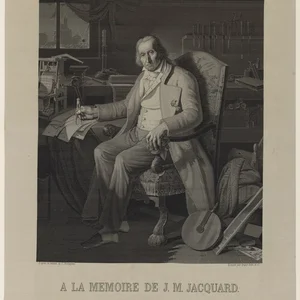

French inventor born in Lyon in 1752, Jacquard developed in 1801 an automated loom using punched cards to control patterns. His invention revolutionized the textile industry and foreshadowed the concept of computer programming.
Joseph Marie Jacquard(1752 — 1834)
Joseph Marie Jacquard
France
8 min read
Frequently asked questions
Key Facts
- 1752: Born in Lyon into a family of weavers
- 1801: Presentation of the Jacquard loom at the Exhibition of Products of French Industry in Paris
- 1804: The loom is officially patented and adopted by Napoleon
- 1806: Declared public property; Jacquard receives a pension and a royalty for each loom sold
- 1834: Death in Oullins; his punched cards would directly inspire Babbage and later the first computers
Works & Achievements
Major invention patented in 1804, using interchangeable punched cards to automate thread selection in figured weaving. Adopted worldwide, it revolutionized the textile industry and directly foreshadowed the concept of the computer program.
Jacquard decisively took up and transformed the unfinished prototype by Jacques de Vaucanson, preserved at the Conservatoire des Arts et Métiers, by incorporating the system of interchangeable punched cards that constitutes the defining originality of his invention.
Jacquard's earliest known invention, a machine designed to mechanically knot the meshes of fishing nets. It demonstrates his early mechanical genius, long before his major invention, and earned him his first local recognition.
Anecdotes
When Jacquard introduced his automatic loom in Lyon, he faced the fury of the *canuts*. Fearing for their jobs, these silk weavers destroyed his machine and, according to tradition, threw its parts into the Saône river. The resistance was so violent that Jacquard had to temporarily leave Lyon for his own safety.
Napoleon I became enthusiastic about the invention at the Exhibition of French Industry Products in 1804. In 1805, he decreed that the Jacquard loom would become "national property" — publicly owned and free to use. In return, Jacquard received a lifetime pension of 3,000 francs per year and a bonus of 50 francs for every loom sold in France.
The English mathematician Charles Babbage, inventor of the Analytical Engine (a forerunner of the computer), drew direct inspiration from Jacquard's punched cards to control the calculations in his machine. He owned a famous portrait of Jacquard woven in silk using 24,000 punched cards, and used it to explain the concept of automatic programming to his contemporaries.
Before becoming an inventor, Jacquard lived through dramatic events during the French Revolution. In 1793, he took part in the defense of Lyon when it was besieged by Republican armies; the city surrendered in October and was harshly repressed under the name "Commune-Affranchie." Like many Lyonnais, Jacquard then endured a period of great poverty.
The Jacquard loom was not invented from scratch: Jacques de Vaucanson had conceived a semi-automatic loom around 1745, but never completed it. Jacquard discovered this abandoned prototype at the Conservatoire des Arts et Métiers in Paris and improved it decisively by adding the system of interchangeable punched cards — the true key to his genius.
Primary Sources
This loom, by replacing the hand of man with a simple and inexpensive mechanism, makes it possible to produce the most intricate patterned fabrics with a regularity and speed that no human hand could achieve.
Citizen Jacquard, inventor of a loom capable of weaving patterned fabrics without the assistance of a draw-boy, shall receive an annual pension of three thousand francs as a national reward, and a bonus of fifty francs for each loom of his invention adopted in the Empire's manufactories.
The invention consists of a mechanism by means of which all kinds of patterned fabrics can be manufactured without the assistance of a draw-boy, through the sole action of the weaver operating the shuttle, the warp threads being raised or lowered in the order determined by the punched cards.
The loom of Monsieur Jacquard, of Lyon, deserves particular attention: through an ingenious mechanism of hooks and needles controlled by punched cards, a single worker can now produce the richest fabrics without any assistance whatsoever.
Key Places
The Lyonnais silk-weavers' district where Jacquard was born, worked, and spent most of his life. La Croix-Rousse was the heart of the *Grande Fabrique*, the world center of silk production in the 18th century, recognizable by its buildings with their large windows and *traboules* — covered passageways running through the blocks.
Institution founded in 1794 where Jacquard presented his improved loom in 1801 and discovered Vaucanson's unfinished prototype. The museum still holds an original Jacquard loom today.
A town south of Lyon where Jacquard retired in his final years, supported by an imperial pension, and where he died on August 7, 1834. A commemorative statue was erected there in his honor.
The heart of Lyon's weaving district, where a statue of Jacquard was unveiled in 1840, six years after his death, in recognition of his contribution to the silk industry. It symbolizes the strong bond between the inventor and the world of the *canuts*.
A Lyon museum housing remarkable examples of silks produced on Jacquard looms, period documents, and tools from the *Grande Fabrique*. An essential testament to Jacquard's industrial and artistic legacy.
Typical Objects

Automated weaving machine using a punched-card mechanism to select warp threads and form complex patterns. Patented in 1804, it is Jacquard's central invention and revolutionized the global textile industry.

Rectangles of rigid cardboard pierced with holes according to a precise code, feeding through the loom to mechanically control the raising of each warp thread. Each card corresponded to one row of fabric, making it possible to “program” endlessly repeatable patterns.

A tapered wooden tool holding the weft bobbin, propelled from one side of the loom to the other to weave the cloth. Jacquard automated the selection of warp threads while leaving the weaver to operate the shuttle by hand.

A system of metal hooks, needles, and springs that, activated by the punched cards, selectively raises the warp threads. This is the essential innovation of the Jacquard patent, which replaced the work of the drawboy.

Silk fabric featuring raised or colored patterns, the flagship product of Lyon's Grande Fabrique. The Jacquard loom made it possible to produce these sumptuous textiles with unmatched precision and speed, making Lyon indispensable on European markets.

A likeness of Jacquard's face woven entirely on his own loom, created using 24,000 punched cards and resembling a fine engraving. A technical masterpiece, it demonstrated to contemporaries the extraordinary capabilities of the machine and was later used by Babbage to illustrate the concept of programming.
School Curriculum
Vocabulary & Tags
Key Vocabulary
Daily Life
Morning
Jacquard began his day very early, like all Lyonnais craftsmen. He would head down to his workshop, check the condition of his looms, and oversee the mounting of the silk warps. During his years of invention, he devoted the first hours of the day to adjusting his mechanisms and solving the technical problems posed by the punched cards.
Afternoon
The afternoon was given over to productive work: overseeing the weaving, checking the quality of the figured fabrics, and conferring with weavers or silk merchants (the *soyeux*). During the period of invention, he spent hours designing mechanical parts, having them fitted by locksmiths, and testing them on his prototype.
Evening
In the evening, Jacquard would often gather with other Lyonnais craftsmen and mechanics to exchange ideas about the latest technical innovations. By candlelight he worked on his drawings and plans — a quiet time suited to reflecting on the mechanical problems he had not yet solved during the day.
Food
Jacquard's table was that of a Lyonnais craftsman of modest means: soup, bread, seasonal vegetables, and occasionally poultry or charcuterie on feast days. Wine from the Beaujolais or the Côtes du Rhône accompanied meals, following local custom. His family endured periods of real poverty, particularly after the Revolution and the siege of Lyon in 1793.
Clothing
Jacquard wore the typical dress of the Lyonnais *canuts*: a dark jacket, a work apron, stockings, and sturdy shoes. When he traveled to Paris to present his work before the consular or imperial authorities, he put on more refined attire — a frock coat and cravat — while maintaining the sober bourgeois style of the era.
Housing
Jacquard lived in modest lodgings in the Croix-Rousse district, a densely packed neighborhood where craftsmen crowded into buildings with tall windows (the so-called "fenêtres de canut") designed to admit as much natural light as possible, essential for precision weaving. In his final years, thanks to his imperial pension, he was able to retire to a more comfortable house in Oullins.
Historical Timeline
Period Vocabulary
Liens externes & ressources
Références
Œuvres
Métier à tisser à cartes perforées (métier Jacquard)
1801–1804
Amélioration du métier Vaucanson
1800–1801
Machine à fabriquer les filets de pêche
vers 1790