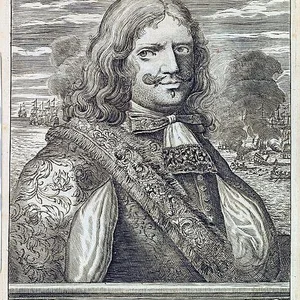

Henry Morgan (c. 1635–1688) was a Welsh privateer in the service of England who led devastating raids against Spanish possessions in the Caribbean. Knighted by the Crown, he ended his career as Lieutenant Governor of Jamaica.
Henry Morgan(1631 — 1688)
Henry Morgan
royaume d'Angleterre
7 min read
Frequently asked questions
Key Facts
- Born around 1635 in Wales, he joined the English Caribbean in the mid-17th century
- In 1668, he led a daring raid on Portobelo (present-day Panama), a Spanish stronghold
- In 1671, he captured and sacked Panama, one of the richest cities in the Spanish Empire in the Americas
- Knighted by Charles II of England around 1674 and later appointed Lieutenant Governor of Jamaica
- Died in 1688 in Port Royal, Jamaica
Works & Achievements
Audacious seizure of one of the Spaniards' best-fortified ports, yielding a considerable ransom and establishing Morgan's reputation as a war leader.
Raid on the towns of Lake Maracaibo followed by a famous escape using a fireship that destroyed the Spanish flagship.
The largest buccaneer expedition of the era: crossing the isthmus and destroying the wealthy city of Panama — a military feat but a diplomatic disaster.
Official recognition by the Crown: Morgan shifted from privateer to senior colonial official responsible for order and defense of the island.
As a representative of royal authority, Morgan organized the hunting and hanging of pirates, helping transform Jamaica from a buccaneer haven into an orderly colony.
Legal victory against the English edition of the book that slandered him; one of the first major libel trials, forcing the publishers to correct their work.
Anecdotes
In 1669, trapped in Lake Maracaibo by three Spanish warships blocking the exit, Morgan turned a captured vessel into a fireship: he packed it with gunpowder and tar and placed logs dressed as sailors on deck to fake a crew. Launched against the Spanish flagship, the fireship set it ablaze and sank it, allowing the buccaneers to escape with their loot.
In 1671, Morgan gathered nearly 1,400 men, crossed the jungle of the Isthmus of Panama, and seized the wealthy Spanish city, which went up in flames. The problem: England and Spain had signed a peace treaty (the Treaty of Madrid) the previous year. The expedition became a diplomatic scandal, and Morgan was recalled and sent to London as a high-profile prisoner.
Far from being punished, Morgan was treated as a hero in London: King Charles II knighted him in 1674, then sent him back to Jamaica as lieutenant governor. Now a representative of order, the former privateer began hunting down and hanging pirates, sometimes his former comrades-in-arms.
When Alexandre Exquemelin's bestselling book about buccaneers appeared, Morgan recognized himself portrayed as a cruel brigand, allegedly once sold as an indentured servant in the West Indies. Furious, he sued the English publishers for libel in 1685 and won £200 in damages: one of the earliest libel trials in history.
In 1668, Morgan captured the stronghold of Portobelo on the Panama coast, despite its protection by powerful forts. According to Exquemelin's account, the buccaneers forced monks and nuns to carry ladders against the ramparts, hoping the defenders would not dare to fire on them.
Primary Sources
The surgeon Exquemelin, who served among the buccaneers, devotes long chapters to "Admiral" Morgan, recounting in detail the captures of Portobelo, Maracaibo, and Panama, as well as the cruelty of the buccaneers towards Spanish prisoners.
The agreement recognizes English possessions in the West Indies and commits both crowns to cease hostilities and acts of privateering in the Caribbean — a peace concluded before Morgan's sack of Panama.
The Governor of Jamaica authorizes Morgan to raise men and attack Spanish positions to defend the island, conferring on him the status of a privateer serving the Crown rather than a simple pirate.
The dispatches exchanged between Jamaica and London report Morgan's expeditions, his recall after Panama, his knighthood, and then his appointment and actions as lieutenant-governor charged with suppressing piracy.
Key Places
Region in southern Wales, near Cardiff, where Henry Morgan was born into a family of minor rural gentry. From here he left to seek his fortune in the West Indies.
English port in the Caribbean, base for buccaneers and one of the richest cities in the New World, nicknamed "the wickedest city". Morgan made it his headquarters, lived there as a planter, and was buried there.
Fortified Spanish port on the Isthmus of Panama, transit point for Peruvian silver. Morgan captured it in 1668 despite its powerful castles.
Spanish city on the shore of a large lake connected to the sea by a narrow channel. In 1669, Morgan was trapped there by a Spanish squadron before escaping using a fireship.
Rich Spanish city on the Pacific coast, outlet for Peruvian gold and silver. Morgan captured and burned it in 1671, the peak and scandal of his career.
Capital where Morgan was brought in 1672 after the sack of Panama. Instead of a trial, he was celebrated, knighted by Charles II, then sent back to govern Jamaica.
Typical Objects

A short, broad, slightly curved blade, ideal for close-quarters combat on crowded decks. It was the iconic weapon of buccaneers during boardings.

A single-shot firearm triggered by a flint spark, often carried in multiple copies as it could only fire once before a lengthy reload. Valuable for the element of surprise at the start of a boarding.

An official document issued by a governor or sovereign authorizing a captain to attack enemy ships and ports. It legally distinguished the privateer, acting for the state, from the outlaw pirate.

A large Spanish silver coin minted especially from the silver of American mines, the reference currency in the Caribbean. It was the main loot coveted by buccaneers.

An iron hook attached to a rope, thrown to catch and pull the enemy ship close in order to board it. An indispensable tool of the boarding technique.

A light, fast sailing vessel, maneuverable in the waters of the West Indies, perfect for surprising galleons and fleeing heavy squadrons. Morgan’s flotillas gathered this type of ship.

The magnetic compass and the cross-staff (or Davis quadrant) allowed keeping a course and estimating latitude by measuring the sun’s altitude. Without them, crossing the Caribbean Sea was a gamble.

Alcohol made from sugarcane, abundant in Jamaica, served on board and at sailors’ festivities. Rum sealed agreements and rewarded the crew after a capture.
School Curriculum
Vocabulary & Tags
Key Vocabulary
Tags
Daily Life
Morning
On board, the day began early: the rigging and sails were checked, weapons were polished, and the horizon was scanned for a Spanish sail. On land, as a Jamaican planter, Morgan inspected his sugar cane plantations and received news from the port.
Afternoon
The afternoon was devoted to maneuvers, training with saber and pistol, or, on land, to business: meetings with the governor, negotiations over prizes and ransoms, management of slaves and estates. Expeditions were prepared in secret to surprise the enemy.
Evening
In the evening, the buccaneers shared a meal, drank rum, and sang; after a capture, the booty was counted and divided according to pre-established rules. Having become a notable, Morgan kept an open table and lived high in the taverns of Port Royal.
Food
They ate jerked meat (dried and smoked), ship's biscuit, fish, turtle, and tropical fruits like plantains. Since water quickly went stale, they mostly drank wine, beer, and Jamaican rum.
Clothing
The buccaneer wore a linen shirt, wide breeches, a belt full of weapons, and a hat or scarf against the sun, all quickly worn out by salt. Having become a knight and governor, Morgan adopted the attire of an English gentleman: doublet, wig, and feathered hat.
Housing
At sea, the crew crowded onto narrow, damp decks, sleeping on bare planks or in a hammock. In Jamaica, Morgan owned vast plantations and fine houses, testament to the fortune amassed through privateering.
Historical Timeline
Period Vocabulary
Liens externes & ressources
Références
Œuvres
Prise de Portobelo
1668
Campagne de Maracaibo
1669
Sac de Panama
1671
Anoblissement et nomination comme lieutenant-gouverneur de la Jamaïque
1674
Répression de la piraterie à la Jamaïque
vers 1675-1681
Procès en diffamation contre les éditeurs d'Exquemelin
1685