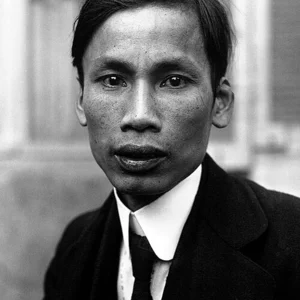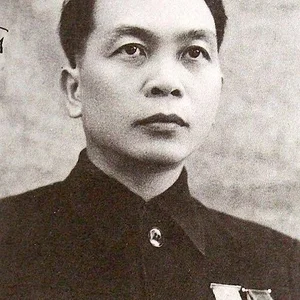

Vietnamese general and politician, the principal military leader of the Việt Minh and later of the North Vietnamese army. The architect of the victory at Diên Biên Phu against France in 1954, he was one of the strategists of both the war of independence and the Vietnam War.
Vo Nguyen Giap(1911 — 2013)
Võ Nguyên Giáp
Vietnam
5 min read
Frequently asked questions
Key Facts
- Born in 1911 in Quảng Bình province, he joined the Vietnamese nationalist and then communist movement in the 1930s
- Founded and commanded the Vietnam People's Army from 1944 alongside Hô Chi Minh
- Won the decisive Battle of Diên Biên Phu in May 1954, ending the French colonial presence in Indochina
- Played a major strategic role in the Vietnam War against the United States (Tet Offensive, 1968)
- Died in 2013 in Hanoi at the age of 102, celebrated as a national hero
Works & Achievements
The first troops organized by Giáp, founding what would become the People's Army of Vietnam.
The siege and defeat of the French army that hastened the end of the colonial presence in Indochina.
A major theoretical work setting out his doctrine of revolutionary warfare, studied around the world.
An account of the battle in which Giáp analyzes his strategy and the tactical turning point of the gradual offensive.
Leading North Vietnamese operations against the United States, including the preparation of the Tet Offensive.
A vital logistical network linking the North to the South through the jungle, a decisive support for the war effort.
Anecdotes
Originally, Giáp was not a soldier but a history teacher at a high school in Hanoi. A great admirer of Napoleon, he loved to reconstruct his battles on the blackboard for his students, long before becoming a feared strategist himself.
In 1954, to bring guns and ammunition up to the hills overlooking Điện Biên Phủ, Giáp had the artillery pieces dismantled and hauled them up by hand and by the strength of thousands of bicycle porters through the jungle. The French, convinced it was impossible, found themselves trapped in the basin.
Nicknamed the “volcano under the snow” for the apparent calm that concealed an iron will, Giáp paid dearly for his commitment: his first wife died in prison under the French colonial administration, which strengthened his resolve.
Giáp accepted enormous loss of life in his offensives, which earned him criticism. He is said to have declared that, to win independence, his people were ready for sacrifices that Western armies could not imagine.
Having become a global figure, Giáp lived to a great age: he died in 2013 at the age of 102. Tens of thousands of Vietnamese queued for days to pay their respects at his state funeral.
Primary Sources
The war of liberation of the Vietnamese people was a war of the entire people, a total war waged on every front: military, political, and economic.
We had decided to change our tactics: from a swift attack for a swift victory, we shifted to a gradual attack for a sure victory.
The whole people is mobilized, everyone is a soldier, every village is a fortress.
Key Places
Giáp's native region in central Vietnam. He spent his childhood there in a family of patriotic scholars.
The capital where Giáp taught history, engaged in political activism, and later served as minister and commander-in-chief. He died there in 2013.
A valley basin in northwestern Vietnam where Giáp won the decisive victory over the French army in 1954. The battle became a symbol of decolonization.
A mountainous area in the north near China where the Việt Minh organized the resistance and where Giáp trained his first armed units.
The city of the 1954 accords that ended the Indochina War following the French defeat at Điện Biên Phủ. Vietnam was divided in two there.
Typical Objects

Lightweight pressed-fiber helmet worn by the soldiers of the Việt Minh and the People's Army. It became a symbol of the Vietnamese fighter.

A reinforced bicycle able to carry up to 200 kg of equipment along jungle trails. It was a key logistical tool in the victory at Điện Biên Phủ.

Artillery pieces taken apart and then reassembled on the heights surrounding the Điện Biên Phủ basin. Their unexpected presence sealed the fate of the French garrison.

An annotated terrain map used to plan offensives and sieges. On it Giáp plotted the positions and lines of advance of his troops.

A plain green cotton outfit worn by soldiers and officers, Giáp included. It embodied the ideal of an army drawn from the people, free of pomp.

Individual weapons often captured from the enemy or supplied by allies, the backbone of the guerrilla campaign. They made a mobile, decentralized war possible.
School Curriculum
Vocabulary & Tags
Key Vocabulary
Daily Life
Morning
On campaign, Giáp rose early in rudimentary shelters in the jungle or the mountains of Việt Bắc. His mornings were devoted to reports from his officers and to studying maps in order to fine-tune his battle plans.
Afternoon
Afternoons were spent in staff meetings, troop inspections, and logistical coordination. A former teacher, he enjoyed explaining his strategic reasoning to his subordinates at length.
Evening
In the evening, by the light of an oil lamp, he read works of military history, drafted directives, and pondered upcoming operations. He often continued working late into the night.
Food
Like his soldiers, he shared a frugal diet of rice, vegetables, and dried fish, especially while on campaign. This austerity reinforced his image as a leader close to his troops.
Clothing
He wore the simple green uniform of the People's Army and the colonial helmet, without ostentatious decorations in everyday life. On official duties, he donned the general's dress uniform with his stars.
Housing
During the wars, he lived in makeshift shelters, caves, or camouflaged huts in the jungle. In peacetime, he resided in Hanoi in a modest official residence.
Historical Timeline
Period Vocabulary
Liens externes & ressources
Références
Œuvres
Formation des unités de propagande armée
1944
Victoire de Diên Biên Phu
1954
Guerre du peuple, armée du peuple
1961
Diên Biên Phu (mémoires)
1964
Construction de la piste Hồ Chí Minh
1959-1975