 flip
flipMisoshiru with Tofu and Wakame
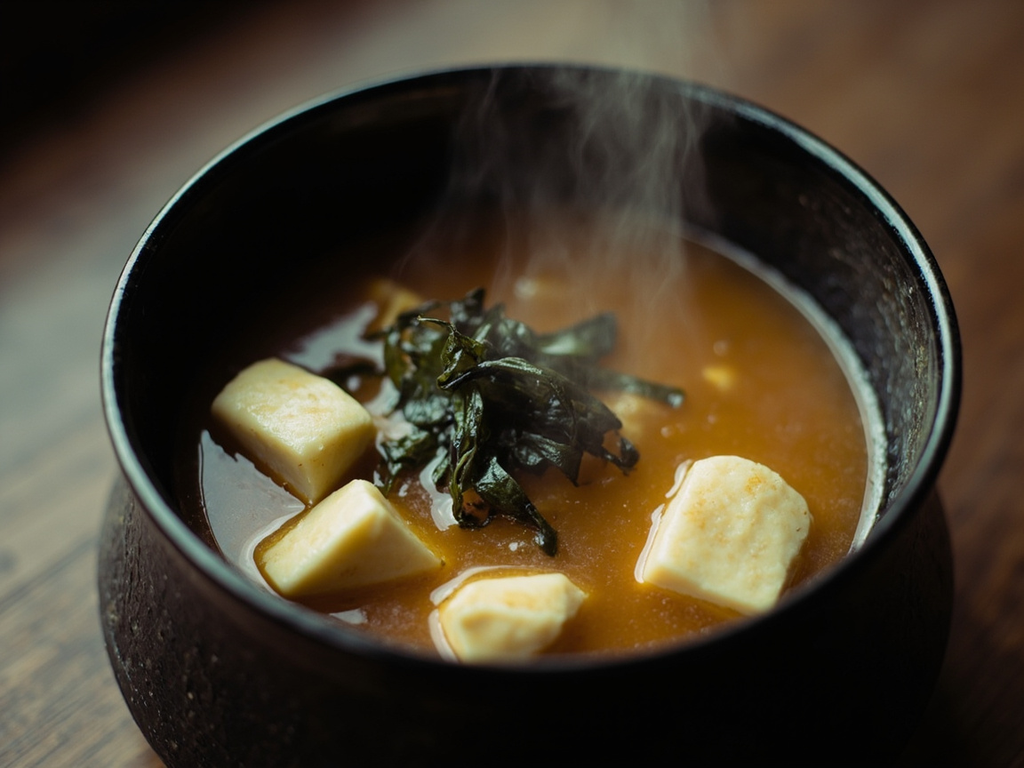
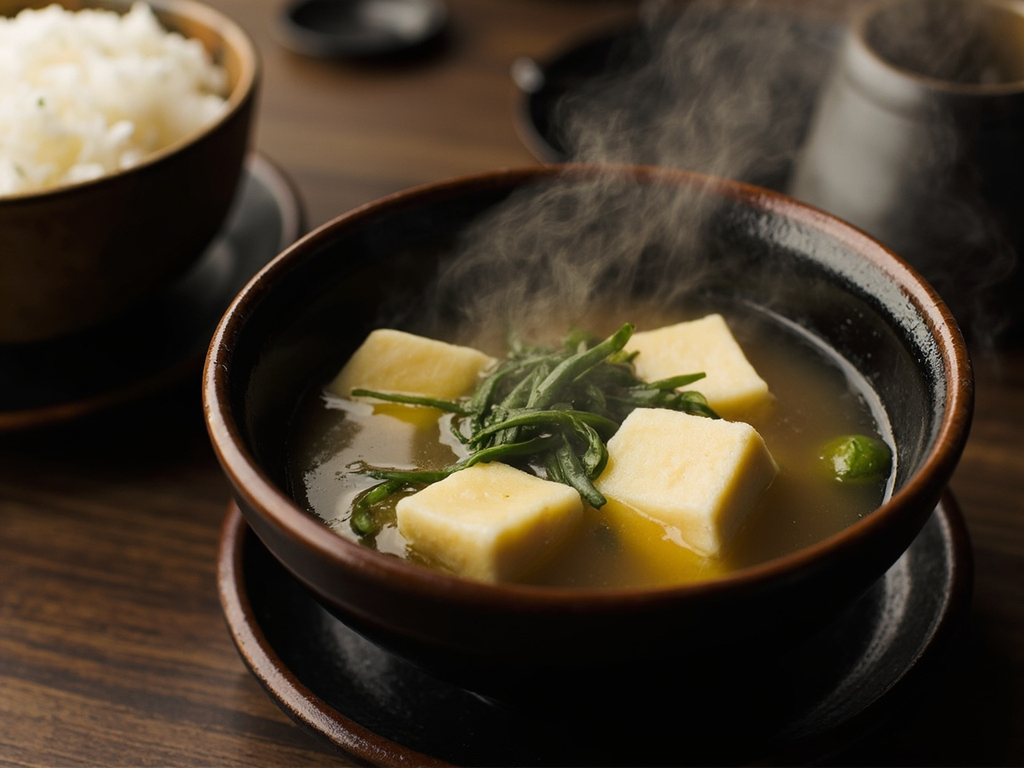
Misoshiru with Tofu and Wakame
Why this dish? It is said that Hokusai always kept a teapot within reach and lived like the common people of Honjo. For them, the steaming bowl of miso soup in the morning, downed with a bowl of rice, was the gesture that opened the workday — his measured in brushstrokes.
A warm dashi broth with a spoonful of miso paste melted in, garnished with cubes of silken tofu and wakame seaweed that unfurls. Comforting, salty-savory, ready in a quarter of an hour.
Me, the crazy old man of drawing, I never wasted time at the table. While the brush was drying, my daughter Oei would drop a spoonful of miso into the bonito broth, never letting it boil — otherwise the miso turns sour and loses its fragrance, mark my words. I would gulp down the steaming bowl standing up, the wakame still alive between my teeth, and return to Mount Fuji that I had not finished drawing. At ninety, perhaps I would finally know how to trace a true wave; in the meantime, this soup is enough for me.
- •Dashi (kombu and katsuobushi) — one bowl per person (umami base broth)
- •Fermented miso paste — a good spoonful per bowl (salty seasoning)
- •Fresh tofu — a few cubes (protein garnish)
- •Dried wakame — a pinch (sea garnish)
- •Edo scallion (negi) — a little, sliced (final freshness)
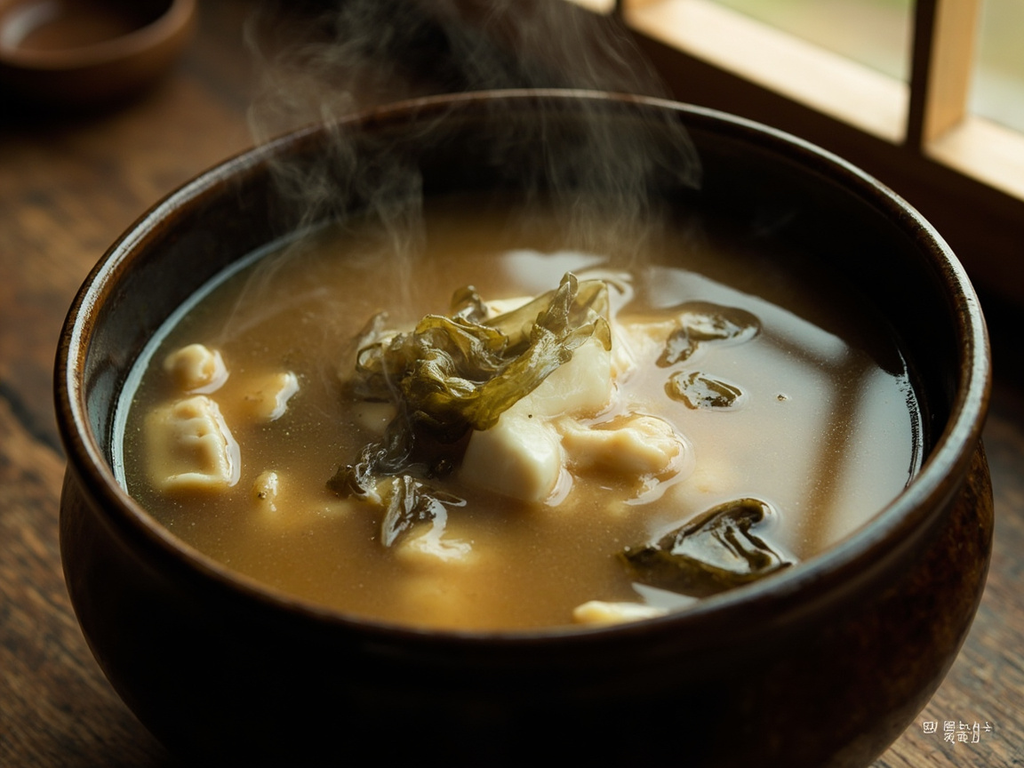
Misoshiru with Tofu and Wakame
A warm dashi broth with a spoonful of miso paste melted in, garnished with cubes of silken tofu and wakame seaweed that unfurls. Comforting, salty-savory, ready in a quarter of an hour.
Why this dish? It is said that Hokusai always kept a teapot within reach and lived like the common people of Honjo. For them, the steaming bowl of miso soup in the morning, downed with a bowl of rice, was the gesture that opened the workday — his measured in brushstrokes.
Me, the crazy old man of drawing, I never wasted time at the table. While the brush was drying, my daughter Oei would drop a spoonful of miso into the bonito broth, never letting it boil — otherwise the miso turns sour and loses its fragrance, mark my words. I would gulp down the steaming bowl standing up, the wakame still alive between my teeth, and return to Mount Fuji that I had not finished drawing. At ninety, perhaps I would finally know how to trace a true wave; in the meantime, this soup is enough for me.
Ingredients (period version)
- Dashi (kombu and katsuobushi) — one bowl per person (umami base broth)
- Fermented miso paste — a good spoonful per bowl (salty seasoning)
- Fresh tofu — a few cubes (protein garnish)
- Dried wakame — a pinch (sea garnish)
- Edo scallion (negi) — a little, sliced (final freshness)
Ingredients
- Water — 800 ml (dashi base)
- Kombu — 10 g (a square) (vegetal umami)
- Katsuobushi (dried bonito flakes) — 15 g (sea umami)
- Miso — 3 tbsp (seasoning)
- Firm or silken tofu — 200 g cubed (garnish)
- Dried wakame — 1 tbsp (garnish)
- Scallion / green onion — 1 stalk, sliced (finish)
Method
- Soak the kombu in cold water for 20 min, then heat gently and remove the kombu just before boiling (it would become bitter).
- Turn off the heat, add the katsuobushi flakes, let steep for 2 min, then strain: this is the dashi.
- Rehydrate the wakame in a little water for 5 min, then drain. Cut the tofu into cubes.
- Reheat the dashi without boiling. Dissolve the miso in a ladleful of broth before incorporating it (never directly).
- Add the tofu and wakame, heat for 1 min without boiling. Serve immediately, with scallion on top.
How it was made : Every Edo household fermented its own miso in jars; its quality marked a family's table. The rule never to boil miso, to preserve its aroma and ferments, was passed from mother to daughter and still holds.
The contemporary twist : Serve it in a small cast-iron bowl as a nod to Hokusai's teapot, and place a wavy wakame leaf on the surface, like a miniature wave.
Sources : Naomichi Ishige, The History and Culture of Japanese Food, Kegan Paul, 2001 · Eric C. Rath, Food and Fantasy in Early Modern Japan, University of California Press, 2010
Hokusai · Charactorium