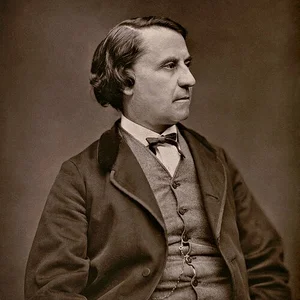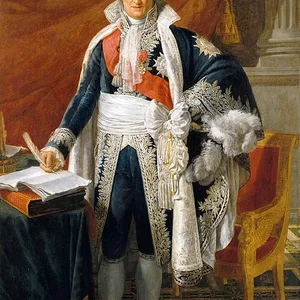

A French jurist and statesman, Portalis was the principal drafter of the Civil Code enacted in 1804, the cornerstone of modern French private law. As Minister of Religious Affairs under Napoleon, he also contributed to the Concordat of 1801, which regulated relations between the Church and the State.
Jean-Étienne-Marie Portalis(1746 — 1807)
Jean-Étienne-Marie Portalis
France
9 min read
Frequently asked questions
Famous Quotes
« Laws are not mere acts of power; they are acts of wisdom, justice, and reason.»
Key Facts
- 1746: Born in Saint-Rémy-de-Provence
- 1793–1795: Imprisoned during the Terror, then exiled to Switzerland and Germany
- 1801: Writes the Preliminary Discourse on the Draft Civil Code, a founding text of French legal philosophy
- 1804: Enactment of the Civil Code of the French (known as the Napoleonic Code), of which he was the principal drafter
- 1804–1807: As Minister of Religious Affairs, he implements the Concordat of 1801 with the Holy See
- 1807: Dies in Paris
Works & Achievements
A masterpiece of legal philosophy laying out the founding principles of the Civil Code, this text argues that laws must rest on wisdom and experience rather than on abstract reason alone. It is still studied today in law schools as a foundational text of modern French law.
Drafted primarily by Portalis together with Tronchet, Bigot de Préameneu, and Maleville, this code of 2,281 articles unified civil law across the entire French territory. It was exported to many European and Latin American countries and remains the foundation of French private law still in force today.
A set of 77 provisions drafted by Portalis to concretely organize the functioning of the Catholic Church in France (dioceses, seminaries, appointments). These unilaterally enacted articles prompted a sharp protest from Pope Pius VII, who had not been consulted.
A philosophical work in which Portalis critiques the excesses of Enlightenment rationalism, arguing for a mode of thought that balances reason with tradition. This text reveals his reflections on the moral foundations of law and society.
A collection of documents written during the Concordat negotiations, shedding light on the behind-the-scenes process of reconciliation between the Catholic Church and the Napoleonic state. These texts showcase Portalis's diplomatic talent and his vision of the relationship between faith and politics.
Anecdotes
In August 1800, Napoleon tasked Portalis and three other jurists (Tronchet, Bigot de Préameneu, and Maleville) with drafting a civil code for all of France. At 54, Portalis produced a complete first draft in just four months — a remarkable feat for a text destined to govern the daily lives of the French for centuries.
Before presenting the draft Civil Code to the legislative assemblies, Portalis delivered his famous 'Preliminary Discourse' before the Council of State in 1801: in a few lucid pages, he explained why laws must be stable, humane, and rooted in tradition rather than ideology. This text is still studied today in law schools as a masterpiece of legal philosophy.
During the Reign of Terror (1793–1794), Portalis was imprisoned as a royalist suspect. He came close to the guillotine as many of his fellow jurists were executed. His survival owed as much to the fall of Robespierre on 9 Thermidor 1794 as to his own caution: he had managed to slip below the radar of the most bloodthirsty revolutionary committees.
In September 1797, the coup of 18 Fructidor targeted moderates: Portalis was placed on the deportation lists for French Guiana, nicknamed "the dry guillotine" because few who were sent there came back alive. He managed to flee and remained in hiding for two years, until Bonaparte's coup of 18 Brumaire 1799 allowed him to return to Paris.
As Minister of Religious Affairs from 1801, Portalis conducted delicate negotiations with the Vatican to implement the Concordat. He had to reconcile a Church wounded by the Revolution with a republican state deeply suspicious of religion, all without offending either the Pope or the army's atheist generals — a balancing act he carried off brilliantly.
Primary Sources
Laws are not mere acts of power; they are acts of wisdom, justice, and reason. The legislator exercises less an authority than a priesthood.
We have guarded against the dangerous ambition of wanting to regulate and foresee everything. Not everything must be regulated, where the law must remain silent.
Religion is necessary for peoples. Without it, societies drift above an abyss. France must be restored a religion legally recognized and protected by civil law.
Philosophy is the daughter of reason, and reason must be the daughter of truth. When philosophy claims to substitute itself for all belief, it oversteps its rights and disrupts the social order it should consolidate.
Key Places
Small Provençal town where Portalis was born in 1746. The region follows a tradition of written law inherited from Roman law, which profoundly shaped the legal vocation of the future codifier.
The city where Portalis studied law and practiced as a barrister before the Parlement d'Aix from 1765 onward. There he built his reputation and developed his earliest convictions about the need for a stable legal system grounded in reason.
The venue where, from 1800 onward, the Civil Code was debated article by article. Portalis presented and defended each title before the councillors of state and Napoleon Bonaparte himself.
Seat of the Conservative Senate under the Consulate, where Portalis took part in drafting the institutions of the new regime and in the earliest discussions on the codification of civil law.
Portalis served here as minister from 1801 to 1807, organizing relations between the state and the three recognized religions under the framework of the Concordat and the Organic Articles.
Typical Objects

The everyday working tool of the jurist and legislator, the quill pen is used to draft articles of law, legal briefs, and speeches. Portalis wore through dozens of them writing down the thousands of articles of the Civil Code.

A compilation of Roman law produced in the 6th century under Emperor Justinian, this is the foundational reference that inspired Portalis in drafting the Civil Code. Having grown up in the south of France under written law, he knew this text by heart.

The Civil Code established civil registries kept by town halls to record births, marriages, and deaths, replacing the parish registers held by the Church. This is one of the most enduring practical innovations of the code drafted by Portalis.

The long black robe with facings worn by lawyers and magistrates in the exercise of their duties, symbolizing the impartiality of justice. Portalis wore it from his earliest days at the Aix bar and continued to don formal attire throughout his ministerial career.

Printed in thousands of copies from 1804 onward, the Civil Code was distributed to every town hall, court, and prefecture in France. The original two-volume edition became the most important legal object of the Napoleonic era.

The official stamp affixed to acts issued by the Ministry of Religious Affairs, it authenticates decrees concerning the organization of recognized faiths. Portalis used it daily to validate the appointment of parish priests, authorize seminaries, and issue ecclesiastical regulations.
School Curriculum
Vocabulary & Tags
Key Vocabulary
Daily Life
Morning
Portalis rises early, around six o'clock. He spends the first hour reading Roman law texts and ongoing legislative drafts. Around eight o'clock, he receives his secretaries to dictate his ministerial correspondence or the articles of the Civil Code then in preparation.
Afternoon
Afternoons are devoted to sessions of the Council of State, where Portalis presents and defends the articles of the Civil Code before the councillors and sometimes Napoleon himself. These sessions, which can last several hours, demand a perfect command of the law, an ability to improvise, and a gift for persuasion that Portalis possesses to a rare degree.
Evening
In the evening, Portalis rejoins his family and receives jurists and politicians in his drawing room. These conversations allow him to refine his thinking on articles still under discussion. He often works late into the night at his desk, surrounded by his law books, drafting his speeches or annotating his colleagues' proposals.
Food
Like any Parisian notable of the early nineteenth century, Portalis eats two main meals: a light lunch around noon (soup, bread, cheese) and a hearty dinner in the evening (roast meat, market vegetables, Burgundy or Bordeaux wine). The Provençal cuisine of his childhood — olive oil, aromatic herbs — remains present at his table.
Clothing
In his capacity as minister and councillor of state, Portalis wears the official dress of the Empire: an embroidered coat in navy blue broadcloth with gold embroidery, knee breeches, silk stockings, and buckled shoes for ceremonies. In his day-to-day work in his study, he prefers a plain frock coat, though in his early years he still keeps the powdered wig inherited from the *Ancien Régime*.
Housing
Portalis resides in Paris in a private mansion in the Faubourg Saint-Germain, the quarter of ministers and notables. His apartment is furnished in the Empire style: straight-lined mahogany furniture, gilded bronzes, velvet curtains. The centrepiece is his personal library, rich in thousands of volumes on law, philosophy, and theology — a testament to the breadth of his erudition.
Historical Timeline
Period Vocabulary
Liens externes & ressources
Références
Œuvres
Discours préliminaire au premier projet de Code civil
1801
Code civil des Français
21 mars 1804
Articles organiques du Concordat
1802
De l'usage et de l'abus de l'esprit philosophique durant le XVIIIe siècle
1820 (posthume)
Discours, rapports et travaux inédits sur le Concordat de 1801
1845 (posthume)