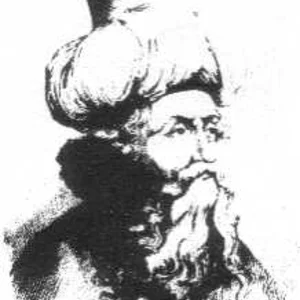

Ibn Arabi was a Muslim mystic, theologian, and philosopher born in Murcia in al-Andalus. Nicknamed al-Shaykh al-Akbar (the Greatest Master), he is one of the major figures of Sufism and profoundly shaped the metaphysical thought of Islam.
Ibn Arabi(1165 — 1240)
Ibn Arabi
califat almohade
6 min read
Frequently asked questions
Famous Quotes
« My heart has become capable of taking on every form.»
Key Facts
- Born in 1165 in Murcia, in Muslim al-Andalus
- Author of the Futuhat al-Makkiyya (The Meccan Illuminations), an encyclopedic summa of Sufism
- Wrote the Fusus al-Hikam (The Bezels of Wisdom), a major work of Sufi metaphysics
- Developed the doctrine of the oneness of being (wahdat al-wujud)
- Died in 1240 in Damascus, where his tomb is located
Works & Achievements
A monumental work spanning several thousand pages, a true encyclopedia of Sufi metaphysics and spirituality, written from visions received in Mecca.
A short text of immense influence, in which each chapter links a prophet to a divine wisdom. It has nourished centuries of commentaries.
A collection of love poems, accompanied by a commentary revealing their hidden mystical meaning. It illustrates the “religion of love” so dear to Ibn Arabi.
The vision that all existence is but a manifestation of the one divine Being. This thought profoundly shaped Sufism and Islamic philosophy.
A short treatise describing the spiritual ascent of the soul through the degrees of being up to the divine presence.
An allegorical account of a spiritual ascension inspired by the Prophet's night journey, blending inner vision and metaphysical teaching.
Anecdotes
Around the age of fifteen, the young Ibn Arabi is said to have met the great philosopher Averroes (Ibn Rushd) in Cordoba. According to his own account, the scholar questioned him about mystical knowledge; the young man answered with both "yes" and "no
suggesting that the path of spiritual intuition went beyond that of reason alone.
Ibn Arabi recounts that very early in life he received a decisive vision during a serious illness. This experience is said to have driven him to abandon ordinary life and devote himself entirely to the spiritual quest and to Sufism.
In 1202, during a pilgrimage to Mecca, he composed love poems inspired by a young woman named Nizam, the daughter of a Persian scholar. Accused of celebrating profane loves, he wrote a commentary of his own showing that every verse concealed a mystical and spiritual meaning.
He was given the title al-Shaykh al-Akbar
the greatest master." A tireless traveler, he journeyed across the entire Muslim world, from Spain to the Maghreb, then from Egypt to Mecca, Baghdad, Anatolia, and finally Damascus, where he ended his days.
His major work
the Futuhat al-Makkiyya (
The Meccan Illuminations
)
runs to thousands of pages. Ibn Arabi claimed to have written nothing of his own initiative
but rather under an inspiration he described as an
unveiling" come from on high.
Primary Sources
My heart has become capable of every form: it is a pasture for gazelles and a convent for Christian monks, a temple for idols and the Kaaba of the pilgrim.
I profess the religion of love; wherever its caravans turn, love remains my religion and my faith.
Divine wisdom manifests in each prophet like a precious stone set in the bezel of a ring, each one reflecting a particular divine name.
Key Places
City of al-Andalus where Ibn Arabi was born in 1165, then under Almohad rule.
Great Andalusian city where Ibn Arabi grew up, studied, and had his first spiritual experiences.
Intellectual capital of Muslim Spain, where he is said to have met the philosopher Averroes in his youth.
Holy city of Islam where he performed the pilgrimage in 1202 and began writing the Futuhat al-Makkiyya.
Capital of the Seljuk sultanate of Anatolia where Ibn Arabi was received with honor during his travels.
Eastern city where he settled at the end of his life, died in 1240, and was buried on Mount Qasiyun.
Typical Objects

A reed cut and split for writing in ink. Ibn Arabi used it to compose his thousands of pages of illuminations.

A codex of hand-copied paper leaves in which mystical treatises and poems were recorded. His works circulated from copy to copy across the Muslim world.

A string of beads used to recite the names of God and devotional invocations. A central instrument of the Sufi practice of dhikr, the remembrance of the divine.

A garment of coarse wool given to the Sufi disciple by his master, a symbol of initiation and of belonging to a spiritual path. Wool (suf) gave Sufism its name.

A small vessel holding black or colored ink, indispensable to the copyist and the author. A constant companion of the medieval scholar.

A cloth on which the believer prostrates toward Mecca. For the Sufi, it marks out the space of contemplation and inner concentration.
School Curriculum
Vocabulary & Tags
Key Vocabulary
Daily Life
Morning
Before dawn, Ibn Arabi would rise for prayer, followed by long periods of *dhikr*, the remembrance of the names of God. The early hours were devoted to meditation and sometimes to teaching a few disciples.
Afternoon
The afternoon was divided between reading, the study of the Quran and the hadiths, and the writing of his treatises. He also received visitors who came seeking spiritual guidance or to discuss theological questions.
Evening
In the evening, after prayer, he continued writing or dictated to his disciples the visions he claimed to receive. The vigils could stretch on into poetic recitations and silent meditation.
Food
Like many Sufis, he practiced frugality and frequent fasting, making do with bread, dates, fruit, and a little water. The simplicity of his food was seen as a discipline of the soul.
Clothing
He wore the plain garb of the Sufis: a long tunic and sometimes the woolen cloak (*khirqa*), a symbol of his spiritual path, along with a turban in keeping with the custom of the scholars of his time.
Housing
A perpetual traveler, he often lodged in mosques, in *zawiyas* (Sufi lodges), or with learned patrons. In Damascus, he eventually settled in a modest dwelling provided by a family of notables.
Historical Timeline
Period Vocabulary
Liens externes & ressources
Références
Œuvres
Al-Futuhat al-Makkiyya (Les Illuminations mecquoises)
vers 1202-1231
Fusus al-Hikam (Les Chatons des sagesses)
vers 1229
Tarjuman al-Ashwaq (L'Interprète des désirs)
vers 1215
Doctrine de l'Unicité de l'être (wahdat al-wujud)
XIIIe siècle
Risalat al-Anwar (L'Épître des lumières)
XIIIe siècle
Kitab al-Isra (Le Livre du voyage nocturne)
vers 1198