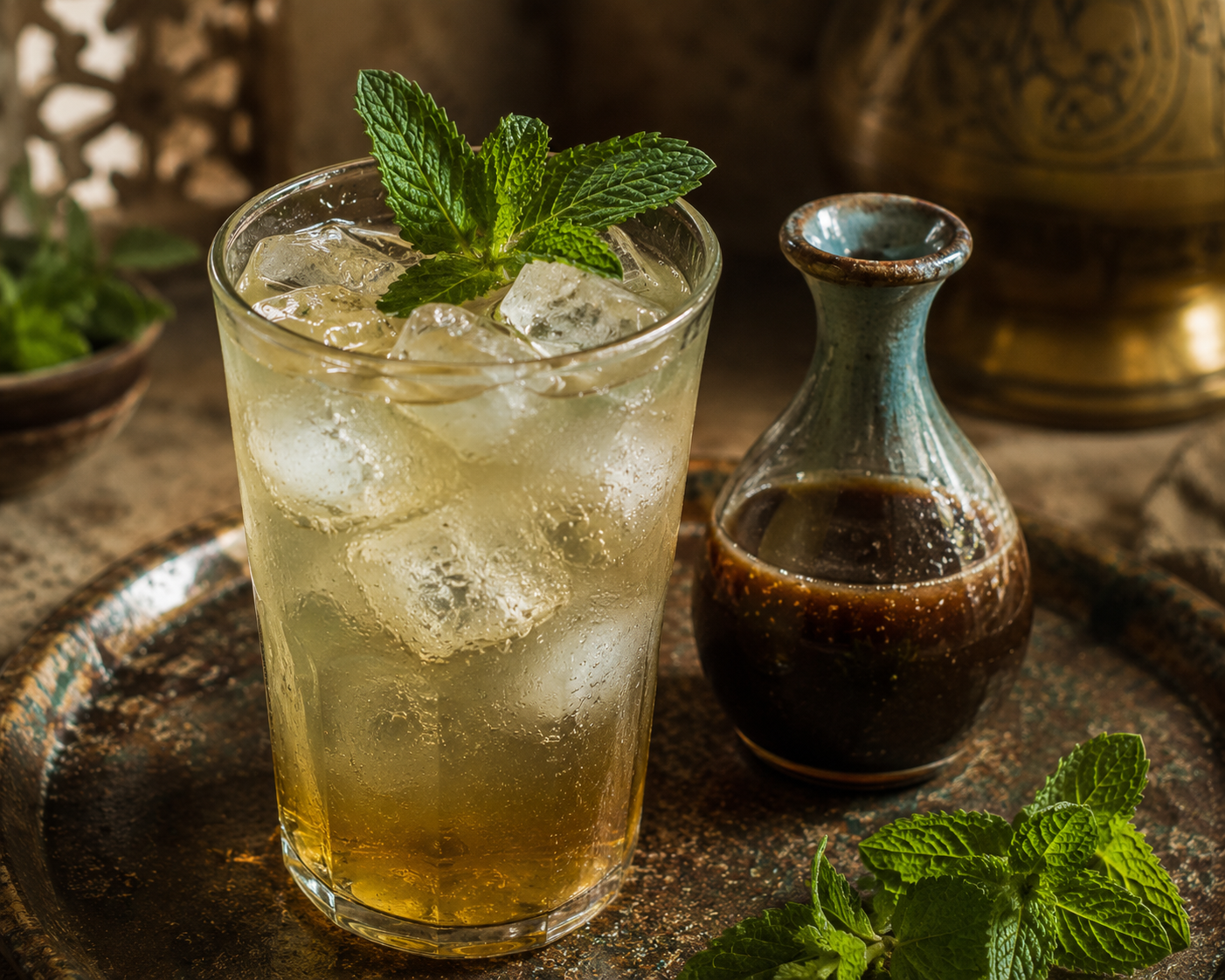
Sekanjabin — Honey and Vinegar Syrup with Mint
An amber syrup of honey and vinegar, infused with mint, stored in a bottle and diluted with cold water when drunk. Tart, sweet, deeply thirst-quenching, it is the medieval antidote to heat — and a reputed digestive remedy.
An amber syrup of honey and vinegar, infused with mint, stored in a bottle and diluted with cold water when drunk. Tart, sweet, deeply thirst-quenching, it is the medieval antidote to heat — and a reputed digestive remedy.
In Cairo, the heat oppresses a man who sits judging all day. So I always kept this sharāb in a jug, which physicians recommend: honey and vinegar cooked together until they form a syrup, into which one throws a few mint sprigs. A spoonful in a cup of cold water, and the mouth is refreshed, the stomach soothed, the mind returns to study. We people of the Law do not touch wine; but God, in His mercy, has not deprived man of delicious drinks. Taste, and you will bless the measure of those who composed it.
- •Honey — two parts (sweet base of syrup)
- •Wine vinegar — one part (preservative acidity)
- •Fresh mint — one bunch (fragrance)
- •Water — for cooking and diluting (medium)
Sekanjabin — Honey and Vinegar Syrup with Mint
An amber syrup of honey and vinegar, infused with mint, stored in a bottle and diluted with cold water when drunk. Tart, sweet, deeply thirst-quenching, it is the medieval antidote to heat — and a reputed digestive remedy.
Why this dish? In the blazing heat of Cairo, where Ibn Khaldun served as grand Maliki qadi, and throughout the Maghreb of scorching summers, sekanjabin (oxymel: honey + vinegar) was THE refreshing drink, both thirst-quenching and reputed to aid digestion. As a scholar observing Islamic prescriptions — thus avoiding wine — he refreshed himself with these permitted perfumed syrups.
In Cairo, the heat oppresses a man who sits judging all day. So I always kept this sharāb in a jug, which physicians recommend: honey and vinegar cooked together until they form a syrup, into which one throws a few mint sprigs. A spoonful in a cup of cold water, and the mouth is refreshed, the stomach soothed, the mind returns to study. We people of the Law do not touch wine; but God, in His mercy, has not deprived man of delicious drinks. Taste, and you will bless the measure of those who composed it.
Ingredients (period version)
- Honey — two parts (sweet base of syrup)
- Wine vinegar — one part (preservative acidity)
- Fresh mint — one bunch (fragrance)
- Water — for cooking and diluting (medium)
Ingredients
- Honey — 300 g (sweet base)
- White wine or cider vinegar — 120 ml (acidity)
- Water — 200 ml for syrup (cooking)
- Fresh mint — 1 large bunch (fragrance)
- Ice-cold water — for serving (dilution)
Method
- In a saucepan, dissolve the honey in the water and bring to a simmer.
- Add the vinegar and let reduce over low heat for 15 to 20 minutes until a light syrup consistency.
- Off the heat, plunge in the mint bunch and let infuse until completely cool.
- Remove the mint, strain, and store the syrup in a bottle (it keeps for several weeks in the fridge).
- To serve: 1 to 2 spoonfuls of syrup in a tall glass of ice-cold water, with a fresh mint leaf.
How it was made : Sekanjabin (from Arabic-Persian sikanjabīn, 'vinegar-honey') is an oxymel inherited from Greek medicine and perfected by Arab physicians (Ibn Sina, Razi) as a health drink. Ubiquitous in medieval cookbooks, it was made with mint, rose, or quince. The concentrated syrup kept for a long time without ice — a rare luxury — and was drunk diluted.
The contemporary twist : Served very cold over crushed ice with a splash of sparkling water and a ribbon of cucumber, it is an elegant, historical mocktail, alcohol-free and refined-sugar-free.
Sources : Arabic medico-culinary treatises (Ibn Sina, al-Razi) on oxymel / sikanjabīn · Kitāb al-ṭabīkh fī al-Maghrib wa-l-Andalus — recipes for sharāb (syrups)
Ibn Khaldun · Charactorium