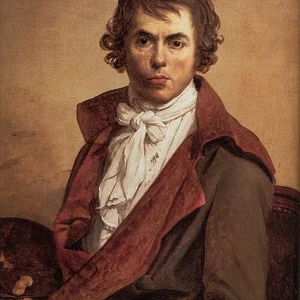

French Neoclassical painter (1748–1825), David was the leading figure in official painting during the Revolution and the Empire. His grand historical compositions and portraits left a lasting mark on Western art.
Jacques-Louis David(1748 — 1825)
Jacques-Louis David
France
9 min read
Frequently asked questions
Famous Quotes
« My paintings must be lessons in courage and virtue.»
Key Facts
- 1784: paints The Oath of the Horatii, a manifesto of Neoclassicism
- 1793: creates The Death of Marat, an icon of the Revolution
- 1799–1807: official painter to Napoleon I
- 1806–1807: completes The Coronation of Napoleon (9.79 × 6.21 m)
- 1816: exiled to Brussels as a regicide following the Restoration, where he dies in 1825
Works & Achievements
Commissioned by Louis XVI and exhibited at the Paris Salon, this painting depicts three Roman brothers swearing to conquer or die for their city. It caused an enormous aesthetic and moral shock, establishing neoclassicism as the dominant style and foreshadowing the civic values of the Revolution.
Painted within weeks of the assassination of the "friend of the people," this work shows Marat stabbed in his medicinal bath with a sobriety and emotional power unlike any other. It is considered one of the absolute masterpieces of Western political painting.
This painting depicts the Sabine women throwing themselves between their Roman husbands and their fathers, calling for reconciliation after war. Often read as a meditation on the wounds of the Revolution, it marked David's return to the artistic scene following his imprisonment.
A heroic equestrian portrait of Napoleon on a rearing horse against a dramatic sky, commissioned by King Charles IV of Spain. This mythologized image of the conqueror became an icon of Napoleonic propaganda, replicated in five versions.
A monumental work (9.79 m × 6.21 m) depicting Napoleon's coronation at Notre-Dame with more than 200 identifiable figures. A masterpiece of ceremonial painting, it stands at once as an exceptional historical document and an unrivalled demonstration of technical virtuosity.
An unfinished portrait of Juliette Récamier reclining on a *méridienne* in a classically inspired setting, left incomplete following a dispute with the sitter. Its modernity and enigmatic serenity make it one of the most fascinating portraits in all of French painting.
Anecdotes
On January 17, 1793, David, sitting as a deputy to the National Convention, voted for the death of King Louis XVI with no appeal and no reprieve. This regicidal vote illustrates the artist's absolute revolutionary commitment — he bound his brush and his political convictions so inseparably together that he became one of the most controversial figures of his era.
A few days before Marat's assassination, David had visited him in the medicinal bath where the friend of the people worked despite the skin disease consuming him. This encounter allowed him to paint The Death of Marat (1793) with striking precision, in just a few weeks — producing what is considered one of the greatest masterpieces of political painting of all time.
After the fall of Robespierre in July 1794, David was arrested and imprisoned. It was during this troubled period that he conceived the project of The Sabine Women, a painting about reconciliation after civil war, as if meditating on the upheaval of a Revolution in which he had been one of the key actors. The work was completed in 1799 and received as a call for national reconciliation.
To paint The Coronation of Napoleon (1805–1807), a colossal canvas nearly ten meters wide, David depicted Letizia Bonaparte, the Emperor's mother, in an honorary box — even though she had not attended the ceremony. Napoleon, who appreciated this skillful flattery, is said to have removed his hat before the finished painting and declared: “David, I salute you.”
In 1816, Louis XVIII exiled all the regicides of 1793, and David was forced to leave Paris for Brussels. Despite several opportunities to petition for a royal pardon and return to France, he refused them all, maintaining he had nothing to be forgiven for. He died in Brussels on December 29, 1825, and his remains were never repatriated — his native city refusing to receive them.
Primary Sources
Academies are aristocratic corporations that stifle nascent genius and bind talent to narrow rules. The freedom of the arts must be as complete as the civil freedom won by the people.
I may have been seduced and led astray by men whom I believed to be driven by love of their country. My crime was to believe in their virtue. I ask to be judged on the totality of my actions, and not on a friendship I thought I had earned.
These masterworks no longer belong to princes or kings: they are the property of the entire people. To open these halls to all citizens is to restore to the nation what has always been rightfully its own.
I want this painting to stand, a thousand years from now, as the most faithful testimony of that memorable day. Every figure, every decoration, every detail of costume must be rendered with an accuracy that posterity will not be able to contest.
Key Places
David was granted a studio-residence in the Louvre palace, a privilege awarded to academic artists and later retained under the Republic and the Empire. It was there that he trained hundreds of students and painted virtually all of his major works.
From 1775 to 1780, David stayed in Rome thanks to his Prix de Rome, studying ancient ruins, Raphael, and Greek sculptors. This formative stay definitively shaped his neoclassical style and his conviction that painting should instruct as much as it moves.
In 1791, David was commissioned to paint a vast canvas commemorating the Tennis Court Oath of 20 June 1789, a founding moment of the Revolution. The work, too ambitious in scope, was never completed, but its preparatory drawings remain invaluable historical documents.
On 2 December 1804, the coronation of Napoleon I took place in Notre-Dame Cathedral. David attended from a special gallery, sketchbook in hand, to prepare the monumental painting that would take him two years to complete.
After 1816, David settled permanently in Brussels, where he continued to paint and teach until his death on 29 December 1825. He refused all royal pardons and died in exile; his remains were interred in the Brussels cemetery, far from France.
Typical Objects

Large oval palette made of pear wood, loaded with oil-ground pigments: lead white, vermilion, ochres, Prussian blue. David worked with a limited but precise palette to achieve the luminous contrasts characteristic of his large compositions.

Natural drawing sticks used for the meticulous preparatory studies that David demanded of himself and his students before any painting began. His studio held hundreds of sheets of drawings — the true scientific foundation of each major composition.

Jointed wooden doll used to study the draping of fabric and the poses of figures in the absence of live models. David used it to refine the positions of his characters and test the effects of light on antique-style drapery.

Circular blue-white-red badge, symbol of revolutionary commitment. David wore the cockade, sat in the Convention, and organized the great republican festivals, closely weaving his identity as an artist with that of a revolutionary citizen.

A support several metres across, essential for the monumental historical compositions that made David's reputation. *The Coronation of Napoleon* required a canvas roughly ten metres wide — difficult to handle even in the vast studio of the Louvre.

Fabrics and accessories inspired by Greek and Roman antiquity, used to dress the models posing in the studio. David was obsessed with archaeological accuracy and had costume reconstructions made from ancient bas-reliefs and statues.
School Curriculum
Vocabulary & Tags
Key Vocabulary
Daily Life
Morning
David rose early to make the most of natural light — the best time to paint in his large studio at the Louvre. He worked standing before his canvas, palette in hand, subjecting his models to long sittings that could last several hours without a break.
Afternoon
Afternoons were often devoted to teaching: over the course of his career, his studio took in as many as four hundred students, including Gros, Ingres, and Gérard. David corrected drawings with absolute exacting standards, forbidding any use of color until a student had achieved full mastery of drawing from antique casts and live models.
Evening
Under the *Ancien Régime* and the Empire, David frequented patrons' dinners and Parisian salons where commissions were secured and useful friendships forged. During the Revolution, his evenings were often spent at the National Convention or preparing the great republican festivals for which he served as official stage director.
Food
Like the cultivated Parisian bourgeoisie of his day, David ate structured meals: soup, roasted or braised meat, vegetables, cheese, and table wine. His time in Rome had introduced him to Mediterranean cuisine, and he enjoyed dining with collectors who commissioned his portraits.
Clothing
Under the *Ancien Régime*, David wore the dress of the academic artist: dark coat, breeches, silk stockings, and powdered wig. During the Revolution he adopted simple civic fashions — short hair, a plain bourgeois coat — and under the Empire he wore the ceremonial costumes required by imperial protocol.
Housing
David had an apartment adjoining his large studio in the Louvre palace, a considerable privilege that allowed him to live and work at the heart of Paris. After his exile in 1816, he settled in a townhouse in central Brussels, where he continued to receive students and patrons until his death.
Historical Timeline
Period Vocabulary
Liens externes & ressources
Références
Œuvres
Bonaparte franchissant les Alpes au Grand-Saint-Bernard
1801
See also
Related Characters
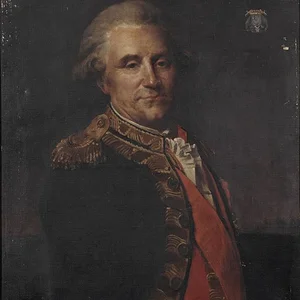
Antoine-Jean-Marie Thévenard
1733 — 1815
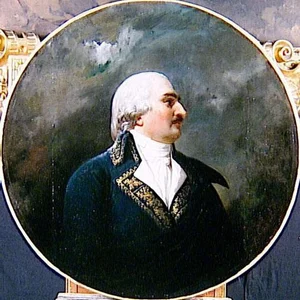
Auguste Marie Henri Picot de Dampierre
1756 — 1793
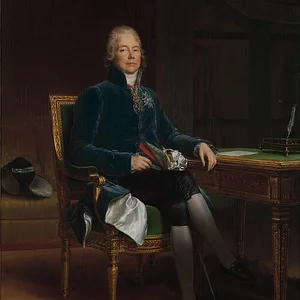
Charles-Maurice de Talleyrand-Périgord
1754 — 1839
Claude Ambroise Régnier
1746 — 1814
Claude-Louis Petiet
1749 — 1806
François Denis Tronchet
1726 — 1806