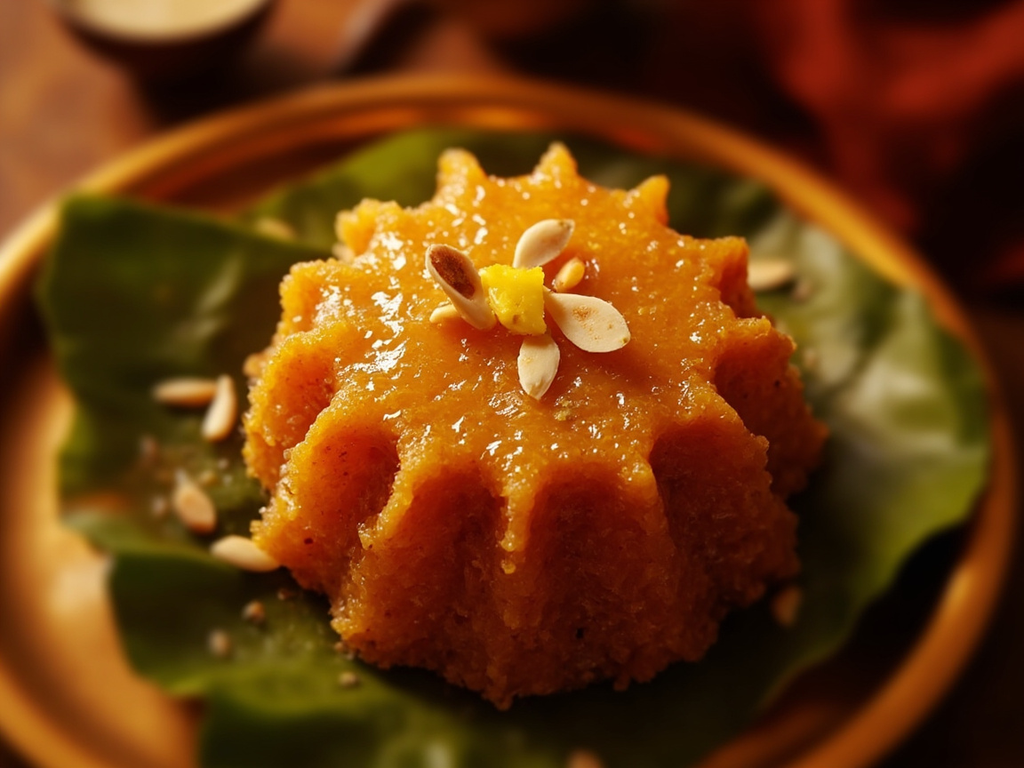
Halva-ye ard (Flour Halva with Saffron and Rosewater)
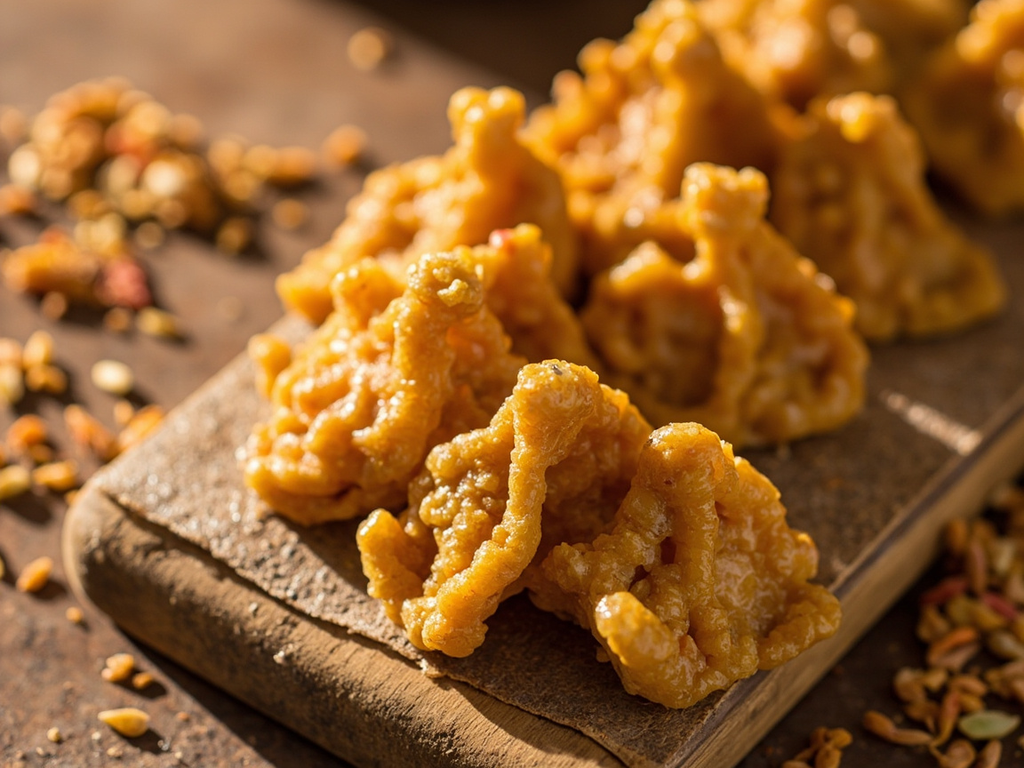
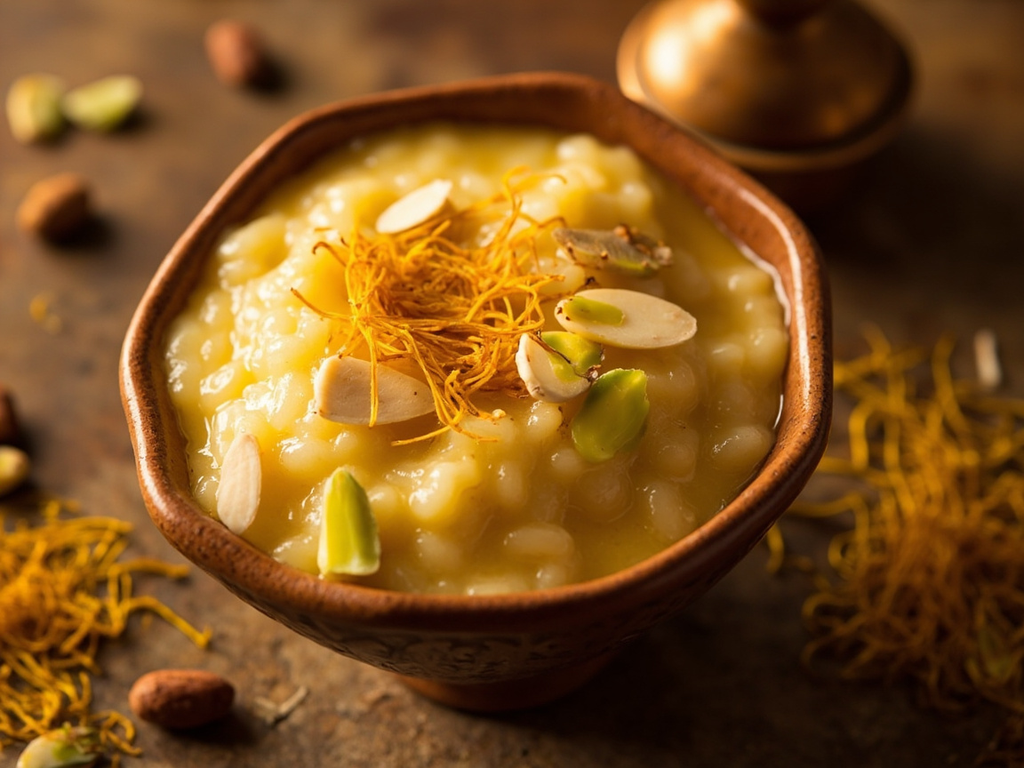
A dense, fragrant halva made by slowly toasting wheat flour in clarified butter until deep hazelnut-colored, then incorporating a saffron-rosewater sugar syrup. The texture is melting yet granular, the taste deeply buttery with floral rose notes. It is a preparation of patience—the flour must be stirred constantly for long minutes.
A dense, fragrant halva made by slowly toasting wheat flour in clarified butter until deep hazelnut-colored, then incorporating a saffron-rosewater sugar syrup. The texture is melting yet granular, the taste deeply buttery with floral rose notes. It is a preparation of patience—the flour must be stirred constantly for long minutes.
Halva, friend, is the cook's prayer. You must stir the flour in the butter without ever stopping, just as the dhikr never ceases in the lover's heart. If you stop, it burns; if you persevere, it turns golden and perfumes the whole house. When I smell this scent of saffron and rose rising from the cauldron, I know the entire khanqah will smile. It is the sweetness we offer to the living and the dead—for the border between them is as thin as a page of calligraphy.
- •Fine wheat flour — Two handfuls (Halva base)
- •Clarified butter (roghan-e kareh) — Equal weight to flour (Toasting and richness)
- •Sugar (or honey) — Equal weight to flour (Syrup)
- •Rosewater — A few spoonfuls (Fragrance)
- •Saffron — A pinch, infused (Color and fragrance)
- •Ground cardamom — A hint (Spice)
- •Pistachios and almonds — For decoration (Garnish)
Halva-ye ard (Flour Halva with Saffron and Rosewater)
A dense, fragrant halva made by slowly toasting wheat flour in clarified butter until deep hazelnut-colored, then incorporating a saffron-rosewater sugar syrup. The texture is melting yet granular, the taste deeply buttery with floral rose notes. It is a preparation of patience—the flour must be stirred constantly for long minutes.
Why this dish? In the Naqshbandi Sufi tradition, halva is prepared for dhikr (invocation) ceremonies, funerals, and commemorations of saints. Jami, master of the Naqshbandi order in Herat, presided over these ceremonies. The halva was distributed to participants as blessed food (tabarruk). Upon Jami's death in 1492, it is reported that halva was distributed for three days in Herat.
Halva, friend, is the cook's prayer. You must stir the flour in the butter without ever stopping, just as the dhikr never ceases in the lover's heart. If you stop, it burns; if you persevere, it turns golden and perfumes the whole house. When I smell this scent of saffron and rose rising from the cauldron, I know the entire khanqah will smile. It is the sweetness we offer to the living and the dead—for the border between them is as thin as a page of calligraphy.
Ingredients (period version)
- Fine wheat flour — Two handfuls (Halva base)
- Clarified butter (roghan-e kareh) — Equal weight to flour (Toasting and richness)
- Sugar (or honey) — Equal weight to flour (Syrup)
- Rosewater — A few spoonfuls (Fragrance)
- Saffron — A pinch, infused (Color and fragrance)
- Ground cardamom — A hint (Spice)
- Pistachios and almonds — For decoration (Garnish)
Ingredients
- All-purpose wheat flour — 200 g (Halva base)
- Clarified butter (ghee) — 200 g (Toasting and richness)
- Powdered sugar — 200 g (Syrup)
- Water — 250 ml (Syrup)
- Rosewater — 3 tbsp (Fragrance)
- Saffron threads — 1/2 g, infused in 2 tbsp hot water (Color and fragrance)
- Ground cardamom — 1/2 tsp (Spice)
- Slivered pistachios — 30 g (Decoration)
- Slivered almonds — 20 g (Decoration)
Method
- Prepare the syrup: in a saucepan, dissolve the sugar in water over medium heat. Bring to a boil, then remove from heat. Add the rosewater, saffron infusion, and cardamom. Keep warm.
- In a large heavy-bottomed pan or wok, melt the ghee over medium-low heat.
- Add all the flour at once and stir immediately with a wooden spoon. This is the crucial moment: stir CONSTANTLY for 15–20 minutes over medium-low heat.
- The flour will gradually change color: white → cream → blond → golden hazelnut. It should release a strong nutty butter fragrance. Do not rush by raising the heat—it will burn.
- When the flour is evenly golden and smells of hazelnuts, remove from heat. Pour the hot syrup in a thin stream while stirring vigorously. Watch for splatters—the mixture will hiss.
- Return to low heat and stir for another 2–3 minutes until the halva forms a smooth mass and pulls away from the sides.
- Pour into an oiled dish or mold. Smooth the surface, decorate with slivered pistachios and almonds in a pattern. Let cool slightly before cutting into diamonds.
How it was made : Flour halva (halva-ye ard) is one of the oldest confections of the Iranian world, mentioned in Arabic culinary texts as early as the 10th century. In Sufism, it has a sacred dimension: it is prepared and distributed during fatiha (prayers for the deceased), mawlid (Prophet's birthday), and urs (saint commemorations). Tradition holds that the halva is stirred with pious intention (niyyat), and each turn of the spoon is accompanied by an invocation. Jami, as sheikh of the Naqshbandi order in Herat, directly oversaw the preparation of halva at the khanqah as part of his spiritual authority.
The contemporary twist : Mold the halva in small dariole molds and unmold as precious bite-sized pieces on a serving tray—ideal for an afternoon tea.
Sources : Kitāb al-Ṭabīkh by Ibn Sayyār al-Warrāq (10th c.), translation by Nawal Nasrallah (2007) · Najmieh Batmanglij, « Food of Life » (2011), chapter on halvā · Jean-Pierre Digard et al., « Le fait culinaire en Iran » in Studia Iranica
Jami · Charactorium