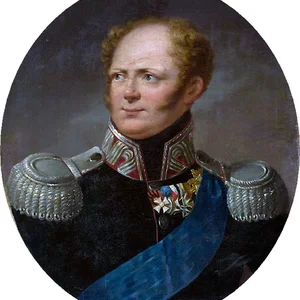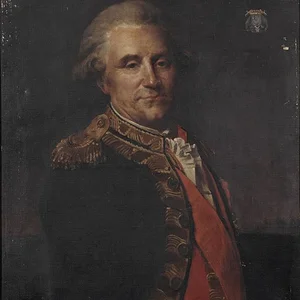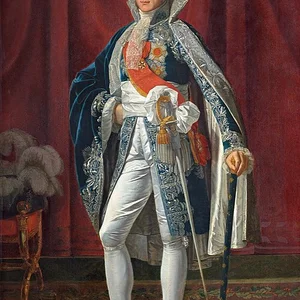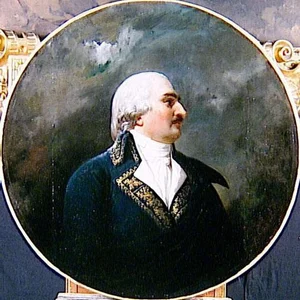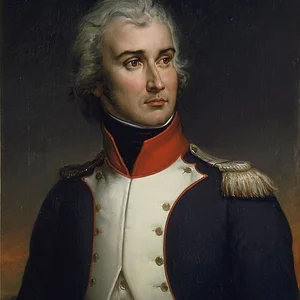

Marshal of the Empire and Duke of Montebello, Jean Lannes was one of Napoleon's most brilliant generals. A loyal comrade-in-arms since the Italian and Egyptian campaigns, he distinguished himself at Montebello, Austerlitz, and Jena. He died of his wounds at the Battle of Essling in 1809.
Jean Lannes(1769 — 1809)
Jean Lannes
France
7 min read
Frequently asked questions
Key Facts
- Born in 1769 in Lectoure in the Gers, he enlisted in the Revolutionary Army
- Distinguished himself at the Battle of Montebello (1800), from which he took his ducal title
- Created Marshal of the Empire in 1804 among the first eighteen marshals
- Played a decisive role at Austerlitz (1805) and Jena (1806)
- Mortally wounded at the Battle of Essling (22 May 1809), he died two days later
Works & Achievements
Commanding alone against a superior Austrian force, Lannes won a decisive victory that opened the road to Marengo. This battle earned him his future title of Duke of Montebello.
Lannes skillfully led the central corps during the Battle of the Three Emperors, holding his positions against repeated attacks and contributing to Napoleon's total victory.
As commander of the Grande Armée's vanguard, Lannes played a crucial role in the crushing of Prussia at Jena. His speed of maneuver contributed to the complete rout of the Prussian army.
Lannes was tasked with conducting the second siege of the Spanish city, defended by its inhabitants to the last breath. The capture of Zaragoza was one of the most difficult and bloody operations of the Peninsular War.
Alongside Bonaparte, Lannes took part in the Egyptian expedition and fought notably at the Siege of Acre, where he was severely wounded, reinforcing the unwavering trust the future Emperor placed in him.
Anecdotes
Jean Lannes was one of the few men who addressed Napoleon informally and spoke to him with complete frankness. The Emperor forgave him this liberty because he saw in him a sincere friend as much as an incomparable soldier. After his death, Napoleon said of him: “I found him a Pygmy and I left him a Giant.”
The son of a stud-groom from Lectoure in the Gers, Lannes was an apprentice dyer before the Revolution. It was the call to arms of 1792, in the face of foreign invasion, that led him to enlist with the national volunteers. Within just a few years, this Gascon craftsman had become a Marshal of the Empire.
At the Battle of Lodi in 1796, Lannes was one of the first to cross the bridge under a hail of grapeshot, charging at the head of the grenadiers. This exemplary bravery caught Bonaparte’s eye, and from that moment on he never lost sight of this fiery young officer.
Gravely wounded at the Battle of Essling in May 1809, both legs shattered by a cannonball, Lannes was carried to the island of Lobau. When Napoleon came to see him, the marshal reportedly said: “You are losing your best friend.” The Emperor, in tears, held him in his arms; Lannes died a few days later, at only 39 years of age.
During the Siege of Zaragoza in 1808–1809, Lannes had to wage an extremely brutal urban war, with Spanish inhabitants resisting house by house, cellar by cellar. The marshal was deeply affected by this bitter struggle, so unlike the set-piece battles he was accustomed to.
Primary Sources
Marshal Lannes has just succumbed to his wounds. France loses one of her bravest defenders and I one of my oldest companions in arms.
Marshal Lannes, at the head of the central corps, repulsed with rare vigor the repeated attacks of the enemy and held his positions until the final decision.
Lannes possessed that rare quality of communicating his momentum to his soldiers; under his command, the idea of retreat seemed not to exist.
Marshal Duke of Montebello, struck by a shell fragment that shattered both his legs, was carried from the battlefield with the utmost care and conveyed to the island of Lobau.
His Majesty, upon learning of the death of Marshal Lannes, could not hold back his tears and remained silent for a long time, which was exceedingly rare for him.
Key Places
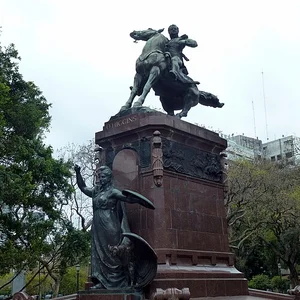
Birthplace of Jean Lannes, in Gascony. An equestrian statue in his honor stands on the main square, a testament to the local pride in this artisan's son who rose to become a Marshal of the Empire.
It was on this island in the Danube, after the Battle of Essling, that Lannes was treated for his wounds. He died there on May 31, 1809, surrounded by his comrades-in-arms and by Napoleon himself.
The site of Lannes's decisive victory on June 9, 1800 against the Austrians, which later earned him the title of Duke of Montebello. This battle directly paved the way for the victory at Marengo.
During the battle of December 2, 1805, Lannes brilliantly commanded the central corps, contributing to Napoleon's greatest victory against the Austrian and Russian empires.
Napoleon had Lannes's remains transferred to the Panthéon with the most solemn honors, granting him a state funeral. This gesture reflects the profound bond the Emperor felt for his companion-in-arms.
Typical Objects

The supreme symbol of the rank of Marshal of the Empire, this baton of blue velvet studded with golden eagles was presented by Napoleon himself. Lannes received his in 1804 during the first promotion of the eighteen marshals.

The regulation curved-blade weapon for officers, suited to close combat and cavalry charges. Lannes, an aggressive vanguard commander, carried a richly decorated general officer's sabre that reflected both his rank and his courage.

The two-cornered hat worn sideways (en bataille), characteristic of the Empire's general officers. It bore a tricolor cockade and a plume for grand ceremonies.

A blue coat embroidered with oak and laurel leaves in gold thread, white breeches, and riding boots: a marshal's parade uniform represented a small fortune. Lannes wore it at imperial ceremonies at the Tuileries.

An optical instrument indispensable to generals for observing the battlefield from their command post. Lannes used one to direct his army corps at battles such as Austerlitz and Jena.

Hand-drawn or engraved maps used by staff officers to plan maneuvers and anticipate enemy movements. They were essential during the campaigns in Italy, Germany, and Spain.
School Curriculum
Vocabulary & Tags
Key Vocabulary
Daily Life
Morning
On campaign, Lannes rose before dawn, often at four or five in the morning. He received reports from his divisional generals, inspected the bivouac positions, and dictated his orders to his aides-de-camp for the day's troop movements.
Afternoon
The afternoon was devoted to scouting the terrain with a spyglass and consulting with his staff. During battles, Lannes personally made his way to the most critical points, exposing himself to danger alongside the humblest of his soldiers.
Evening
In the evening, gathered around a bivouac fire, Lannes would often share soup and bread rations with his veterans, which earned him their deep affection. He went to bed late, after signing the reports sent to the Emperor.
Food
Like many soldiers of the Grande Armée, Lannes often ate whatever the campaign provided: coarse bread, vegetable soup, boiled or roasted meat cooked over the bivouac fire. In peacetime in Paris, he could afford a more refined table, befitting his rank as a marshal.
Clothing
On duty, Lannes wore the marshal's uniform: a blue coat with gold embroidery, fringed gold epaulettes, white breeches, and riding boots. On the battlefield, he sometimes preferred a more understated outfit to avoid being singled out by enemy sharpshooters.
Housing
On campaign, Lannes lodged in a staff tent or in a requisitioned house near the battlefield. In Paris, his imperial endowments allowed him to reside in a private mansion befitting his rank as marshal and peer of the Empire.
Historical Timeline
Period Vocabulary
Liens externes & ressources
Références
Œuvres
Victoire de Montebello
9 juin 1800
Commandement du Ve Corps à Austerlitz
2 décembre 1805
Conduite de l'avant-garde à Iéna
14 octobre 1806
Participation à la campagne d'Égypte
1798-1799