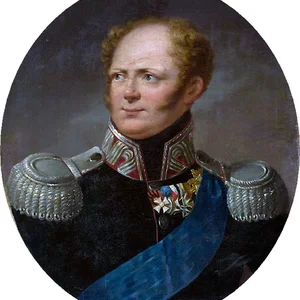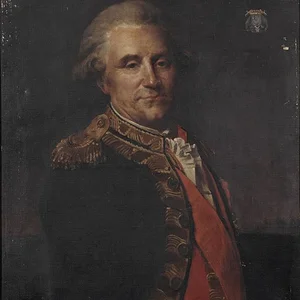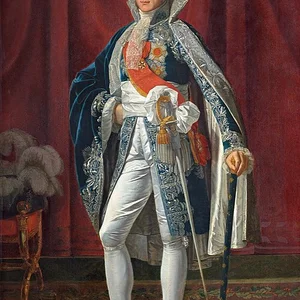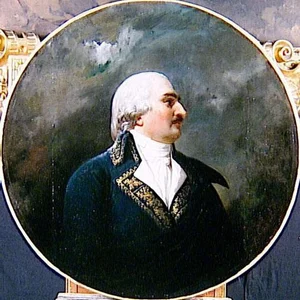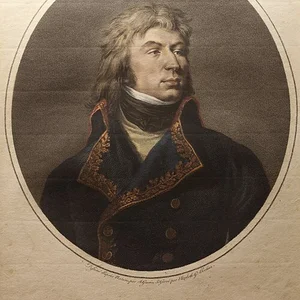

A divisional general of the First Empire, Reynier took part in the great Napoleonic campaigns in Egypt, Italy, and Central Europe. He distinguished himself notably at the Battle of Maida (1806) and during the Russian campaign (1812).
Jean-Louis-Ébénézer Reynier(1771 — 1814)
Jean-Louis-Ébénézer Reynier
France
8 min read
Frequently asked questions
Key Facts
- Born in 1771 in Lausanne, he joined the French Revolutionary Army
- Took part in the Egyptian campaign (1798–1799) under Bonaparte
- Defeated at the Battle of Maida in Calabria (1806)
- Commanded the 7th Corps during the Russian campaign (1812)
- Died in 1814 in Paris from wounds sustained in battle
Works & Achievements
Reynier's major work on the Egyptian campaign, describing the political and military situation following the death of Kléber. This first-hand account is a valuable source for the history of Napoleon's expedition to the East.
Reynier led this allied corps of Saxon soldiers throughout the Russian campaign, from the crossing of the Niemen to the disastrous retreat, maintaining relative cohesion despite extreme conditions.
An official document in which Reynier accounts for the Calabria campaign and the circumstances of the Battle of Maida, addressed to the Minister of War. An essential primary source for understanding French strategy in the Kingdom of Naples.
A collection of dispatches, orders of battle, and situation reports exchanged with the supreme command, held at the Archives of the Service Historique de la Défense in Vincennes. These documents shed light on the day-to-day management of a major Napoleonic unit.
Anecdotes
At the Battle of Maida in Calabria (4 July 1806), Reynier commanded the French forces against the British troops of General Stuart. His defeat — a rare setback for the Napoleonic armies against the English on the European continent — was partly attributed to an underestimation of the firepower of British infantry deployed in open order. This failure had a lasting influence on tactical thinking within the imperial general staff.
During the Egyptian campaign (1798–1801), Reynier distinguished himself as one of the most active divisional generals. At the Battle of Heliopolis (20 March 1800), he commanded the right wing of the French army which, under Kléber, routed an Ottoman army far superior in numbers. This victory temporarily allowed the French to consolidate their position in Egypt.
In 1812, Reynier commanded the VII Corps, composed largely of Saxon soldiers — reluctant allies of Napoleon. With little enthusiasm for dying on behalf of the Emperor of the French, these troops endured immense suffering during the retreat through the Russian cold. Reynier nonetheless managed to maintain a degree of cohesion within his corps under extreme conditions.
At the Battle of Leipzig in October 1813, known as the “Battle of Nations,” the Saxon troops under Reynier’s command defected in the midst of fighting and went over to the Coalition. This spectacular reversal contributed to Napoleon’s defeat and placed Reynier in a particularly difficult position: he found himself commanding soldiers who had just switched sides to the enemy in the heat of battle.
Recognized for his abilities as a staff officer and his mastery of logistical matters, Reynier nevertheless had a reputation for a difficult temperament and did not hesitate to oppose the orders of his superiors. This independence of mind earned him several temporary falls from grace over the course of his career, most notably after the Egyptian campaign, where his relations with the military hierarchy were strained.
Primary Sources
Reynier meticulously describes the military and political situation in Egypt following Kléber's death, offering a firsthand account of the difficulties of the French occupation and the complex relations with local populations and Ottoman powers.
Reynier recounts in this report the circumstances of the engagement in Calabria, seeking to explain the reasons for the French defeat against the British and to clarify his own share of responsibility in the outcome of the battle.
The full collection of dispatches and situation reports exchanged between Reynier and the imperial general staff documents his requests for reinforcements, his tactical decisions, and his relations with the supreme command during various campaigns.
These official bulletins drafted under Napoleon's supervision repeatedly mention the operations of Reynier's corps during the German and Russian campaigns, notably during the catastrophic retreat of 1812.
Key Places
Birthplace of Jean-Louis-Ébénézer Reynier, born on January 4, 1771 in this Swiss city, then an intellectual hub of the Enlightenment. Switzerland supplied many officers to the French Revolutionary and Imperial armies.
Site near present-day Cairo where a decisive battle took place on March 20, 1800: Reynier commanded the right wing of the French army that crushed the Ottoman forces under Kléber's overall command.
Village in southern Italy where the Battle of Maida took place on July 4, 1806. Reynier commanded the Imperial forces and was defeated by the British under General Stuart, in one of the rare French setbacks on the continent.
City in central Germany where the "Battle of the Nations" was fought from October 16 to 19, 1813. It was here that Reynier's Saxon troops defected to join the coalition, contributing to Napoleon's decisive defeat.
Capital of the French Empire where Reynier died on February 27, 1814, just weeks before Napoleon's abdication. He resided there between campaigns and moved in the military and political circles of the Imperial high administration.
Typical Objects

The standard sidearm of imperial general officers, with a curved blade suited for both thrusting and slashing. Reynier carried a richly ornamented saber, a symbol of his rank as divisional general.

The two-cornered hat characteristic of Napoleonic general officers, worn "en bataille" (sideways) to be recognized on the battlefield. Adorned with feathers and a tricolor cockade.

An essential optical instrument for observing enemy movements from high ground or command posts. Reynier used it to direct his divisions during the great Napoleonic battles.

A detailed topographic map used for planning military operations and reading the terrain. The imperial general staff had developed precise cartography of Europe to support its campaigns.

Imperial blue coat embroidered in gold, two-star epaulettes, white breeches, and riding boots. The distinctive mark of a divisional general's rank within the Grande Armée.

A badge of authority presented to general officers to symbolize their power over the troops. Reynier received the insignia of his rank at each successive promotion within the imperial military hierarchy.
School Curriculum
Vocabulary & Tags
Key Vocabulary
Daily Life
Morning
Reynier rose before dawn during campaigns, as required by imperial military routine. He received reports from his brigade generals and studied maps with his staff to anticipate the day's movements. Orders of the day were drawn up and transmitted to the regiments in the early hours.
Afternoon
A divisional general's afternoon on campaign was devoted to troop inspections, organizing billets, and receiving scouts reporting enemy positions. During engagements, Reynier would take position on high ground to observe the battlefield through his spyglass and coordinate his divisions.
Evening
Evenings at the bivouac brought Reynier and his senior officers together over a frugal meal, often prepared from locally requisitioned resources. Plans for the following day were discussed, along with news arriving from imperial headquarters. Officers would write their personal correspondence during these moments of relative calm.
Food
On campaign, the diet of Napoleonic generals — though better than that of ordinary soldiers — remained heavily dependent on the territory being crossed. Army bread, boiled or roasted meat, wine or brandy formed the standard fare. In Egypt, Reynier had to adapt to a very different local diet: dates, rice, mutton, and vegetables from the Nile region.
Clothing
The uniform of a divisional general featured a blue coat embroidered in gold with distinctive epaulettes, worn over a white waistcoat and jacket. In the field, a grey greatcoat might replace the regulation coat for greater comfort. Riding boots and a bicorne hat adorned with plumes completed the outfit for reviews and battles.
Housing
Between campaigns, Reynier lived in a Paris apartment befitting his rank. On campaign, he typically occupied the most convenient house in whichever village served as his headquarters — sometimes a requisitioned château or town hall. His study housed the maps and military correspondence essential to the exercise of his command.
Historical Timeline
Period Vocabulary
Liens externes & ressources
Références
Œuvres
De l'Egypte après la bataille d'Héliopolis
1802
Commandement du VII° Corps (Corps saxon) lors de la campagne de Russie
1812
Rapport sur les opérations en Calabre
1806
Correspondance militaire avec l'état-major impérial
1800-1814