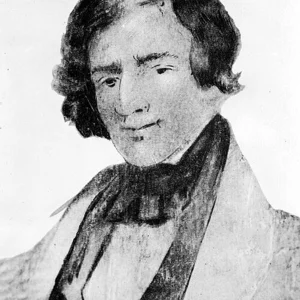

American trapper, explorer, and cartographer. The first known man to cross the Sierra Nevada range and the Great Basin desert overland, he helped map the American West before his early death at age 32.
Jedediah Smith(1799 — 1831)
Jedediah Smith
États-Unis
7 min read
Frequently asked questions
Key Facts
- Born in 1799 in Jericho (now Bainbridge), in the state of New York
- Joined William Henry Ashley's fur-trading expedition on the Missouri in 1822
- First overland crossing of the Sierra Nevada by an American in 1827
- First to cross the Great Basin desert and reach California overland from the east (1826-1827)
- Killed in 1831 by Comanches on the Santa Fe Trail, near the Cimarron River
Works & Achievements
Smith and his companions identify this passable gap through the Rockies, which would become the major route of the conquest of the West and of the Oregon Trail.
First American to reach California overland from the east, crossing the Mojave Desert and opening a new route to the Pacific.
First known crossing of the Sierra Nevada from west to east, followed by the exploration of the Great Basin Desert as far as the Great Salt Lake.
Smith travels up the coast toward Oregon, journeying through territories then unknown to Americans, despite the Umpqua massacre that decimated his party.
His surveys and observations made it possible to correct and complete the maps of the West, notably by proving the nonexistence of the mythical “Buenaventura” River.
With his partners, he bought out William Ashley's fur company and led the great trapping expeditions across the Rockies.
Anecdotes
In 1823, in the Black Hills, Jedediah Smith was attacked by a grizzly bear that tore off part of his scalp and nearly severed one of his ears. Keeping his composure, he ordered his companion Jim Clyman to stitch his head and ear back together with a needle and thread. He would carry these scars, growing his hair long to hide them, for the rest of his life.
Among trappers known for drinking, swearing, and smoking, Smith stood out: a devout Methodist, he drank no alcohol, did not smoke, and always carried his Bible. His companions nicknamed him “the praying trapper” and respected his remarkable uprightness.
In 1826, Smith became the first American to reach California overland from the east. Suspicious, the Mexican governor José María de Echeandía detained him in San Diego, convinced that a man who had arrived alone across the desert could only be a spy.
In 1827, he crossed the Sierra Nevada from west to east for the first time, then traversed the scorching desert of the Great Basin. Running out of water and food, he and his two companions buried themselves in the sand to survive the heat and arrived at the Great Salt Lake skeletal.
His end was tragic and brutal: in 1831, having set out alone to find water in the desert along the Santa Fe Trail, he was killed by Comanche warriors near the Cimarron River, at only 32 years old. His body was never found.
Primary Sources
One of his ears was torn from his head out to the outer rim. He told me to take a needle and thread and sew up the wounds around his head.
In it, Smith gives an account of his journey across the unexplored regions of the West, describing the crossing of the mountains and deserts all the way to California.
Day by day, Rogers records the life of the party, the encounters with the Spanish missions and the Indians, and the wary reception from the Mexican authorities.
To enterprising young men. The subscriber wishes to engage one hundred men to ascend the Missouri River to its source and to be employed there for one, two, or three years.
Key Places
Village in New York State where Jedediah Smith was born in 1799 into a family of pioneers. There he received a formative Christian education.
Wide pass through the Rocky Mountains rediscovered by Smith and his companions in 1824. It became the main gateway to the West for pioneers.
Spanish mission near present-day Los Angeles, where Smith arrived in 1826 at the end of his crossing of the desert. He was welcomed there but then treated as a suspect by the Mexican authorities.
High mountain range that Smith was the first to cross from west to east in 1827, through snow and cold. A major geographical feat.
Rallying point for the trappers, which Smith reached, exhausted, after crossing the Great Basin in 1827. A key region of his explorations.
Desert region of the southern Great Plains where Smith, having set out alone to look for water, was killed by Comanches in 1831. His body was never found.
Liens externes & ressources
Références
Œuvres
Redécouverte du South Pass
1824
Première expédition terrestre vers la Californie
1826-1827
Premier franchissement de la Sierra Nevada et du Grand Bassin
1827
Exploration de la côte Pacifique (Californie-Oregon)
1828
Contributions cartographiques de l'Ouest américain
1826-1831
Direction de la Smith, Jackson & Sublette
1826-1830