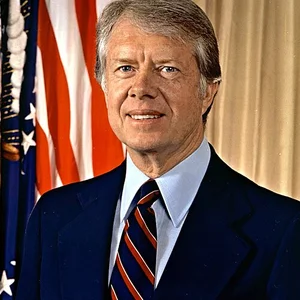

American statesman, 39th President of the United States from 1977 to 1981. A Democrat from Georgia, he remained famous for his diplomatic work and humanitarian commitment after his presidency, crowned by the Nobel Peace Prize in 2002.
Jimmy Carter(1924 — 2024)
Jimmy Carter
États-Unis
6 min read
Frequently asked questions
Key Facts
- Elected 39th President of the United States in 1976, in office from 1977 to 1981
- Sponsored the Camp David Accords in 1978, leading to the Israeli-Egyptian peace treaty of 1979
- Faced the Iran hostage crisis in Tehran (1979-1981), which weighed on his bid for reelection
- Defeated by Ronald Reagan in the 1980 presidential election
- Awarded the Nobel Peace Prize in 2002 for his diplomatic and humanitarian work
Works & Achievements
Major diplomatic mediation that led to the first peace treaty between Israel and an Arab country, Egypt.
An institutional response to the oil crisis, intended to coordinate American energy policy.
Agreements providing for the return of the Panama Canal to Panama by 1999, a bold gesture toward Latin America.
A nuclear arms limitation treaty signed with the USSR, illustrating the policy of détente.
An organization devoted to human rights, democracy, and global health, extending his work beyond the presidency.
A public health effort that brought cases of this parasitic disease down from millions to a mere handful worldwide.
An honor recognizing decades of efforts to resolve conflicts peacefully and advance human rights.
Carter built and renovated homes for disadvantaged families with his own hands for decades.
Anecdotes
Before becoming president, Jimmy Carter was a peanut farmer in Georgia. His family ran a prosperous farm, and during his 1976 campaign, his supporters handed out peanuts to promote him. It's one of the most famous images of his political career.
In 1979, Carter reported having observed a UFO about a decade earlier, in 1969, while he was waiting for a meeting in Georgia. He described a strange light in the sky and promised during his campaign to make public the government's information on the subject, which made him popular among the curious.
A naval officer, Carter was trained in the nuclear submarine program under Admiral Hyman Rickover. In 1952, he took part in dismantling a damaged nuclear reactor at Chalk River, in Canada, going down into the radioactive zone himself for only a few seconds at a time because of the radiation.
In September 1978, Carter brought together Egyptian President Anwar Sadat and Israeli Prime Minister Menachem Begin for thirteen days at the presidential retreat of Camp David. His patient mediation led to the Camp David Accords, a major turning point for peace in the Middle East.
After his presidency, Carter devoted decades to humanitarian work, notably building houses with his own hands for the organization Habitat for Humanity. His campaign against a parasitic disease, the Guinea worm, helped reduce the number of cases worldwide from millions to just a few dozen.
Primary Sources
Because we are free we can never be indifferent to the fate of freedom elsewhere. Our moral sense dictates a clearcut preference for these societies which share with us an abiding respect for individual human rights.
The threat is nearly invisible in ordinary ways. It is a crisis of confidence. It is a crisis that strikes at the very heart and soul and spirit of our national will.
The parties pledge to settle the disputes between them by peaceful means. A just, comprehensive, and durable peace in the Middle East must be established.
War may sometimes be a necessary evil. But no matter how necessary, it is always an evil, never a good. We will not learn how to live together in peace by killing each other's children.
Key Places
Small rural town where Carter was born, grew up, and returned to live for the rest of his life. His peanut farm was located there.
Residence and workplace of the president from 1977 to 1981. There Carter conducted his domestic and foreign policy.
Presidential country retreat where Carter negotiated the historic 1978 peace accords between Egypt and Israel.
School where Carter received his training as a naval officer and graduated in 1946.
Organization founded in 1982 by Carter to defend human rights, observe elections, and fight diseases around the world.
City where Carter received the Nobel Peace Prize in December 2002, the crowning recognition of his diplomatic work.
Typical Objects

A symbol of his roots as a Georgia farmer, the peanut became the emblem of his 1976 presidential campaign.

Used to sign treaties, laws, and historic agreements such as the Camp David Accords. Presidents often give these pens to several signatories.

After his presidency, Carter built homes for the needy with this tool. It became the symbol of his hands-on humanitarian commitment.

Awarded in 2002, it honors his efforts for peace and human rights. Made of gold, it bears the likeness of Alfred Nobel.

Carter appeared on television wearing a cardigan to call on Americans to save energy during the oil crisis. The garment came to symbolize his message of restraint.

Carter had solar panels installed on the White House roof in 1979 to promote renewable energy, a pioneering gesture for the time.
School Curriculum
Vocabulary & Tags
Key Vocabulary
Tags
Daily Life
Morning
An early riser disciplined by his military training, President Carter began his day very early at the White House. He read intelligence reports and numerous files, known for his attention to detail and his fast reading.
Afternoon
His afternoons were devoted to meetings with his advisers, diplomatic negotiations, and domestic policy decisions. During the Camp David Accords, he shuttled back and forth between the Egyptian and Israeli delegations.
Evening
In the evening, a deeply devout man, Carter read the Bible, sometimes in Spanish to practice. He regularly taught Sunday school at the Baptist church in Plains, a habit he kept all his life.
Food
Coming from the rural South, Carter enjoyed simple Georgia cooking: peanuts, grits, catfish, and vegetables from the garden. He avoided hard liquor and led a sober life.
Clothing
He favored understated attire and sought to demystify the presidential office, sometimes appearing in a cardigan or jeans. For official ceremonies, he wore the classic suit.
Housing
After the White House, Carter returned to live in his modest home in Plains, which he had built in the 1960s. There he led a simple life, without the lavish lifestyle of other former presidents.
Historical Timeline
Period Vocabulary
Liens externes & ressources
Références
Œuvres
Accords de Camp David
1978
Création du Département de l'Énergie
1977
Traités sur le canal de Panama
1977
Accords SALT II
1979
Fondation du Centre Carter
1982
Campagne contre le ver de Guinée
années 1980-2020
Prix Nobel de la paix
2002