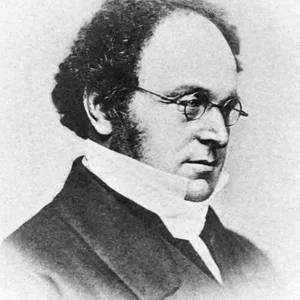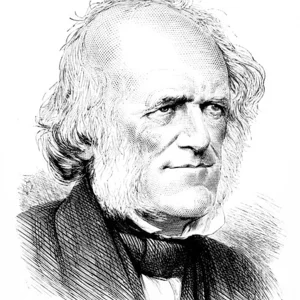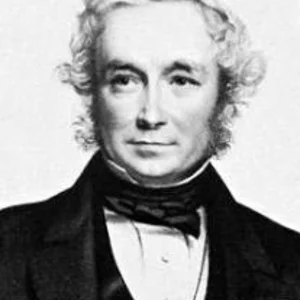

British botanist and geologist, professor at the University of Cambridge. As Charles Darwin's mentor, he recommended the young naturalist for the voyage of HMS Beagle, which gave rise to the theory of evolution.
John Stevens Henslow(1796 — 1861)
John Stevens Henslow
Royaume-Uni de Grande-Bretagne et d'Irlande
6 min read
Frequently asked questions
Key Facts
- Born in 1796 in Rochester, England, died in 1861 in Hitcham.
- Appointed professor of botany at the University of Cambridge in 1825.
- Mentor of Charles Darwin, whom he recommended in 1831 to sail as the naturalist aboard HMS Beagle.
- Founded the Cambridge Botanic Garden and developed teaching methods based on the direct observation of plants.
- Rector of the parish of Hitcham, where he worked to bring scientific education to rural communities.
Works & Achievements
By proposing his student as the Beagle's naturalist, Henslow set in motion the voyage that led Darwin to the theory of evolution — arguably his most famous contribution.
A botany textbook that reformed the teaching of the discipline, emphasizing the observation of living plants and their functions.
An inventory of the plants of the British Isles used as a tool for teaching and classification.
Henslow designed and had built a new botanic garden intended for scientific teaching, still in use today.
Henslow introduced practical work and field excursions, leaving a lasting mark on the teaching of the natural sciences.
As a parson, he created schools and gardens to teach science to the children and poor families of his rural parish.
Henslow identified phosphate-rich nodules, giving rise to an agricultural fertilizer industry in the region.
Anecdotes
In 1831, when he was offered a position as naturalist aboard HMS Beagle, John Henslow declined in order to stay close to his family — but he immediately thought of his young student Charles Darwin and warmly recommended him to Captain FitzRoy. Without that suggestion, the theory of evolution might never have come to light.
At Cambridge, Henslow organized field excursions where students went off to gather plants in the countryside. The regulars of these outings were nicknamed the “men who walk with Henslow,” so contagious was his enthusiasm for nature observed in the open air.
Henslow revolutionized the teaching of botany by having his students handle real plants, instead of merely making them memorize texts by heart. Darwin would later write that Henslow's lectures were the only ones from his university years of which he kept a truly useful memory.
Having become the parson of the village of Hitcham, Henslow cared so much for his poor parishioners that he founded a school where he taught science to farmers' children and set up gardens to teach them practical botany. He transformed a rural parish into a small laboratory of popular education.
Henslow was one of the founders of the Cambridge museum and botanical garden as we know them today, and he corresponded faithfully with Darwin throughout the entire Beagle voyage, receiving and preserving the specimens his former student sent him from the other side of the world.
Primary Sources
I recommend you as a man who is perfectly qualified to collect, observe, and note anything worth noting in natural history.
His knowledge was great in botany, entomology, chemistry, mineralogy, and geology. His most marked taste was for drawing conclusions from long and patient observations.
The study of botany should not be limited to memorizing names, but to understanding the organization and functions of living plants.
I am sending you a crate of specimens; make whatever use of them you think best, for I do not know to whom else I might entrust them.
Key Places
Town in south-east England where John Stevens Henslow was born in 1796.
Henslow studied here and then became professor of mineralogy and later of botany; it was here that he met and trained Charles Darwin.
A scientific garden that Henslow was one of the chief architects of, designed as a tool for teaching and research.
Rural village where Henslow became the parson in 1832; there he carried out a programme of popular education and died in 1861.
Town where Henslow helped to found a museum and worked to spread science among the general public.
Typical Objects

Two wooden boards tightened with straps, used to flatten and dry collected plants in order to preserve them. An essential tool for the field botanist.

A small magnifying lens for closely examining flowers, stamens and the organs of plants. Henslow encouraged his students to observe rather than memorise.

A collection of dried plants mounted on sheets and labelled, serving as a scientific reference. Henslow built an immense one, the foundation of his teaching at Cambridge.

A hammer with a flat head and a pick used to break rocks in order to extract minerals and fossils. Henslow also taught mineralogy and geology.

An optical instrument for observing plant structures invisible to the naked eye, such as cells and pollen grains. A key tool of the emerging field of physiological botany.

A metal box carried over the shoulder on excursions to transport freshly picked plants without damaging them. A companion on Henslow's field outings.
School Curriculum
Vocabulary & Tags
Key Vocabulary
Tags
Daily Life
Morning
As a professor at Cambridge, Henslow devoted his mornings to preparing and giving his botany lectures, often illustrated with fresh plants. After becoming a clergyman, he began the day with parish business and scientific correspondence.
Afternoon
The afternoon was readily set aside for field excursions with his students, gathering plants in the countryside around Cambridge. He also examined the specimens he received and organized his immense herbarium.
Evening
In the evening, he read, wrote letters to his former pupils such as Darwin, and worked on his books. A family man, he loved spending these hours with his wife and children.
Food
The diet of a British academic and clergyman in the Victorian era relied on bread, roast meat, vegetables from the garden, cheese, and tea, a drink that became central in the 19th century.
Clothing
Henslow wore the dark attire of an Anglican clergyman — a black frock coat and white collar — and, when carrying out his university duties, the academic gown of Cambridge.
Housing
He lived in the university quarters at Cambridge, then in the rectory of the village of Hitcham, a vast country house surrounded by gardens where he conducted his botanical experiments.
Historical Timeline
Period Vocabulary
Liens externes & ressources
Références
Œuvres
Recommandation de Darwin pour le HMS Beagle
1831
The Principles of Descriptive and Physiological Botany
1835
A Catalogue of British Plants
1829
Fondation du jardin botanique de Cambridge
1831-1846
Réforme de l'enseignement de la botanique à Cambridge
1825-1861
Œuvre d'éducation populaire à Hitcham
1832-1861
Découverte des coprolithes phosphatés du Suffolk
1843