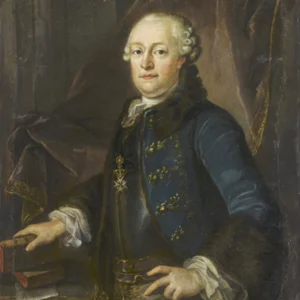

French navigator, hydrographer, and statesman (1738–1810), Fleurieu contributed to maritime cartography and oversaw several scientific expeditions. Minister of the Navy under Louis XVI, he played a key role in organizing France's major voyages of exploration.
Charles Pierre Claret de Fleurieu(1738 — 1810)
Charles Pierre Claret de Fleurieu
France
7 min read
Frequently asked questions
Key Facts
- Born in 1738 in Lyon, died in 1810 in Paris
- Minister of the Navy under Louis XVI (1790)
- Organized and oversaw the La Pérouse expedition (1785)
- Author of influential hydrographic works and navigation tables
- Member of the Académie de marine and the Institut de France
Works & Achievements
A maritime expedition commanded by Fleurieu to test Pierre Le Roy's chronometers under real sea conditions. This voyage provided scientific proof that longitude could at last be calculated accurately at sea, revolutionizing ocean navigation.
A geographical work in which Fleurieu analyzes and presents the discoveries made during recent voyages in the Pacific, advancing knowledge of the southern lands and contributing to the cartography of that vast region.
Fleurieu was the principal architect of this major scientific expedition, drafting the detailed instructions given to La Pérouse for a round-the-world voyage with geographical, scientific, and ethnographic objectives.
Following the disappearance of La Pérouse, Fleurieu organized, in his capacity as Minister of the Navy, the rescue expedition entrusted to Rear Admiral d'Entrecasteaux, tasked with finding traces of the lost explorer in the Pacific.
Fleurieu edited and annotated the journals and documents brought back by survivors of the La Pérouse expedition, enabling their posthumous publication and preserving for posterity the scientific legacy of that tragic voyage.
Anecdotes
In 1768, Louis XV entrusted Fleurieu with a secret mission: to test in open sea the new marine chronometers invented by Pierre Le Roy. These revolutionary instruments made it possible to calculate longitude with precision, a problem that had cost the lives of thousands of sailors for centuries. His eighteen-month voyage proved that marine chronometry was finally reliable, opening a new era of navigation.
It was Fleurieu who designed and organized in detail the expedition of the comte de La Pérouse in 1785, one of the greatest scientific adventures of the 18th century. He himself wrote the precise instructions given to the explorer: to observe coastlines, meet peoples, and collect scientific data. When La Pérouse disappeared in 1788, Fleurieu was among the first to call for the dispatch of a rescue expedition.
After the Revolution, Fleurieu achieved the rare feat of surviving the Terror without being arrested — despite having served as a minister of King Louis XVI. Discreet and recognized for his scientific expertise, he was quickly rehabilitated and continued to serve the state under the Republic and then under Napoleon. His reputation as a man of science protected him where so many other nobles lost their heads.
An entire peninsula in Australia bears Fleurieu's name to this day: the Fleurieu Peninsula, south of Adelaide. It was named in his honor during the great French expeditions that mapped the Australian coastlines at the turn of the 19th century. A tribute paid by geography to a man who had never once set foot on that continent.
Primary Sources
The repeated experiments with this marine chronometer, under varied and often unfavorable circumstances, have consistently confirmed the accuracy of its readings for determining longitudes at sea.
You will strive to collect all observations useful to the natural sciences, geography, and hydrography; you will treat the peoples you encounter with humanity and gentleness.
The certainty of geographical positions, obtained through the use of marine chronometers, now makes it possible to draw maps whose accuracy can be guaranteed to navigators.
This voyage, whose early news we followed with anxiety, could not be presented to the public without the authentic documents and journals that alone guarantee its scientific value.
Key Places
Fleurieu's birthplace, where he was born on **17 August 1738** into a family of the Lyonnais nobility. Lyon was at the time one of the great cities of the kingdom of France, renowned for its trade and silk industry.
It was from Paris that Fleurieu held his highest offices, most notably as Minister of the Navy (1790–1791) and as the organizer of France's great scientific expeditions of the Age of Enlightenment. He died there in 1810.
The great Breton military port and principal arsenal of the French royal navy. As director of ports and arsenals, Fleurieu oversaw Brest and knew intimately this bastion of French maritime power.
Seat of the royal court where Fleurieu served **Louis XVI**. It was at Versailles that he planned the great scientific expeditions, most notably that of **La Pérouse**, in close collaboration with the king.
This peninsula south of Adelaide was named in Fleurieu's honor during the great French expeditions that charted the Australian coastline in the early nineteenth century. It stands as a lasting testament to Fleurieu's enduring mark on world exploration.
Liens externes & ressources
Références
Œuvres
Voyage pour éprouver les montres marines de Le Roy (1768-1769)
1768-1769
Découvertes des Français en 1768 et 1769 dans le sud-est de la Nouvelle-Guinée
1790
Organisation de l'expédition La Pérouse
1785
Organisation de l'expédition d'Entrecasteaux
1791
Voyage de La Pérouse autour du monde (édition critique)
1797
See also
Related Characters
Ferdinand II of Aragon
1452 — 1516
Ferdinand II of Spain
Fridtjof Nansen
1861 — 1930
Phidias
499 av. J.-C. — 429 av. J.-C.
Anne Thérèse de Marguenat de Courcelles, marquise de Lambert
Antoine François de Fourcroy
1755 — 1809