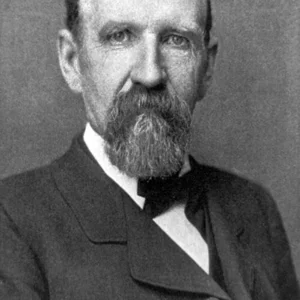

Joshua Slocum (1844-1909) was a Canadian-American deep-sea captain. Between 1895 and 1898, he completed the first solo circumnavigation of the globe under sail aboard the Spray. He recounted his feat in a narrative that became a classic of maritime literature.
Joshua Slocum(1844 — 1909)
Joshua Slocum
États-Unis
7 min read
Frequently asked questions
Famous Quotes
« To young men contemplating a voyage I would say go.»
Key Facts
- Born on 20 February 1844 in Mount Hanley, Nova Scotia (Canada), he became an American citizen and a deep-sea captain as early as the 1860s-1870s.
- From 1895 to 1898, he accomplished the first solo circumnavigation of the globe under sail (more than 74,000 km) aboard the Spray, an 11.2 m sloop he had rebuilt himself.
- In 1900, he published Sailing Alone Around the World, a narrative that became a classic of maritime literature.
- In November 1909, he disappeared at sea during another crossing aboard the Spray; neither the man nor the boat was ever found.
Works & Achievements
The first circumnavigation of the globe completed single-handed, covering roughly 74,000 km in more than three years aboard the Spray.
An account of his voyage around the world, now a global classic of maritime literature and a touchstone for solo sailors.
An account of the journey home from Brazil to the United States after the wreck of the Aquidneck, aboard a boat the family built themselves.
An account of the perilous delivery, from New York, of a warship (the Destroyer) ordered by Brazil.
A nearly 11-metre vessel Slocum built in Brazil to bring his family back to the United States, more than 8,000 km away.
At Fairhaven, Slocum almost entirely rebuilt an old sloop he had been given, turning it into the boat of his great feat.
Anecdotes
Off the Azores, Slocum fell ill after eating white cheese and plums, just before a storm hit. Feverish, he claims he saw a ghostly sailor holding the helm of the Spray and calling out to him: “I am the pilot of the Pinta, come to help you.” By morning, the boat had held its course on its own through a night of heavy weather.
In the Strait of Magellan, Slocum feared that natives of Tierra del Fuego might climb aboard while he slept. So he scattered upholstery tacks across the deck of the Spray. When night fell, barefoot intruders climbed aboard, stepped on the spikes, and dove screaming back into the sea.
In South Africa, Slocum was introduced to President Paul Kruger. When it was explained that the sailor was sailing around the Earth, Kruger, who was convinced the Earth was flat, curtly corrected him: one does not sail “around” the world, but “in” the world. Slocum chose not to contradict him.
The Spray had a reputation for holding its course almost on its own once the sails were properly set. On long Pacific crossings, Slocum claims he went whole days without touching the helm, reading, cooking, or mending his sails while the boat ran straight ahead.
Shortly after Gibraltar, the Spray was chased by a pirate vessel off the coast of Morocco. As the pursuers were gaining ground, a violent squall struck: the pirate ship's mast snapped, and Slocum, who could not even swim, managed to escape.
Primary Sources
I was born in the breezes, and I had studied the sea as perhaps few men have studied it, neglecting all else.
I am the pilot of the Pinta come to aid you. Lie quiet, señor captain, and I will guide your ship tonight.
My tin clock, my only timepiece, had by this time lost its minute-hand, but after I boiled her she told the hours, and that was near enough on a long voyage.
To young men contemplating a voyage I would say go.
Key Places
Hilltop village overlooking the Bay of Fundy where Slocum was born in 1844, into a modest family that looked to the sea.
Harbor where Slocum rebuilt the Spray plank by plank between 1892 and 1894, turning a wreck into a legendary boat.
Stormy passage between the Atlantic and the Pacific that Slocum crossed in 1896 through repeated ordeals, driven back several times by the winds.
Home of Robert Louis Stevenson where Slocum was welcomed by his widow Fanny in 1896, who gave him books on navigation.
Harbor where Slocum dropped anchor on June 27, 1898, completing the first solo sailing circumnavigation of the globe in history.
Last harbor from which Slocum set sail in November 1909 for South America, before vanishing forever at sea.
Typical Objects

An old oyster sloop nearly 11 meters long that Slocum rebuilt almost entirely with his own hands. It was aboard this vessel that he completed the first solo voyage around the world (1895–1898).

A mirror-based instrument used to measure the height of the sun or stars above the horizon. Slocum used it to fix his position and steer across thousands of miles, without any crew.

A cheap alarm clock bought for one dollar, which became his only timepiece for lack of a reliable chronometer. Missing its minute hand, he boiled it to get it running again.

Small broad-headed nails that Slocum scattered across the deck of the Spray in the Strait of Magellan. They were meant to deter intruders from climbing aboard barefoot during the night.

Volumes describing coastlines, currents, and the dangers of navigation. In Samoa, Fanny Stevenson, widow of the writer Robert Louis Stevenson, gave him several volumes.

A notebook in which Slocum recorded his course, distances, observations, and the day-to-day incidents. These notes later fed into his account Sailing Alone Around the World.
School Curriculum
Vocabulary & Tags
Key Vocabulary
Tags
Daily Life
Morning
At daybreak, Slocum would inspect the deck and the trim of the sails, then check that the Spray was still holding its course. If the sky was clear, he measured the sun's height with his sextant to fix his position. He then lit his small stove to make coffee and breakfast.
Afternoon
In the afternoon, with the boat sailing more or less on its own, he had precious free time: he read a great deal, for he carried a veritable little library on board. He mended sails and rigging, recorded his route in the logbook, and sometimes fished to add variety to his meals.
Evening
When evening came, he secured the rigging for the night and hoisted a lantern to signal his presence to other ships. After a simple meal, he would sometimes talk or sing aloud, his only company in the vastness. Then he slept while the Spray sailed on.
Food
On board, he lived on long-keeping provisions: ship's biscuit, salted meat, potatoes, coffee, and tea. At ports of call, he took on fresh fruit and vegetables — on one occasion, plums and cheese gave him a violent bout of indigestion. Flying fish that landed on the deck sometimes rounded out his meals.
Clothing
Slocum wore the rugged clothing of a late-19th-century sailor: a shirt and trousers of heavy canvas or wool, a cap, and sturdy shoes. In rough weather, he pulled on oilskins and a waterproof hat to stay dry under the sea spray.
Housing
His floating home was the cramped cabin of the Spray: a bunk, a chest, his stove, his charts, and his books all fit into very little space. In port, he was often welcomed ashore by local notables, consuls, or sailors curious about his feat.
Historical Timeline
Period Vocabulary
Liens externes & ressources
Références
Œuvres
Premier tour du monde à la voile en solitaire
1895-1898
Sailing Alone Around the World
1900
Voyage of the Liberdade
1890
Voyage of the Destroyer from New York to Brazil
1894
La Liberdade
1888
Reconstruction du Spray
1892-1894