 flip
flipPoi
Poi
Why this dish? From the common fisherman to the queen regent, no one escaped poi: it was at every meal, every hour, the immovable base of the Hawaiian table. Kaʻahumanu, daughter of the highest aliʻi, dipped her fingers into the same calabash of poi as her ancestors — for taro, Hāloa, is in Hawaiian belief the elder sibling of the first man, the nourishing ancestor.
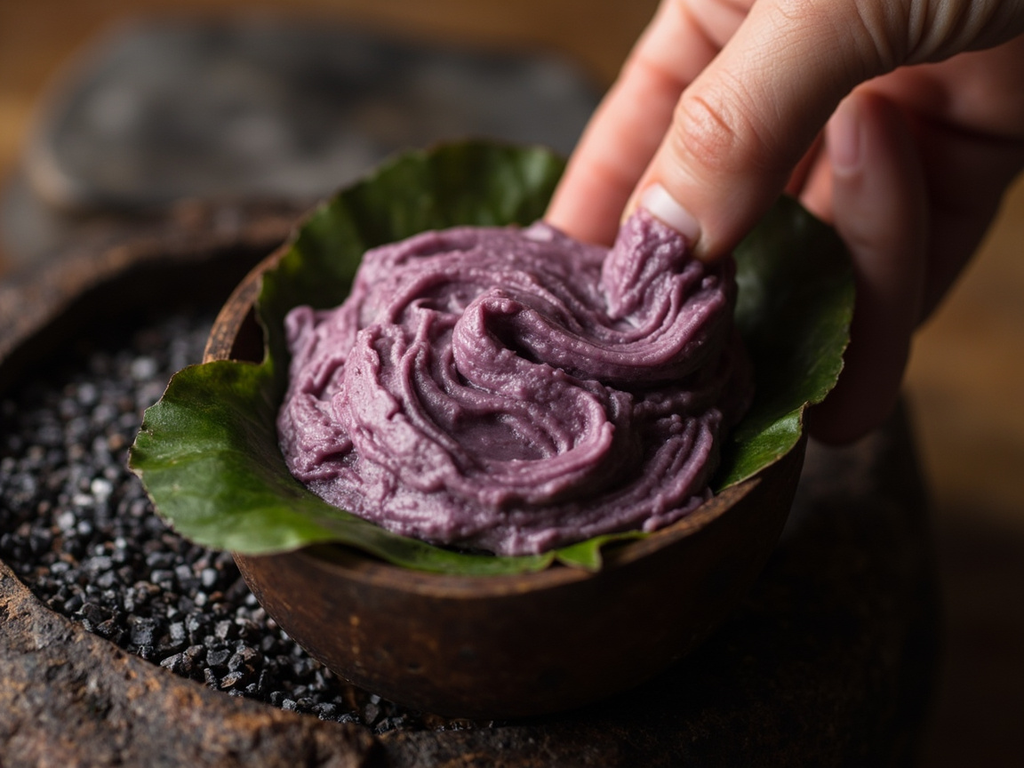
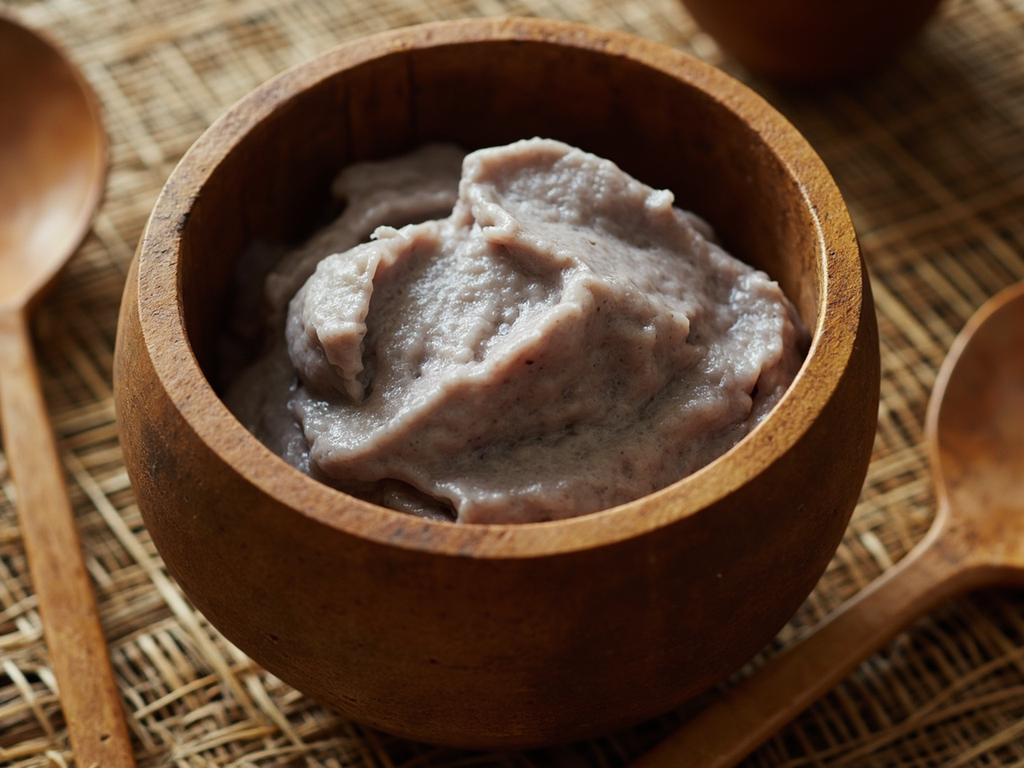
A smooth, gray-purple paste made from cooked taro root, pounded and mixed with water. Fresh, it is sweet and starchy; left for one to three days, it sours gently through fermentation and becomes tangy. It is judged by density: "one-finger" poi (thick), "two-finger," or "three-finger" (liquid).
Come closer, and do not be afraid to dirty your fingers — here we eat no other way. This root you see is Hāloa, our elder brother who came from the earth; to respect him is to respect ourselves. At my table we pound it long on the stone board until it is smooth as lagoon water, then let it sleep a day or two so it takes on that bite that wakes the mouth. Taste it sour with a little salted fish: that is the true food of the islands, the one that made our kings strong.
- •Taro roots (kalo) — several large roots (starch base)
- •Spring water — as needed (mixing and fermentation)
Poi
A smooth, gray-purple paste made from cooked taro root, pounded and mixed with water. Fresh, it is sweet and starchy; left for one to three days, it sours gently through fermentation and becomes tangy. It is judged by density: "one-finger" poi (thick), "two-finger," or "three-finger" (liquid).
Why this dish? From the common fisherman to the queen regent, no one escaped poi: it was at every meal, every hour, the immovable base of the Hawaiian table. Kaʻahumanu, daughter of the highest aliʻi, dipped her fingers into the same calabash of poi as her ancestors — for taro, Hāloa, is in Hawaiian belief the elder sibling of the first man, the nourishing ancestor.
Come closer, and do not be afraid to dirty your fingers — here we eat no other way. This root you see is Hāloa, our elder brother who came from the earth; to respect him is to respect ourselves. At my table we pound it long on the stone board until it is smooth as lagoon water, then let it sleep a day or two so it takes on that bite that wakes the mouth. Taste it sour with a little salted fish: that is the true food of the islands, the one that made our kings strong.
Ingredients (period version)
- Taro roots (kalo) — several large roots (starch base)
- Spring water — as needed (mixing and fermentation)
Ingredients
- Taro root — 1 kg (starch base)
- Water — 200 to 400 ml (adjust consistency)
Method
- Peel the taro (wear gloves: raw taro irritates the skin) and cut into large chunks.
- Steam or simmer for 45 min to 1 hour, until a knife slides in without resistance.
- Mash the hot taro with a pestle (or food processor) adding water little by little, until perfectly smooth, no lumps.
- For fresh (sweet) poi, serve immediately. For traditional poi, cover and let ferment 1 to 3 days at room temperature: it becomes sour and more liquid.
- Serve in a calabash, to eat with fingers alongside fish or meat.
How it was made : Taro was cooked in the imu or steamed, then pounded on a wooden board (papa kuʻi ʻai) with a stone pestle (pōhaku kuʻi ʻai), a slow, rhythmic task reserved for men. The added water triggered natural lactic fermentation; depending on taste, people ate one-day-old poi (sweet) or two-to-three-day-old poi (frankly sour).
The contemporary twist : Served as a smoothed quenelle on a black slate, topped with a streak of raw fish and a pinch of red ʻalaea salt — poi leaves the calabash for the chef's plate.
Sources : Margaret Titcomb, Native Use of Fish in Hawaii (1972) · Rachel Laudan, The Food of Paradise: Exploring Hawaii's Culinary Heritage (1996)
Ka'ahumanu · Charactorium