 flip
flipAmazura mochi, offering to the Moon
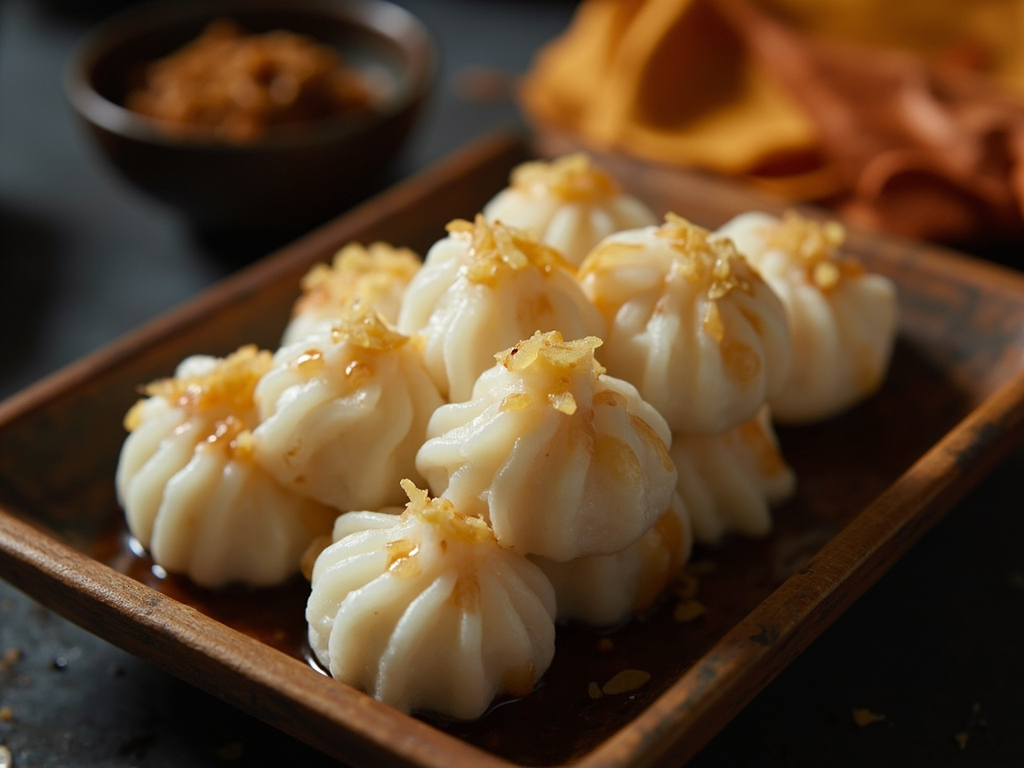
Amazura mochi, offering to the Moon
Why this dish? Kaguya-hime does not belong to Earth: she is a daughter of the Moon, and to it she returns on the night of the fifteenth day of the eighth month. Inspired by Japanese customs of moon-viewing (tsukimi), this offering of white rice cakes round as the full moon is dedicated to her — without reproducing any sacred rite.
Small pounded rice cakes, soft and round, drizzled with amazura syrup. White as the moon, they are stacked as an offering during nocturnal contemplation.
When the full moon of the eighth month comes, do not close your shutters: instead, set out these white cakes, round as the orb where I am awaited. We pound the cooked rice until it becomes smooth and tender, roll small moons between moistened palms, and make them gleam with a thread of that vine syrup, so rare it was kept for feast days. Place them facing the sky. When I leave the Earth, it is this sweetness I shall miss — not its richness, but its pallor, like my true homeland.
- •Cooked glutinous rice (mochigome) — two bowls (pounded base of mochi)
- •Amazura (vine sap syrup) — a drizzle (rare sweetness)
- •Rice flour — a pinch (to prevent sticking)
Amazura mochi, offering to the Moon
Small pounded rice cakes, soft and round, drizzled with amazura syrup. White as the moon, they are stacked as an offering during nocturnal contemplation.
Why this dish? Kaguya-hime does not belong to Earth: she is a daughter of the Moon, and to it she returns on the night of the fifteenth day of the eighth month. Inspired by Japanese customs of moon-viewing (tsukimi), this offering of white rice cakes round as the full moon is dedicated to her — without reproducing any sacred rite.
When the full moon of the eighth month comes, do not close your shutters: instead, set out these white cakes, round as the orb where I am awaited. We pound the cooked rice until it becomes smooth and tender, roll small moons between moistened palms, and make them gleam with a thread of that vine syrup, so rare it was kept for feast days. Place them facing the sky. When I leave the Earth, it is this sweetness I shall miss — not its richness, but its pallor, like my true homeland.
Ingredients (period version)
- Cooked glutinous rice (mochigome) — two bowls (pounded base of mochi)
- Amazura (vine sap syrup) — a drizzle (rare sweetness)
- Rice flour — a pinch (to prevent sticking)
Ingredients
- Glutinous rice (mochigome) — 300 g (raw) (mochi base)
- Mild maple syrup or grain syrup (mugi-amazake/natural sweetener) if amazura unavailable — 2 tbsp (sweet glaze)
- Potato starch OR katakuriko (for shaping) — 2 tbsp (anti-stick)
- Water — as needed for cooking (rice cooking)
Method
- Soak the glutinous rice for 2 hours, then steam until tender.
- Pound the hot rice in a mortar (or mash vigorously) until you get a smooth, elastic paste.
- With moistened hands dusted with starch, shape small, even balls, round as full moons.
- Stack them in a pyramid on a tray, like a tsukimi offering.
- Just before serving, drizzle with a thin stream of syrup.
How it was made : In Heian, sugar was an almost unavailable imported commodity: sweetness came from amazura, syrup made by boiling the sap of a wild vine, or from dried fruits. Mochi itself was already an ancient and noble food, associated with festivity and the sacred. (The custom of tsukimi dango, however, was only established in the Edo period: this is an evocation, not a reproduction.)
The contemporary twist : Stack thirteen small moons in a pyramid facing the window, in the manner of modern tsukimi offerings, on the evening of the autumn full moon.
Kaguya-hime · Charactorium