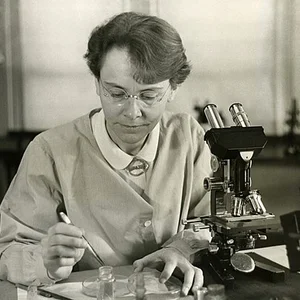
Kamala Sohonie was an Indian biochemist, the first Indian woman to earn a doctorate in science. She broke down gender barriers in scientific research and studied the nutritional value of local foods.
Kamala Sohonie(1911 — 1998)
Kamala Sohonie
Inde, Raj britannique, Union indienne
6 min read
Frequently asked questions
Key Facts
- Born in 1912 in Indore, India, into a family of chemists
- In 1933, refused admission to the Indian Institute of Science by C. V. Raman because of her sex, before finally being admitted on a conditional basis
- First Indian woman to earn a doctorate (PhD) in science, at the University of Cambridge (1939)
- Demonstrated the presence of the enzyme cytochrome c in all plant cells
- Died in 1998, after a career devoted to biochemistry and nutrition (study of 'Neera', a nutritious drink)
Works & Achievements
By compelling the institute to accept her, she paved the way for women students to enter higher scientific education in India.
Master's work analyzing the nutritional value of proteins essential to the Indian diet.
Her Cambridge thesis showed that this respiratory enzyme is present in all plant cells, a major contribution to biochemistry.
She became the first Indian woman to hold a doctorate in science, after a remarkably brief and rapid thesis.
She demonstrated the nutritional richness of palm sap for poor children and pregnant women; work rewarded with a presidential prize.
The first woman to lead this Bombay institute, she trained generations of biochemistry researchers there.
Anecdotes
In 1933, Kamala Sohonie applied to the Indian Institute of Science in Bangalore, but its director, the famous physicist and Nobel laureate C. V. Raman, refused to admit her solely because she was a woman. Stubborn, she sat outside his office until she got her way. Raman eventually took her on “as a trial,” under humiliating conditions — and she became the institute's very first female student.
Years later, Kamala Sohonie had forgotten nothing of this episode. By her own recollection, she acknowledged Raman's genius as a scientist, but reproached him for his narrow-mindedness and the humiliation of having treated her differently because she was a woman. Her persistence forced the institute to open its doors to women students after her.
At the University of Cambridge, Kamala discovered that all plant cells contain an enzyme called cytochrome c, essential to plant respiration. Her doctoral thesis, famously very short (around forty pages) and written in a little over a year, so impressed her examiners that she earned her degree in 1939 — becoming the first Indian woman to hold a doctorate in science.
Back in India, Kamala Sohonie studied “neera,” a sweet sap drawn from the palm tree. She demonstrated that it is rich in vitamins and iron and that it can fight malnutrition in poor children and pregnant women. This work earned her a presidential award (the Rashtrapati Award).
In 1998, while being honored at a ceremony held in New Delhi by the Indian Council of Medical Research, Kamala Sohonie collapsed. She died shortly afterward, at 87, celebrated to the very end for a life devoted to science and nutrition.
Primary Sources
Although Raman was a great scientist, he was very narrow-minded. I can never forget the way he treated me, just because I was a woman. If a woman could do good work, why shouldn't she be given a chance?
Work establishing that cytochrome c, an enzyme involved in cellular oxidation, is present in all the plant cells studied.
A study showing that neera, rich in vitamin C, vitamin A and iron, improves the health of malnourished children and pregnant women when added to their diet.
Key Places
City in central India where Kamala Bhagvat was born in 1911, into a family of chemists.
Prestigious institute where she was admitted in 1933 as its first female student, after C. V. Raman's initial refusal.
Where she pursued her doctorate in biochemistry and discovered cytochrome c in plant cells, earning her degree in 1939.
Institution where she taught biochemistry from 1949 and of which she became the first female director in 1969.
Indian capital where she collapsed and then died in 1998, during a ceremony held in her honour by the Indian Council of Medical Research.
Liens externes & ressources
Références
Œuvres
Première femme admise à l'Indian Institute of Science
1933
Recherches sur les protéines du lait et des légumineuses
1936
Découverte du cytochrome c dans les cellules végétales
1939
Doctorat ès sciences de l'université de Cambridge
1939
Études sur le neera et la lutte contre la malnutrition
années 1950
Direction du Royal Institute of Science
1969