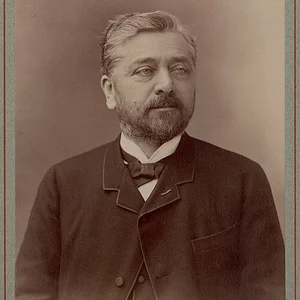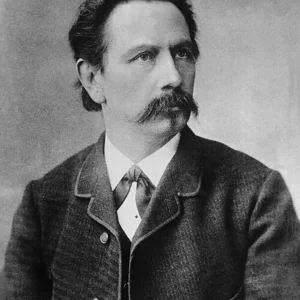

German engineer and inventor, Karl Benz is considered the father of the automobile. In 1885, he built the Benz Patent-Motorwagen, the first vehicle with an internal combustion engine recognized as a true automobile.
Karl Benz(1844 — 1929)
Carl Benz
grand-duché de Bade, République de Bade
8 min read
Frequently asked questions
Key Facts
- 1844: born in Mühlburg (now Karlsruhe), Germany
- 1885: filing of the Benz Patent-Motorwagen patent, the first gasoline-powered vehicle
- 1886: the Patent-Motorwagen is officially recognized as the first automobile
- 1888: his wife Bertha Benz completes the first long-distance automobile journey in history
- 1926: merger of Benz & Cie with Daimler-Motoren-Gesellschaft, giving birth to Mercedes-Benz
Works & Achievements
The first patented internal-combustion motor vehicle, powered by a single-cylinder engine producing 0.75 hp and reaching 16 km/h; the original is preserved at the Deutsches Museum in Munich.
The founding legal document recognizing the invention of the automobile; officially dated 29 January 1886, it is celebrated as the birth certificate of the modern automobile.
The world's first mass-produced automobile — light and relatively affordable — marking the transition from artisan invention to the emerging automotive industry.
Benz introduced multi-cylinder engines into its lineup, responding to competition from Daimler and paving the way for comfortable touring automobiles.
Karl Benz's memoirs, written at age 81 — a valuable primary historical source tracing his research, his doubts, and his vision of the automobile as a revolution in human mobility.
Anecdotes
On August 5, 1888, without telling her husband, Bertha Benz took the Motorwagen with their two sons and drove nearly 106 kilometers from Mannheim to Pforzheim — the first long-distance automobile journey in history. Along the way, she unclogged a fuel line herself with a hairpin and convinced a cobbler to re-line the leather brake pads: a demonstration that the car was viable, and tremendous publicity for her husband's invention.
Patent no. 37435, filed on January 29, 1886 at the Imperial Patent Office in Berlin, is today considered the birth certificate of the automobile. Karl Benz had worked for years without a stable income, taking on heavy debts, before this official document enshrined his invention. His wife Bertha had even pawned her family jewels to fund the experiments.
For months, Karl Benz tested his motorized tricycle at night in the courtyard of his Mannheim workshop, so as not to frighten passers-by or alert the competition. The noise of the internal combustion engine was so unfamiliar that neighbors believed it was some kind of infernal machine. The local police eventually banned him from driving in the city, forcing him to test his vehicle on isolated roads.
Contrary to what one might assume, Karl Benz and Gottlieb Daimler — the two pioneers of the German automobile — never met during their lifetimes, even though they were working in parallel less than 100 kilometers apart. It was only in 1926, three years before Benz's death, that their companies merged to form Mercedes-Benz — one of industrial history's great ironies.
In 1893, the Benz Velo became the world's first mass-produced automobile: 1,200 units built over several years at a price relatively accessible to the middle class. It was this model that transformed the automobile from a laboratory curiosity into a real commercial product, laying the foundations of the global automotive industry.
Primary Sources
The subject of the present invention is a vehicle propelled by a light gas engine, in which the engine, the transmission mechanism, and the steering device form a single inseparable unit.
I knew that my car had to be built down to the smallest detail by me alone. I had no one to help me, no one to guide me. I walked in the dark, but I had a light before me.
The horseless carriages completed the journey from Paris to Rouen without major incident, proving that this mode of locomotion is destined for a great future. The average speed achieved exceeded the most optimistic expectations of the organizers.
Benz & Cie, Rheinische Gasmotorenfabrik, Mannheim. Petrol-engine motor cars. Models available for two and four persons. Demonstrations available on request at our workshops.
Key Places
Birthplace of Karl Benz on November 25, 1844, in the Grand Duchy of Baden. His father, a locomotive mechanic, died there when Karl was only two years old.
The city where Benz established his Benz & Cie workshops and built and tested the Benz Patent-Motorwagen between 1883 and 1886; the industrial heart of his entire life's work.
Benz studied mechanical engineering here from 1861 to 1864 under Professor Ferdinand Redtenbacher, a founder of modern theoretical mechanics.
Destination of Bertha Benz's historic journey in August 1888: 106 kilometres travelled from Mannheim, proving to the world the reliability of the automobile.
The small town where Karl Benz spent the final years of his life and died on April 4, 1929; his home is today a place of remembrance.
Typical Objects

A tricycle with a tubular steel frame, single-cylinder four-stroke engine of 954 cc mounted at the rear, cooled by evaporation: this is the central object of Benz's entire life's work — the first autonomous internal-combustion vehicle recognized as a proper automobile.

Benz designed and built his own engines, refining the Otto cycle to achieve sufficient power and reliability to propel a vehicle; the engine is the heart of all his inventions.

Benz invented an original carburetor that vaporized petroleum spirit and mixed it with air before ignition, solving one of the major technical problems of the era.

To trigger the ignition of the air-fuel mixture, Benz developed an electrical ignition system using a coil and trembler, the direct ancestor of the modern spark plug.

Precision instruments indispensable to engineers of the time, they allowed Benz to calculate the dimensions and tolerances of his mechanical parts on paper before any manufacturing took place.

Karl Benz personally machined most of the parts for his prototypes on precision machine tools; the mechanical workshop was his true laboratory.

The primitive braking system used on the Motorwagen, which Bertha Benz had reinforced by a cobbler during her 1888 journey, illustrating the technical limitations of the first automobile.
School Curriculum
Vocabulary & Tags
Key Vocabulary
Tags
Daily Life
Morning
Karl Benz rises early, around six o'clock, and reaches his workshop before his workers. He spends the first hours checking parts being machined, annotating his technical drawings, and noting down problems discovered during the previous day's tests. His wife Bertha prepares him a simple breakfast — bread, butter, coffee — which he often eats standing up, leaning over his blueprints.
Afternoon
The afternoon is devoted to mechanical testing and engine tuning in the workshop yard, away from prying eyes. Benz works in a mechanic's overalls, hands covered in grease, personally adjusting the carburetor and ignition. He sometimes receives curious investors or journalists, for whom he gives brief low-speed demonstrations of the Motorwagen.
Evening
At the end of the day, Karl Benz returns home to have dinner with his family — Bertha and their five children. The table is the setting for lively exchanges: Bertha, a strong-willed woman and partner in spirit, discusses commercial strategies and technical improvements. After dinner, Benz still spends an hour or two at his personal desk drafting patents or checking calculations.
Food
Benz's diet is that of the German working bourgeoisie of the 19th century: plenty of rye bread, sausages, sauerkraut, potatoes, and pork on better days. Local light beer is the everyday drink, while coffee is a precious commodity reserved for the morning. Garden vegetables round out the daily fare in summer.
Clothing
In the workshop, Benz wears a grey or blue cotton overalls over a plain dark wool suit. For official outings or presentations to investors, he dons a black frock coat with buttons, a stiff high collar, and a top hat — the standard attire of a respectable engineer-entrepreneur of the Wilhelmine era.
Housing
The Benz family first lived modestly in lodgings adjoining their early workshops in Mannheim, burdened by debt. The commercial success of the Benz Velo in the 1890s allowed them to move into a more spacious middle-class house with a garden. There, Benz set up a personal study where blueprints, patents, and correspondence with manufacturers from around the world gradually piled up.
Historical Timeline
Period Vocabulary
Liens externes & ressources
Références
Œuvres
Benz Patent-Motorwagen n° 1
1885–1886
Brevet impérial allemand n° 37435
29 janvier 1886
Benz Velo
1893
Benz Landaulet — moteur quatre cylindres
1902
Lebensfahrt eines deutschen Erfinders (autobiographie)
1925